
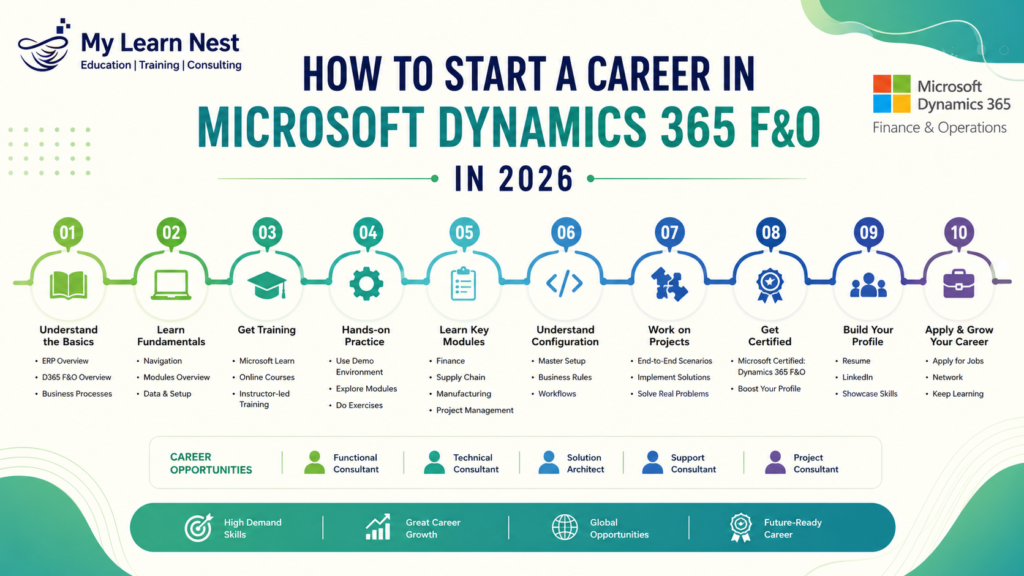
How to Start a Career in Microsoft Dynamics 365 F&O in 2026
Microsoft Dynamics 365 Finance & Operations (D365 F&O) is an enterprise resource planning (ERP) platform used to manage important business processes such as finance, procurement, supply chain, inventory, manufacturing, sales operations, and reporting. A career in Microsoft Dynamics 365 F&O in 2026 can be suitable for graduates, finance professionals, supply chain professionals, ERP consultants, business analysts, and IT professionals who want to build a specialization in enterprise applications.
Microsoft’s current learning resources describe Finance and Operations apps as covering global financial systems and operational business processes, while its functional-consultant guidance emphasizes requirements analysis, configuration, data migration, testing, and support. (Microsoft Learn)
Why Choose a D365 F&O Career in 2026?
Organizations implementing ERP systems need professionals who can understand business requirements and convert them into practical technology solutions. D365 F&O provides career opportunities across functional consulting, technical development, implementation, testing, support, data migration, integration, and solution architecture.
The career is especially interesting for professionals who want a combination of business knowledge and technology skills. Rather than focusing only on programming, a D365 F&O professional can work directly with business processes and stakeholders.
Who Can Start a Career in D365 F&O?
D365 F&O is not limited to computer science graduates. People from several educational and professional backgrounds can move into this field.
Commerce and finance graduates can consider the Finance functional path. Professionals with purchasing, logistics, inventory, manufacturing, or supply chain experience can explore Supply Chain Management. IT graduates and software developers may prefer technical consulting or development.
Microsoft’s beginner Finance and Operations learning path is designed for roles including business users, functional consultants, and administrators and lists no prerequisites. (Microsoft Learn)
Skills Required for a D365 F&O Career
A successful D365 F&O consultant usually develops three categories of skills: business-process knowledge, Dynamics 365 knowledge, and communication skills.
Important areas include:
- ERP fundamentals
- Finance and accounting concepts
- Supply chain concepts
- Procurement and sourcing
- Inventory management
- Business-process mapping
- Requirement gathering
- D365 F&O configuration
- Data migration
- Testing
- Reporting
- Power Platform integration
- Communication and documentation
Functional consultants are expected to analyze business requirements and understand implementation activities such as configuration, data migration, testing, and support. (Microsoft Learn)
How to Learn Microsoft Dynamics 365 F&O
Start with the fundamentals of Finance and Operations apps. Learn how ERP systems support finance and operational processes before moving into detailed modules.
Next, choose a specialization. For example, you can focus on D365 Finance, Supply Chain Management, or technical development.
For the Finance functional path, Microsoft currently provides training covering areas such as general ledger, accounts payable, accounts receivable, budgeting, fixed assets, cash and bank management, and related finance processes.
Certification and Microsoft Learn Resources
Certification can help demonstrate your knowledge, but practical understanding is equally important. Microsoft currently lists Dynamics 365 Finance Functional Consultant Associate among its role-specific credentials.
Candidates should rely on current Microsoft Learn material because certification exams and credential structures can change. For example, the older MB-300 core exam was retired on February 29, 2024, so older blogs should not be treated as the current certification roadmap.
How MyLearnNest Can Help You Learn D365 F&O
MyLearnNest can help learners build their D365 F&O knowledge through structured training, business-process examples, hands-on practice, interview preparation, and real-time project scenarios.
The goal should not be only to memorize menu paths. Learners should understand why a business process is configured, how users execute it, what problems can occur, and how a consultant resolves those problems.
D365 F&O Career Opportunities
After developing the required skills, professionals can explore roles such as:
- D365 F&O Functional Consultant
- D365 Finance Functional Consultant
- D365 SCM Functional Consultant
- D365 F&O Technical Consultant
- D365 F&O Developer
- ERP Business Analyst
- D365 Application Support Consultant
- D365 Solution Architect
Microsoft describes its Finance functional consultant role around gathering and analyzing requirements and implementing solutions, while its developer role focuses on implementing and extending Finance and Operations applications to meet business requirements.
Final Thoughts on Starting a D365 F&O Career in 2026
A successful D365 F&O career requires more than completing a training course. Build knowledge of business processes, practice configuration, understand implementation methodologies, work on realistic scenarios, and develop strong communication skills.
Dynamics 365 F&O Functional vs Technical Consultant
One of the most important decisions for someone entering the D365 F&O field is choosing between a functional consultant and a technical consultant career.
Although both professionals work on the same ERP ecosystem, their responsibilities are different.
What Is a D365 F&O Functional Consultant?
A functional consultant focuses mainly on business requirements and processes. They work with users and stakeholders to understand how the organization operates and determine how D365 F&O can support those requirements.
Microsoft explains that functional consultants bridge business needs and product capabilities and are involved in activities such as configuration, data migration, testing, and support.
What Does a D365 F&O Functional Consultant Do?
Typical responsibilities include:
- Gathering business requirements
- Conducting requirement discussions
- Mapping business processes
- Configuring D365 F&O
- Preparing functional documents
- Supporting data migration
- Creating test scenarios
- Performing functional testing
- Supporting users
- Training end users
- Coordinating with technical consultants
What Is a D365 F&O Technical Consultant?
A technical consultant focuses on the technical side of the application. This can include custom development, integrations, extensions, troubleshooting, technical architecture, and system-related implementation work.
Microsoft’s D365 Finance and Operations developer training describes developers as key technical resources who implement and extend the application to meet business requirements. (Microsoft Learn)
What Skills Does a Technical Consultant Need?
A technical professional generally needs knowledge of:
- X++
- Visual Studio
- D365 F&O development tools
- Extensions
- APIs and integrations
- Data entities
- SQL concepts
- Azure-related technologies
- Application Lifecycle Management
- Debugging
- Testing
- Power Platform integration
Microsoft’s current developer certification renewal material includes areas such as Azure integration, Visual Studio development, test frameworks, and Finance and Operations technical architecture. (Microsoft Learn)
Functional Consultant vs Technical Consultant
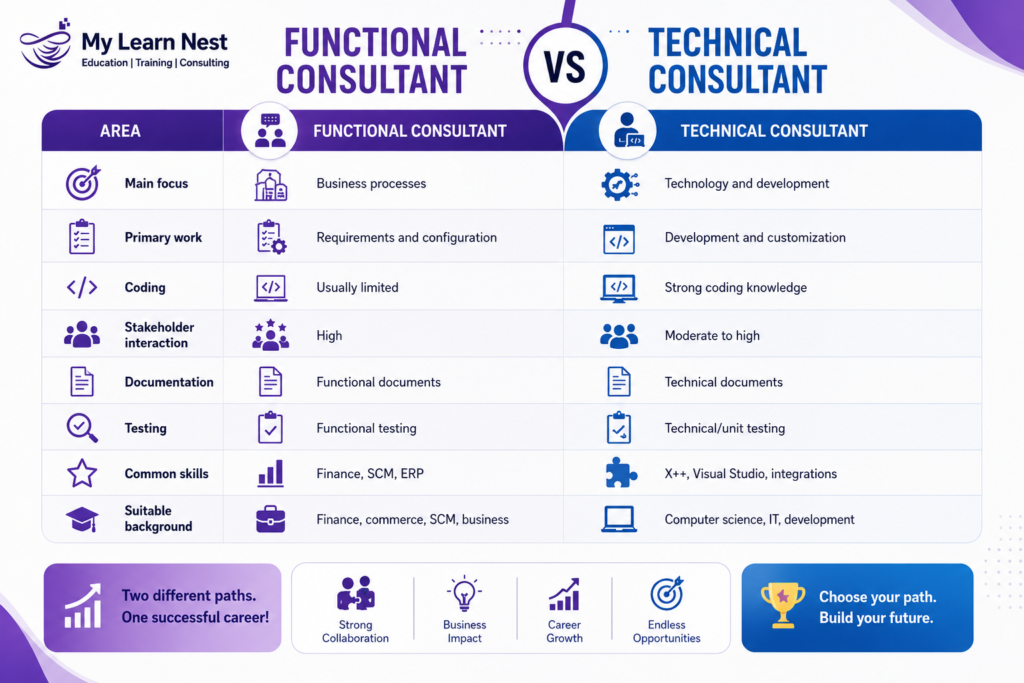
Which D365 F&O Career Path Is Better?
There is no universally better path. The right choice depends on your interests and existing skills.Someone with finance, accounting, procurement, manufacturing, or supply-chain knowledge may find the functional route more natural.
Someone who enjoys programming and software development may prefer the technical route.
Can a Functional Consultant Learn Technical Skills?
Yes. Learning technical concepts can make a functional consultant more effective when communicating with developers and understanding integrations, extensions, and technical limitations.
Similarly, technical consultants benefit from understanding business processes because development decisions should support actual business requirements.
D365 F&O Career Roadmap for Freshers
Freshers often search for a clear D365 F&O career roadmap because ERP consulting is different from traditional software development.
The best approach is to build knowledge step by step instead of trying to learn every module simultaneously.
Step 1: Understand ERP Fundamentals
Begin by understanding what an ERP system does.
Learn concepts such as:
- Companies and organizations
- Business units
- Legal entities
- Financial dimensions
- Transactions
- Workflows
- Master data
- Reference data
- Business processes
Microsoft’s introductory Finance and Operations learning path is specifically positioned as a starting point for people entering the field. (Microsoft Learn)
Step 2: Learn Core Business Processes
Before focusing on configuration, understand how businesses operate.
For Finance, study:
- General ledger
- Accounts payable
- Accounts receivable
- Cash and bank management
- Budgeting
- Fixed assets
For SCM, study:
- Procurement
- Inventory
- Warehouse management
- Sales orders
- Product information
- Master planning
- Production
Step 3: Choose a Specialization
Freshers should avoid trying to become experts in every D365 module immediately.
Choose one primary area such as:
D365 Finance, D365 Supply Chain Management, or D365 F&O Technical Development.
Step 4: Learn D365 F&O Navigation and Configuration
Once the fundamentals are clear, move into the application.
Practice:
- Creating and configuring legal entities
- Setting up financial dimensions
- Configuring parameters
- Creating master data
- Setting up workflows
- Processing transactions
- Reviewing journals
- Understanding posting
Step 5: Learn Requirement Gathering
A consultant is not only a person who knows software screens.
Learn how to ask questions such as:
- “What is the current business process?”
- “What problem are users facing?”
- “What is the expected process?”
- “What reports are required?”
- “What approvals are required?”
- “What systems need to integrate with D365?”
Step 6: Practice Real-Time Scenarios
Freshers should create end-to-end scenarios rather than learning isolated features.
For example, in procurement, practice:
Purchase Requisition → Purchase Order → Product Receipt → Vendor Invoice → Payment
This helps connect multiple processes together.
Step 7: Learn Documentation
Important consultant documents can include:
- Business requirement documents
- Functional requirement documents
- Process flow documents
- Test cases
- User acceptance testing scenarios
- Configuration documents
- Training documents
Step 8: Build Interview Skills
Learn to explain processes instead of giving one-line definitions.
A good fresher should be able to explain:
“How does a purchase order flow through D365 F&O?”
rather than simply answering:
“Purchase order is a document created for purchasing.”
Step 9: Build a D365 F&O Resume
Highlight practical skills instead of filling the resume with only course names.
Include:
- D365 F&O modules learned
- Business processes practiced
- Configuration exposure
- Real-time project scenarios
- Testing knowledge
- Documentation experience
- Relevant certifications
- Finance or SCM knowledge
Step 10: Apply for Entry-Level Opportunities
Search for roles such as:
- Junior D365 F&O Consultant
- Associate Functional Consultant
- ERP Consultant
- D365 Finance Trainee
- D365 SCM Trainee
- D365 Application Support Analyst
- Junior D365 Developer
D365 F&O Fresher Roadmap in One View
ERP Fundamentals → Business Process Knowledge → Module Specialization → D365 Configuration → Real-Time Scenarios → Documentation → Testing → Interview Preparation → Entry-Level Job
This sequence can provide a practical starting point for a fresher.
D365 F&O Salary in India and Hyderabad
Salary is one of the biggest reasons professionals consider a career in Dynamics 365 F&O. However, compensation varies considerably based on experience, specialization, employer, certifications, project exposure, and technical or functional skills.
D365 F&O Salary in India
Current Glassdoor salary data for Microsoft Dynamics 365 Finance Functional Consultants in India shows a reported average base salary around ₹9 lakh per year, with an additional average component of around ₹2 lakh. The same page reports a base-pay range of approximately ₹5 lakh to ₹22.3 lakh per year. These figures are based on a limited set of reported salaries and should therefore be treated as indicative rather than guaranteed. (Glassdoor)
Another Glassdoor listing for Microsoft Dynamics 365 Finance & Operations Functional Consultants reports an India average of approximately ₹10.55 lakh per year, with reported typical annual pay ranging from about ₹5.48 lakh to ₹26.25 lakh. (Glassdoor)
D365 F&O Salary for Freshers
Entry-level salaries can vary based on whether the candidate joins as a trainee, support professional, functional consultant, or developer.
Freshers with strong business-process knowledge, hands-on project practice, good communication, and relevant technical or functional skills may be better positioned than candidates who only have theoretical training.
D365 F&O Salary for Experienced Professionals
As professionals gain experience, they can move into senior consultant, lead consultant, solution architect, technical architect, or specialist roles.
Specialization can have a significant impact on salary. Finance, SCM, technical development, integration, architecture, and project leadership can lead to different compensation levels.
D365 F&O Salary in Hyderabad
Hyderabad is an important technology and consulting market for ERP professionals. Current publicly reported salary information gives useful examples, although the sample sizes are limited.
Glassdoor’s current data includes a reported Hyderabad salary of ₹9 lakh per year for a D365 Finance & Operations Functional Consultant with 1–3 years of experience, submitted in April 2025. It also lists a reported Hyderabad salary of ₹24 lakh per year for a professional with 10–14 years of experience, submitted in August 2023. (Glassdoor)
Job postings also show that compensation can vary significantly. For example, a July 2026 Hyderabad listing for a D365 Finance Functional Consultant advertised ₹20 lakh per year, demonstrating that experienced or role-specific opportunities can be substantially above entry-level packages. (Indeed)
What Determines D365 F&O Salary?
Salary can depend on:
- Years of experience
- Finance or SCM specialization
- Functional vs technical role
- X++ development skills
- Integration knowledge
- Power Platform skills
- Implementation experience
- Client-facing skills
- Certification
- Employer and project
- Location
- International project exposure
How to Increase Your D365 F&O Salary
Do not focus only on collecting certificates. Build project experience and specialize in valuable skills.
A professional can improve their profile by learning D365 Finance or SCM deeply, understanding end-to-end implementation, developing integration knowledge, learning Power Platform, improving communication, and gaining experience with real implementation scenarios.
D365 F&O Real-Time Project Scenarios
Real-time scenarios are among the best ways to understand how Dynamics 365 F&O is used in business.
Procure-to-Pay Scenario
A manufacturing organization needs to purchase raw materials from suppliers.
The process can involve:
Purchase Requisition → Purchase Order → Product Receipt → Vendor Invoice → Payment
The consultant must understand vendor setup, procurement policies, purchase orders, receiving, invoice matching, and financial postings.
Order-to-Cash Scenario
A company receives customer orders through its sales team.
The typical process may include:
Sales Order → Picking → Packing → Shipment → Customer Invoice → Payment
The consultant needs to understand customer master data, sales orders, inventory availability, warehouse processes, invoicing, and financial impact.
Inventory Management Scenario
A company notices that its inventory records do not match physical stock.
A D365 consultant may investigate:
- Inventory transactions
- Stock movements
- Counting processes
- Warehouse transactions
- Adjustment journals
- Product dimensions
- Inventory closing
Finance Month-End Closing Scenario
The finance team needs to complete month-end activities.
The consultant may work with:
- General ledger
- Accruals
- Bank reconciliation
- Fixed assets
- Accounts payable
- Accounts receivable
- Financial reporting
- Period closing
Vendor Invoice Approval Scenario
A business wants invoices above a specific amount to require management approval.The consultant must understand the business requirement and configure a suitable workflow.
The scenario involves:
Invoice Entry → Validation → Workflow Approval → Posting → Payment
Data Migration Scenario
A company is moving from a legacy ERP system to Dynamics 365 F&O.
The implementation team may need to migrate:
- Customers
- Vendors
- Products
- Chart of accounts
- Opening balances
- Inventory
- Other master and transactional data
Data migration should include mapping, transformation, validation, testing, and reconciliation.
Integration Scenario
An organization uses an external application for one business process and D365 F&O for finance.The consultant and technical team may need to design an integration between the systems.
This is where functional understanding and technical integration skills need to work together.
Production Scenario
A manufacturing company wants to manufacture finished products using raw materials.
The D365 process may involve:
Bill of Materials → Production Order → Material Consumption → Production → Finished Goods → Inventory
The consultant needs to understand the relationship between manufacturing, inventory, costing, and finance.
Why Real-Time D365 F&O Projects Matter
Real-time projects help learners understand the difference between theoretical knowledge and implementation knowledge.
A professional who can explain business requirement → solution design → configuration → testing → deployment → support is better prepared for consulting interviews and project work.
Top D365 F&O Interview Questions for Experienced Professionals
Experienced D365 F&O professionals are often asked scenario-based questions rather than basic definitions.
What Is the Difference Between a Legal Entity and an Operating Unit?
A legal entity represents an organization that has a legal identity, while operating units can represent organizational structures used to manage business operations.
How Do You Gather Requirements From a Client?
Start by understanding the current process, business problem, stakeholders, expected future process, exceptions, integrations, approvals, reporting requirements, and compliance needs.
Explain a Procure-to-Pay Process in D365 F&O
A typical process starts with purchasing requirements and continues through purchase order creation, product receipt, vendor invoice processing, and payment.
How Would You Handle a Business Requirement That D365 F&O Does Not Support Out of the Box?
First determine whether the requirement can be addressed through standard configuration. If not, evaluate alternatives such as workflow, personalization, Power Platform, integration, or an extension. Customization should be considered only after standard functionality and supported alternatives have been evaluated.
How Do You Approach Data Migration?
Start with source-data analysis, mapping, cleansing, transformation, migration, validation, reconciliation, testing, and final cutover planning.
What Is the Difference Between Configuration and Customization?
Configuration uses the standard application capabilities to meet business requirements. Customization or extension modifies or extends the application’s behavior when standard capabilities are insufficient.
How Do You Prepare Functional Test Cases?
A functional test case should define the business scenario, prerequisites, test data, steps, expected result, actual result, and status.
How Do You Handle a Production Issue?
First reproduce and understand the issue, determine its business impact, analyze logs or transactions where appropriate, identify the root cause, implement or coordinate the appropriate solution, test it, and document the resolution.
How Does a Functional Consultant Work With a Technical Consultant?
The functional consultant explains the business requirement and expected behavior. The technical consultant determines how the requirement can be implemented technically and communicates technical limitations, dependencies, and implementation considerations.
What Is a Business Process Flow?
A business process flow describes how a business activity moves from one step to another.
For example:
Purchase Requirement → Purchase Order → Receipt → Invoice → Payment
How Do You Handle Client Changes During an Implementation?
The consultant should document the change, understand its business value, analyze impact on scope, timelines, configuration, testing, integrations, and data, and then follow the project’s change-management process.
How Do You Explain a D365 F&O Solution to a Non-Technical Client?
Avoid technical terminology. Explain the solution in terms of the client’s business process, user actions, approvals, expected results, controls, and business benefits.
What Makes an Experienced D365 F&O Consultant Different From a Fresher?
An experienced consultant should be able to connect business requirements with practical solutions, anticipate implementation risks, troubleshoot issues, communicate with stakeholders, understand dependencies between modules, and contribute to end-to-end project delivery.
How Do You Prepare for a D365 F&O Interview?
Study the module thoroughly, revise end-to-end business processes, practice scenario-based questions, understand implementation documentation, review common production issues, and prepare examples from real projects.
Final Thoughts on D365 F&O Careers
Microsoft Dynamics 365 F&O offers multiple career paths across functional consulting, technical consulting, development, implementation, application support, integration, and solution architecture. Microsoft continues to provide role-specific learning and credentials across Dynamics 365 Finance, Supply Chain Management, and developer roles. (Microsoft Learn)
For freshers, the most important step is to build strong fundamentals and practice end-to-end business scenarios. For experienced professionals, specialization, implementation experience, technical awareness, communication, and continuous learning can help create better career opportunities.

