
Cybersecurity has become one of the fastest-growing technology career paths, and SOC Analyst is one of the most practical entry points for freshers who want to enter the security industry.
Organizations today monitor huge volumes of activity across endpoints, networks, identities, applications, servers, and cloud environments. Security Operations Centers help detect suspicious activity, investigate security alerts, respond to incidents, and protect business systems.For students and working professionals, choosing the right SOC Analyst Training in
Hyderabad is therefore about more than learning cybersecurity theory. A job-oriented program should provide practical exposure to SIEM platforms, endpoint security, log analysis, incident response, threat hunting, security monitoring, and the investigation techniques used by real SOC teams.
- If you are searching for the best SOC Analyst course in Hyderabad for freshers in 2026, this guide explains what you should learn, which tools matter, what practical training should include, and how to choose the right SOC Analyst Training Institute in Hyderabad.
At MyLearnNest, the objective of career-oriented cybersecurity training should be to help learners move from fundamental concepts to practical security investigations and job-ready skills.
What Is a SOC Analyst?
A SOC Analyst is a cybersecurity professional responsible for monitoring an organization’s technology environment for potential security threats.SOC analysts work with security alerts and data generated by systems such as SIEM platforms, firewalls, endpoint security solutions, identity platforms, cloud services, and network devices.
Their responsibilities can include:
- security alertsMonitoring
- Analysing logs
- Investigating suspicious activity
- Identifying potential threats
- Validating security incidents
- Escalating confirmed incidents
- Supporting incident response
- Investigating endpoint activity
- Performing threat intelligence research
- Conducting threat hunting
- Creating investigation reports
- Improving security detections
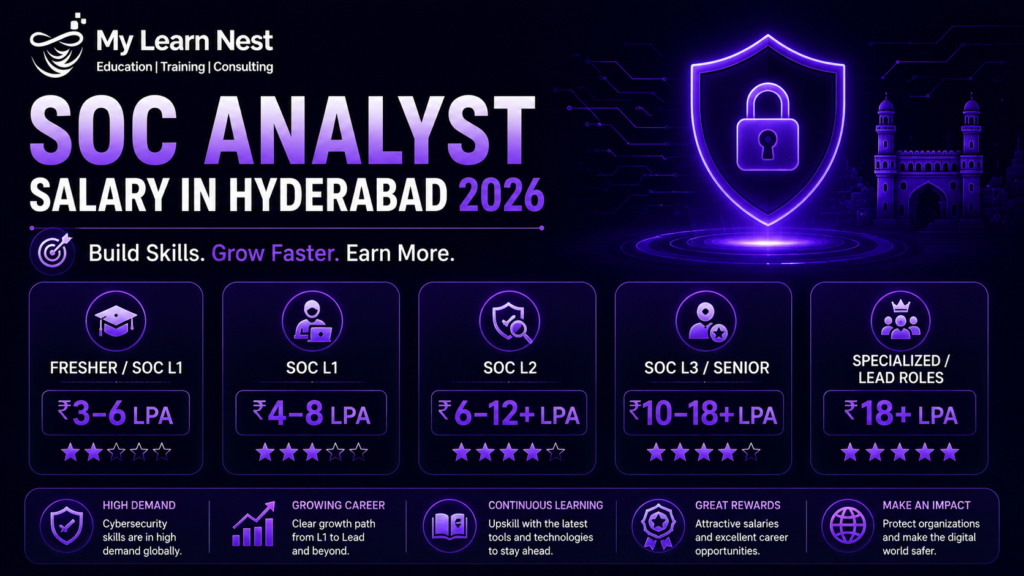
SOC roles are generally divided into different levels.
SOC Analyst L1
L1 analysts are usually responsible for initial alert monitoring and triage. They review alerts, determine severity, gather basic evidence, document findings, and escalate genuine threats.
SOC Analyst L2
L2 analysts perform deeper investigations and correlate information across multiple security sources. They may investigate compromised accounts, malware, suspicious network activity, and endpoint incidents.
SOC Analyst L3
L3 analysts typically work on advanced investigations, threat hunting, detection engineering, malware analysis, and complex incident responseFor freshers, an L1 SOC role can provide a strong foundation for progressing toward L2, L3, threat hunting, detection engineering, or other cybersecurity specializations.
Why SOC Analyst Training in Hyderabad Matters in 2026
Hyderabad has developed into a major technology and enterprise hub, with IT services companies, Global Capability Centers, financial organizations, healthcare and pharmaceutical companies, SaaS businesses, and cloud-focused enterprises.These organizations generate enormous amounts of security data.Someone needs to monitor it. Someone needs to investigate unusual activity.Someone needs to determine whether an alert is a false positive or an actual security incident.
That creates demand for security operations professionals.
For candidates searching for a SOC Analyst Course in Hyderabad, the opportunity is particularly relevant because SOC roles exist across managed security service providers, consulting organizations, enterprise security teams, and technology companies.A strong training program can help freshers understand the tools and investigation methods used in these environments before they enter the job market.
Why Choose a SOC Analyst Course for Freshers in Hyderabad?
Freshers often face one major challenge when applying for cybersecurity jobs: employers want candidates who understand security concepts and can demonstrate practical skills.A degree or certificate can show that you studied cybersecurity, but it does not necessarily demonstrate that you can investigate an alert.A practical SOC Analyst Course for Freshers in Hyderabad should bridge that gap.
Instead of learning only definitions, students should practise questions such as:
- What happened?
- Which user or device was involved?
- Where did the activity originate?
- Is the behaviour normal
- What evidence supports the alert?
- What should happen next?
This investigative approach is at the heart of SOC work.
What Will You Learn in a SOC Analyst Course in Hyderabad?
A complete SOC curriculum should progress from cybersecurity fundamentals to practical security operations.
Important areas include:
- Networking fundamentals
- Windows security
- Linux security
- Cybersecurity fundamentals
- Log analysis
- SIEM
- EDR and XDR
- Microsoft Sentinel
- KQL
- Splunk
- SPL
- IBM QRadar
- Incident response
- Threat intelligence
- Threat hunting
- MITRE ATT&CK
- Network security
- Security monitoring
- PowerShell
- Python
- SOAR and automation
The purpose is not to memorize a long list of technologies.The purpose is to understand how these technologies work together during a security investigation.
SOC Analyst Tools Every Fresher Should Learn
Modern SOC teams use different platforms depending on their organization and technology environment.A good SOC Analyst Training in Hyderabad program should therefore expose students to the major categories of security tools.
Microsoft Sentinel
Microsoft Sentinel is a cloud-native SIEM platform used to collect and analyse security information from different sources.
Students should learn how to:
- Search security logs
- Investigate incidents
- Analyse authentication activity
- Create queries
- Investigate suspicious IP addresses
- Build analytics rules
- Work with security incidents
- Perform threat hunting
Learning Sentinel becomes even more valuable when combined with KQL.
KQL
Kusto Query Language is used extensively within Microsoft security environments.A SOC analyst can use KQL to search and investigate large amounts of security telemetry.
For example, analysts can use queries to investigate:
- Failed authentication attempts
- Suspicious processes
- PowerShell activity
- Network connections
- Account activity
- Endpoint events
KQL should be taught through investigation exercises rather than only syntax examples.
Splunk
Splunk is another important enterprise SIEM platform.
A good Splunk curriculum should cover:
- Searching logs
- SPL
- Fields
- Alerts
- Dashboards
- Correlation
- Authentication analysis
- Network investigations
- Security monitoring
Learning more than one SIEM also helps students understand transferable SOC concepts.
IBM QRadar
QRadar is another enterprise security platform that students may encounter in security operations environments.
Training can introduce students to:
- Events
- Offenses
- Rules
- Correlation
- Log sources
- Investigation workflows
Understanding different SIEM platforms helps freshers become more adaptable when applying for SOC jobs.
Microsoft Defender XDR
Modern security investigations often require analysts to correlate information from identities, email, endpoints, applications, and other sources.Microsoft Defender XDR provides a unified approach to security investigation across Microsoft security technologies Students should understand incident investigation, alert correlation, identity investigation, endpoint activity, and advanced hunting.
Microsoft Defender for Endpoint
Endpoint security is an important part of SOC operations Students should learn how to investigate:
- Device activity
- Process execution
- Suspicious files
- Network connections
- Malware alerts
- User activity
- Endpoint timelines
Understanding what happened on an endpoint is often essential for determining whether an alert represents a real attack.
Why SIEM Training Is Important
SIEM is one of the core technologies used in security operations However, students should understand SIEM as a discipline rather than learning only one product.
A typical security monitoring pipeline looks like:
Log Source → Collection → Ingestion → Parsing → Normalization → Correlation → Detection → Alert → Investigation → Response
SOC analysts may work with logs from:
- Windows systems
- Linux systems
- Firewalls
- VPNs
- DNS
- Proxy servers
- Active Directory
- Endpoint platforms
- Cloud services
- Applications
Understanding this pipeline helps analysts investigate security events regardless of which SIEM product an organization uses.
Why Windows and Linux Security Matter
Many SOC alerts originate from operating systems A fresher therefore needs a practical understanding of Windows and Linux.
Windows training should include:
- Windows Event Logs
- Authentication events
- PowerShell
- Processes
- Services
- Scheduled tasks
- Active Directory basics
- Account activity
Linux training can cover:
- SSH
- Authentication logs
- Processes
- Users and permissions
- System logs
- Cron jobs
- Network connections
An analyst who understands operating-system behaviour can interpret alerts more effectively.
Network Security for SOC Analysts
Networking knowledge is another essential foundation.
A SOC analyst should understand:
- TCP/IP
- DNS
- HTTP and HTTPS
- Ports
- Protocols
- Firewalls
- VPNs
- IDS/IPS
- Proxies
- Network traffic
Suppose an alert shows that an endpoint connected to a suspicious external IP address.
A trained analyst should ask:
- Which process initiated the connection?
- What protocol was used?
- Was the destination known?
- Did other systems contact the same destination?
- Did the connection occur before or after another suspicious event?
This is why networking should be part of every practical SOC Analyst Course in Hyderabad.
Incident Response Training
SOC analysts do more than monitor dashboards Once an alert is confirmed as malicious, the organization may need to contain, investigate, and recover from the incident.
Students should understand the incident response lifecycle:
- Preparation
- Detection and analysis
- Containment
- Eradication
- Recovery
- Lessons learned
A practical course can use scenarios such as:
- Phishing
- Malware
- Credential compromise
- Brute-force attacks
- Suspicious PowerShell
- Account takeover
- Data exfiltration
- Ransomware
Scenario-based learning helps students understand how security incidents are handled in real environments.
Threat Intelligence for SOC Analysts
Threat intelligence provides context around suspicious activity For example, when a SOC analyst discovers a suspicious IP address, they may need to determine whether it has previously been associated with malicious activity.
Threat intelligence can involve:
- IP addresses
- Domains
- URLs
- File hashes
- Malware families
- Threat actors
- Attack techniques
The goal is to transform a raw indicator into useful investigation context.
Threat Hunting
Threat hunting takes SOC analysis beyond simply responding to generated alerts Instead of waiting for a detection, analysts develop a hypothesis and search available security telemetry for evidence.
For example:
“Could an attacker be using PowerShell to execute malicious commands in the environment?”
The analyst can then search endpoint and SIEM data for relevant activity.
Threat hunting commonly involves:
- Hypothesis development
- Query building
- Log analysis
- Endpoint telemetry
- Behaviour analysis
- MITRE ATT&CK
- Detection development
Freshers do not necessarily need advanced threat-hunting expertise on day one, but understanding the fundamentals provides a strong foundation for future L2 and L3 progression.
MITRE ATT&CK for SOC Analysts
MITRE ATT&CK provides a common framework for describing adversary behaviour SOC teams can use ATT&CK to understand and map techniques associated with attacks.
It covers areas such as:
- Initial Access
- Execution
- Persistence
- Privilege Escalation
- Defence Evasion
- Credential Access
- Discovery
- Lateral Movement
- Collection
- Command and Control
- Exfiltration
- Impact
Learning MITRE ATT&CK helps analysts communicate investigations using a common security vocabulary.
PowerShell and Python for SOC Automation
Automation can help SOC analysts reduce repetitive manual work.
PowerShell can be useful for Windows security investigations and administrative automation.
Python can be used for tasks such as:
- Log parsing
- Indicator processing
- Data enrichment
- Hash analysis
- Report generation
- API integration
Freshers do not need to become software developers.
However, basic scripting skills can make them more productive and create an advantage during technical interviews.
SOAR and Security Automation
Security Orchestration, Automation and Response, or SOAR, can automate repetitive security workflows.
For example:
Alert → Extract Indicator → Enrich Indicator → Check Reputation → Create Investigation Record → Notify Analyst → Approved Response
Students should understand concepts such as:
- Playbooks
- Automation
- Enrichment
- Workflow orchestration
- Approvals
- Response actions
Understanding SOAR also helps students see how modern SOC teams use automation to handle large alert volumes.
Real-Time SOC Projects for Freshers
Hands-on projects are one of the most important parts of a practical SOC Analyst Training Institute in Hyderabad.
A student should be able to demonstrate what they learned through realistic scenarios.
Phishing Investigation Project
Students can investigate a suspicious email and identify:
- Sender information
- URLs
- Domains
- Attachments
- Indicators of compromise
- User activity
- Recommended response
Brute-Force Detection Project
Students can analyse authentication logs to identify:
- Repeated failed logins
- Successful login after multiple failures
- Source IP addresses
- Account activity
- Unusual authentication patterns
Malware Investigation Project
Students can investigate an endpoint alert and examine:
- Parent process
- Child processes
- File activity
- Network connections
- User activity
- Possible persistence
Threat Hunting Project
Students can create a hypothesis based on a MITRE ATT&CK technique and use SIEM or endpoint data to search for evidence.
These projects demonstrate practical ability much better than a certificate alone.
How to Choose the Best SOC Analyst Training Institute in Hyderabad
Choosing an institute requires more than comparing course fees.
Before joining, evaluate the training based on practical outcomes.
Check the Curriculum
Make sure the course covers modern SOC technologies and investigation techniques.
Ask About Hands-On Labs
Ask whether every student gets practical access to security tools.
Check the Projects
Ask to see examples of projects students complete during training.
Understand Trainer Experience
Find out whether instructors have practical experience in SOC operations, SIEM, incident response, cloud security, or enterprise security environments.
Check Interview Preparation
A career-focused course should help students prepare for:
- SOC L1 interviews
- SIEM questions
- Networking questions
- Log-analysis questions
- KQL or SPL exercises
- Incident scenarios
- Technical assessments
- HR interviews
Verify Career Support
If an institute provides placement or career support, understand exactly what that support includes rather than relying only on promotional claims.
SOC Analyst Course for Freshers: Who Can Join?
A SOC Analyst Course for Freshers in Hyderabad can be suitable for students and graduates from different technical backgrounds.
Learners may come from:
- Computer science
- Information technology
- Networking
- System administration
- Cloud
- IT support
- Other technology backgrounds
The most important requirement is willingness to learn technical concepts and practise investigation.
A good beginner curriculum should gradually move through:
Networking → Operating Systems → Cybersecurity Fundamentals → SIEM → Endpoint Security → Alert Investigation → Incident Response → Threat Hunting
This progression prevents beginners from being overwhelmed by advanced concepts too early.
SOC Analyst Interview Preparation
Technical knowledge is only one part of getting your first SOC job. You also need to explain how you would investigate a security event.
Interviewers may ask questions such as:
- What would you do if you receive a high-severity alert?
- How would you investigate multiple failed login attempts?
- What is the difference between SIEM and EDR?
- How would you investigate a suspicious PowerShell alert?
- What is MITRE ATT&CK?
- How is KQL used in Sentinel?
- How would you identify whether an alert is a false positive?
Candidates should be able to explain their reasoning step by step.
This is why practical mock interviews and scenario-based preparation should be part of a job-oriented SOC program.
SOC Analyst Career Roadmap for Freshers
A practical roadmap can help learners understand what to study first.
Step 1: Learn Networking
Understand TCP/IP, DNS, ports, protocols, firewalls, VPNs, and basic network traffic.
Step 2: Learn Windows and Linux
Understand authentication, processes, logs, permissions, services, and system activity.
Step 3: Learn SOC Fundamentals
Understand SOC roles, alert lifecycle, log sources, monitoring, triage, and escalation.
Step 4: Learn SIEM
Build hands-on skills with platforms such as Microsoft Sentinel, Splunk, and QRadar.
Step 5: Learn KQL and SPL
Practise writing queries to search and investigate security data.
Step 6: Learn Endpoint Security
Understand EDR/XDR concepts and endpoint investigation.
Step 7: Learn Incident Response
Practise phishing, malware, credential compromise, and other security scenarios.
Step 8: Learn Threat Intelligence and Threat Hunting
Use indicators, behavioural analysis, and MITRE ATT&CK to investigate threats.
Step 9: Build Projects
Create practical investigation projects that you can explain during interviews.
Step 10: Prepare for SOC L1 Jobs
Work on technical questions, scenario-based interviews, resume preparation, and mock interviews.
SOC Analyst Career Opportunities in Hyderabad
A SOC Analyst can build a career across several types of organizations.
Potential environments include:
- Managed Security Service Providers
- IT services companies
- Consulting companies
- Global Capability Centers
- Banking and financial services
- Healthcare organizations
- Pharmaceutical companies
- SaaS companies
- Enterprise security teams
- Cloud and technology companies
Starting with an L1 role can provide exposure to different alerts, technologies, clients, and security incidents.
With experience, analysts can progress toward roles such as:
- SOC Analyst L2
- SOC Analyst L3
- Threat Hunter
- Incident Response Analyst
- Detection Engineer
- Security Engineer
- SIEM Engineer
- Security Operations Lead
The specific career path depends on experience, skills, and specialization.
Common Mistakes Freshers Make When Learning SOC
Many beginners make the mistake of focusing entirely on certificates.
A certificate can support your profile, but practical skills are what help you explain your capabilities.
Other common mistakes include:
- Learning only one SIEM
- Ignoring networking
- Avoiding Linux
- Memorizing interview answers
- Not practising log analysis
- Skipping hands-on labs
- Ignoring incident response
- Not building projects
- Learning tools without understanding security concepts
The better approach is to combine fundamentals, tools, practical investigations, and career preparation.
What Makes a Job-Oriented SOC Analyst Training Program Different?
A job-oriented program should connect every topic to an actual security operation.
For example, instead of simply teaching Windows Event IDs, students should investigate suspicious authentication activity.Instead of simply teaching KQL syntax, students should use KQL to answer investigation questions.
Instead of simply explaining MITRE ATT&CK, students should map observed attacker behaviour to relevant techniques. Instead of demonstrating a SIEM dashboard, students should investigate an alert from start to finish.
This approach helps learners understand how a SOC analyst thinks, not just what a SOC analyst knows.
SOC Analyst Training at MyLearnNest
At MyLearnNest, learners looking for a career-focused SOC Analyst Training in Hyderabad can follow a structured path from cybersecurity fundamentals to practical SOC skills.
The learning approach should focus on understanding security concepts, working with industry-relevant tools, investigating alerts, completing practical scenarios, and preparing for interviews.
Students can progressively develop skills across:
- Cybersecurity fundamentals
- Networking
- Windows and Linux security
- SIEM
- Microsoft Sentinel
- KQL
- Splunk
- IBM QRadar
- Defender XDR
- Endpoint security
- Incident response
- Threat intelligence
- Threat hunting
- MITRE ATT&CK
- PowerShell
- Python
- SOAR
- Security monitoring
The objective is not simply to complete a course.
The objective is to develop the confidence to investigate a security alert, understand the available evidence, determine its severity, document findings, and recommend an appropriate next step.
Future of SOC Analyst Careers in 2026
SOC operations are evolving as organizations adopt cloud infrastructure, identity-based security, EDR/XDR platforms, automation, and AI-assisted security operations.
Security teams are increasingly expected to monitor large and diverse environments while reducing response time.
This means SOC analysts need to develop beyond basic dashboard monitoring.
Skills such as:
- Threat hunting
- Detection engineering
- Cloud security
- Identity security
- Automation
- KQL
- SIEM
- EDR/XDR
- Incident response
- MITRE ATT&CK
can become increasingly valuable as analysts progress in their careers.
AI may automate some repetitive SOC activities, but analysts will still need to understand alerts, validate evidence, investigate context, make decisions, and handle complex incidents.
The strongest professionals will likely be those who combine security knowledge with practical investigation and automation skills.
Frequently Asked Questions
Is SOC Analyst a good career for freshers in 2026?
Yes. SOC Analyst roles can provide an accessible starting point for candidates who want to enter cybersecurity. L1 positions allow freshers to develop practical experience in security monitoring, alert triage, SIEM, and incident investigation.
Which SOC Analyst course is best for freshers?
The best course is one that combines cybersecurity fundamentals with hands-on SIEM, endpoint security, log analysis, incident response, threat intelligence, threat hunting, practical projects, and interview preparation.
What should I learn in a SOC Analyst course in Hyderabad?
You should learn networking, Windows and Linux security, SIEM, Microsoft Sentinel, KQL, Splunk, endpoint security, incident response, threat intelligence, MITRE ATT&CK, threat hunting, security monitoring, and basic automation.
Is hands-on training important for SOC Analysts?
Yes. SOC work is highly practical. Students should learn how to investigate alerts and analyse logs rather than relying only on theoretical lessons.
Can freshers get SOC Analyst jobs in Hyderabad?
Freshers can apply for L1 SOC roles, particularly with MSSPs, consulting organizations, IT services companies, and other organizations that maintain security operations teams. Practical skills can help candidates stand out.
How long does it take to become a SOC Analyst?
The timeframe varies depending on your existing technical background and the amount of time you dedicate to learning and practising. A structured learning path can help you progress from fundamentals to practical SOC skills systematically.
What tools should a fresher learn for SOC?
Important tools and technologies include Microsoft Sentinel, KQL, Splunk, SPL, IBM QRadar, Microsoft Defender XDR, Microsoft Defender for Endpoint, SIEM concepts, SOAR, and relevant security-analysis tools.
Is certification enough to get a SOC Analyst job?
Certification can support your profile, but practical knowledge is important. Employers may evaluate your ability to understand security concepts, investigate alerts, analyse logs, and explain incident scenarios.
Conclusion
Choosing the best SOC Analyst course in Hyderabad for freshers in 2026 is an important decision for anyone planning to start a cybersecurity career.
The right SOC Analyst Training in Hyderabad should go beyond theoretical cybersecurity lessons. It should help you understand networking, operating systems, SIEM, endpoint security, log analysis, incident response, threat intelligence, threat hunting, MITRE ATT&CK, automation, and security monitoring.
Tools such as Microsoft Sentinel, KQL, Splunk, IBM QRadar, Microsoft Defender XDR, and Microsoft Defender for Endpoint can provide valuable practical exposure.
Most importantly, you should work on realistic projects and security scenarios so that you can demonstrate what you know during interviews.
When comparing a SOC Analyst Training Institute in Hyderabad, look carefully at the curriculum, lab environment, trainer experience, practical projects, interview preparation, and career support.
Don’t choose a course only because it offers a certificate. Choose a learning path that helps you become capable of doing the actual work.
If your goal is to start your cybersecurity career as a SOC Analyst, building practical skills today can help you prepare for the opportunities available in Hyderabad’s growing security ecosystem.
Learn the fundamentals. Practice with security tools. Investigate real scenarios. Build projects. Prepare for interviews. Then take the next step toward your SOC Analyst caree

