
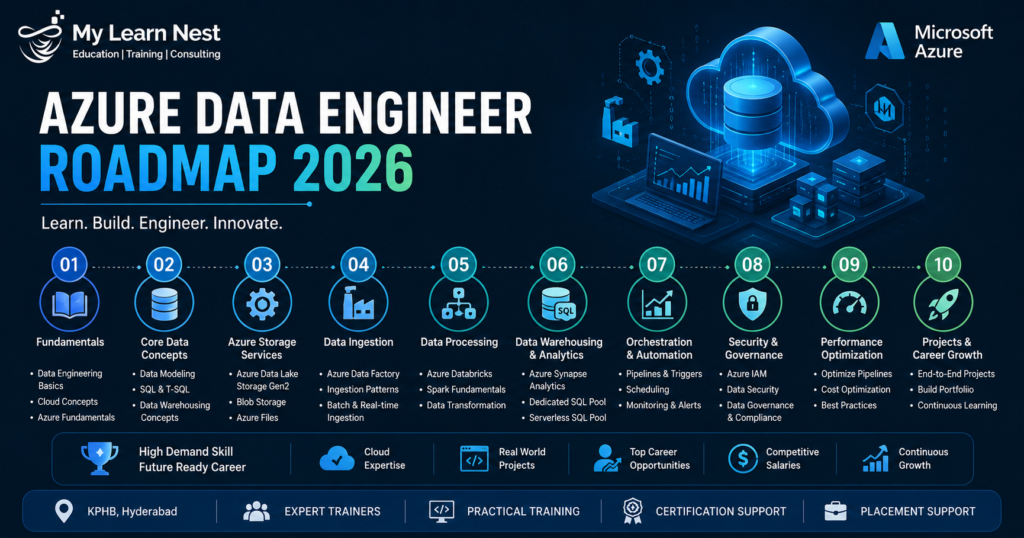
Azure Data Engineer Roadmap 2026
Azure Data Engineering is one of the important career paths in the cloud data industry. Organizations use cloud platforms to collect data from applications, databases, files, APIs, IoT systems, and business applications and then transform that data into reliable datasets for reporting, analytics, machine learning, and AI.
An Azure Data Engineer is responsible for designing, developing, monitoring, and maintaining data solutions on Microsoft Azure. The role commonly involves services such as Azure Data Factory, Azure Data Lake Storage, Azure Databricks, Azure Synapse, Azure SQL, and other data services depending on the project.
Microsoft describes Azure Data Factory as a cloud-based data integration and ETL service used to create data-driven workflows and pipelines that can ingest and transform data at scale. (Microsoft Learn)
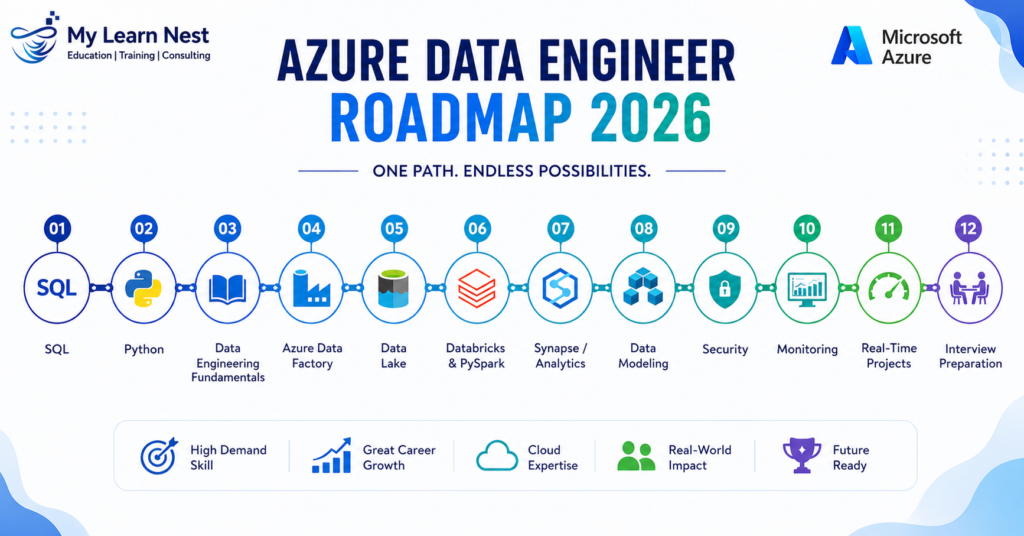
Start With SQL
SQL should be the first major skill in an Azure Data Engineer roadmap. Learn SELECT statements, joins, aggregations, subqueries, CTEs, window functions, views, stored procedures, and data manipulation.
A data engineer regularly works with large datasets, so understanding how to write correct and efficient SQL is more valuable than simply memorizing syntax.
Learn Python
Python is widely used in modern data engineering for data processing, automation, API integration, validation, and working with frameworks such as PySpark.
A beginner does not need to become an advanced Python developer immediately. Focus first on functions, data structures, exception handling, file operations, modules, and basic object-oriented concepts.
Learn Data Engineering Fundamentals
Before learning every Azure service, understand fundamental concepts such as ETL, ELT, data lakes, data warehouses, batch processing, streaming, data modeling, partitioning, data quality, and orchestration.
This foundation helps you understand why a particular Azure service is selected for a project.
Learn Azure Data Factory
Azure Data Factory is a major skill for Azure Data Engineers. It is used to build pipelines that move and transform data between different systems. Microsoft describes it as a platform for orchestrating data movement and transformation through data-driven workflows. (Microsoft Learn) Practice creating pipelines, datasets, linked services, parameters, variables, triggers, and monitoring workflows.
Learn Azure Data Lake Storage
Azure Data Lake Storage provides scalable cloud storage for data engineering workloads. Learn concepts such as containers, folders, access control, file formats, partitioned data, and different data layers.
A common architecture is:
Source Systems → Data Lake → Transformation → Data Warehouse → Reporting
Learn Azure Databricks and PySpark
Azure Databricks is widely used for distributed data processing and transformation. Microsoft currently provides an Azure Databricks Data Engineer Associate certification focused on integrating and modeling data, building optimized pipelines, troubleshooting workloads, and applying data quality and governance practices with Unity Catalog. (Microsoft Learn)
For an Azure Data Engineer, learning PySpark is particularly useful when dealing with larger datasets and transformation workloads.
Learn Azure Synapse and Modern Analytics
Understand how analytical workloads can be built using Azure Synapse and related Azure services. Learn data warehouses, external data, dedicated and serverless approaches, SQL analytics, and integration with data pipelines.
The exact service mix differs from project to project, so focus on architectural understanding rather than trying to memorize every Azure feature.
Learn Data Modeling
Data modeling is an important part of data engineering. Understand fact tables, dimension tables, star schemas, normalization, denormalization, surrogate keys, and slowly changing dimensions.
A good data engineer should know not only how to move data but also how to structure it for efficient analytics.
Learn Data Security and Governance
Azure Data Engineers work with business and potentially sensitive information. Learn identity, access management, encryption concepts, role-based access, data quality, lineage, governance, and secure data movement.
Learn Monitoring and Troubleshooting
Production data pipelines can fail because of incorrect credentials, schema changes, unavailable source systems, bad records, network issues, or application changes.
Learn how to monitor pipeline runs, identify failures, review logs, retry activities, and communicate the root cause to stakeholders.
Azure Data Engineer Roadmap 2026
How to Become an Azure Data Engineer Without Experience
Many beginners believe they need several years of professional experience before applying for data engineering jobs. In reality, you can begin building a career without previous data-engineering employment by developing practical skills and demonstrating them through projects.
The key is to replace missing professional experience with strong fundamentals, hands-on projects, and the ability to explain your work clearly.
Start With a Strong Technical Foundation
Start with SQL, Python, Linux basics, Git, and data engineering concepts.
SQL should receive the most attention in the beginning because it appears across databases, warehouses, transformation processes, and analytical systems.
Learn Azure Step by Step
Do not try to learn the complete Azure platform.
Focus on services relevant to data engineering, especially Azure Data Factory, Azure Data Lake Storage, Azure Databricks, Synapse or other analytical services, and Azure identity and monitoring concepts.
Microsoft’s Azure Data Fundamentals certification is designed for people beginning to work with data in the cloud and can be useful as an introductory learning milestone. (Microsoft Learn)
Build Three Strong Projects
Instead of creating many small projects, build a few complete projects. For example, create a retail sales pipeline, an e-commerce analytics pipeline, and a streaming or near-real-time data project.
Each project should include source data, ingestion, transformation, storage, data quality checks, and reporting or analytical output.
Create a Project Portfolio
Your portfolio should explain what problem the project solves, which Azure services you used, how the pipeline works, what transformations were performed, and what challenges you solved.
Screenshots, architecture diagrams, SQL scripts, PySpark notebooks, and GitHub documentation can make the project more convincing.
Learn to Explain Your Projects
During an interview, you may be asked:
- “Why did you use Data Factory?”
- “Why did you choose Databricks?”
- “How did you handle duplicate records?”
- “How did you handle pipeline failure?”
- “How did you partition the data?”
- “How did you secure the data?”
A candidate who can answer these questions demonstrates practical understanding.
Apply for Suitable Entry-Level Roles
Without professional experience, do not limit your search to a job title containing only “Azure Data Engineer.”
Roles such as Junior Data Engineer, Associate Data Engineer, Cloud Data Engineer Trainee, Data Engineering Intern, and ETL Developer can also provide entry points.
Can You Become an Azure Data Engineer Without Experience?
Yes, but the goal should not be to pretend that project experience is the same as professional experience.Be honest about your background and clearly separate academic, personal, internship, and professional projects.
The strongest beginner profile combines SQL + Python + Azure + Projects + Communication + Problem-Solving.
Azure Data Engineer Salary in Hyderabad
Salary depends on experience, company, technical skills, domain, project complexity, and the combination of technologies a candidate knows.
Current Glassdoor data for Azure Data Engineers in Hyderabad reports an average salary of about ₹9 lakh per year, with recent submissions showing examples such as ₹8–₹10 lakh for 4–6 years of experience and ₹13 lakh for another 4–6 year submission. (Glassdoor)
These figures are market indicators rather than guaranteed salary ranges. Actual offers vary substantially.
Azure Data Engineer Salary for Freshers
Freshers may enter through junior data engineering, ETL, cloud support, trainee, or associate roles.
The initial package can vary according to the company and the candidate’s technical preparation. A fresher with strong SQL, Python, Azure Data Factory, Databricks, and practical projects can build a stronger profile than someone who knows only basic cloud terminology.
Azure Data Engineer Salary for Experienced Professionals
Professionals with several years of experience can move into senior data engineer, lead engineer, cloud data architect, or specialized data platform roles.
Hyderabad job listings show demand for professionals working with Azure Data Factory, Databricks, PySpark, Python, SQL, data modeling, ETL/ELT, pipeline optimization, and cloud data platforms. (Indeed)
What Influences Azure Data Engineer Salary?
The most important factors include technical depth, project experience, cloud knowledge, data modeling, programming, communication, and the ability to troubleshoot production pipelines.
A candidate who combines Azure + Databricks + PySpark + SQL + Python + data engineering architecture can generally target a broader range of opportunities.
Azure Data Engineer Salary Growth
Career growth usually comes from increased responsibility rather than simply increasing the number of certifications.
A professional can progress from Junior Data Engineer to Data Engineer, Senior Data Engineer, Lead Data Engineer, Data Architect, or Cloud Data Architect depending on skills and experience.
Azure Data Engineer Real-Time Projects
Real-time projects help beginners understand how Azure services work together in an actual data platform.
Retail Sales Data Engineering Project
Build a retail analytics pipeline where daily sales data comes from CSV files or an operational database.
Azure Data Factory can ingest the data into Azure Data Lake Storage. Databricks can clean and transform the raw information, and the resulting datasets can be prepared for reporting.
The project can answer questions such as total sales, top products, customer trends, monthly revenue, and store performance.
E-Commerce Data Pipeline Project
Create an e-commerce platform using customer, product, order, payment, and shipment data.
The project can demonstrate incremental loading, duplicate handling, schema validation, transformations, and analytical modeling. The final output can be connected to Power BI to create business dashboards.
Banking Data Processing Project
Create a simplified banking data pipeline containing customer, account, and transaction information.
The main objective can be to demonstrate data ingestion, transformation, data quality, and secure access.For portfolio projects, use public or synthetic datasets rather than real financial information.
Healthcare Analytics Data Pipeline
Create a healthcare analytics project using synthetic patient, appointment, treatment, and billing datasets.The project can show how multiple data sources are integrated into a centralized analytical model.
Again, use anonymized or synthetic data for learning projects.
Real-Time Streaming Project
A more advanced project can process continuously arriving event data such as website activity, application events, or IoT messages.
The architecture can involve event ingestion, stream processing, storage, transformation, and real-time analytics.This project is useful for demonstrating that you understand the difference between traditional batch pipelines and streaming architectures.
Azure Data Engineer Project Architecture
A practical project can follow this pattern:
Source → Data Factory → Data Lake → Databricks/PySpark → Curated Data → Warehouse/Analytics → Power BI
The exact architecture should depend on the business problem rather than simply using every Azure service in one project.
What Makes a Real-Time Project Valuable?
A good project should show that you can solve a business problem.Do not focus only on creating pipelines. Explain how you handled incremental loads, failures, duplicate records, changing schemas, data quality, security, performance, and monitoring.
That is the type of thinking employers look for in data engineering interviews.
Azure Data Engineer vs Data Analyst
Azure Data Engineers and Data Analysts both work with data, but their responsibilities are different. A Data Engineer is primarily responsible for building and maintaining the systems that collect, transform, store, and deliver data.
A Data Analyst generally focuses on using prepared data to generate insights, reports, dashboards, and business recommendations.
What Does an Azure Data Engineer Do?
A data engineer works on data pipelines, storage, transformations, orchestration, data modeling, integration, monitoring, and reliability.
The engineer is usually more concerned with questions such as:
- “How do we ingest this data?”
- “How do we transform it?”
- “How do we handle millions of records?”
- “How do we schedule the pipeline?”
- “How do we make the system reliable?”
What Does a Data Analyst Do?
A data analyst usually focuses on analyzing business data and answering questions such as:
- “Why did sales decrease?”
- “Which product performs best?”
- “Which region has the highest revenue?”
- “What is the monthly customer trend?”
The analyst often works with SQL, Excel, Power BI, Tableau, Python, and statistical or analytical techniques.
Azure Data Engineer vs Data Analyst Career Choice
A person who enjoys programming, cloud platforms, architecture, automation, and large-scale data processing may prefer data engineering.
A person who enjoys business analysis, visualization, reporting, statistics, and explaining insights may prefer data analytics.
Neither role is universally better. They solve different problems.
Azure Data Engineer vs Data Analyst Comparison
Area | Azure Data Engineer | Data Analyst |
Main focus | Building data systems | Analyzing data |
Core work | Pipelines and transformations | Reports and insights |
Key skills | SQL, Python, Azure, PySpark | SQL, Excel, Power BI, analytics |
Cloud knowledge | High | Useful but not always essential |
Data modeling | Important | Important |
Programming | Moderate to high | Basic to moderate |
Main output | Reliable datasets and pipelines | Reports and business insights |
Azure Data Engineer Skills Checklist
A successful Azure Data Engineer should gradually develop technical, cloud, data, and communication skills.
Start with SQL and Python, because they form the foundation for most data-engineering tasks.
Next, learn Azure Data Factory, Azure Data Lake Storage, Databricks, PySpark, and analytical data platforms. These technologies appear frequently in current Azure data-engineering job requirements in Hyderabad. (Indeed)
Data modeling should also be part of the skill set. Understand fact tables, dimensions, data warehouses, data lakes, partitioning, and slowly changing dimensions.
You should also understand ETL/ELT, batch processing, incremental loading, data quality, monitoring, security, Git, and CI/CD concepts. Communication is often overlooked. A data engineer may need to understand requirements from analysts or business users and explain technical problems to people who are not data engineers.
Azure Data Engineer Interview Scenarios
Azure Data Engineer interviews often test problem-solving rather than simple definitions.
Scenario: A Data Factory Pipeline Suddenly Fails
The first step is to identify which activity failed and inspect the error message. Then check source availability, credentials, network connectivity, parameters, schema changes, and recent configuration changes.
The interviewer is usually looking for a structured troubleshooting approach rather than one specific command.
Scenario: A Pipeline Takes Too Long
Start by identifying the slow activity.
Check whether the problem is caused by source extraction, data movement, transformation, query performance, network transfer, or resource limitations.
Then optimize the appropriate stage instead of simply increasing resources.
Scenario: Duplicate Records Are Appearing
First identify why duplicates are being generated.
The cause may be repeated ingestion, missing business keys, incorrect joins, failed incremental logic, or incorrect merge logic.A robust solution should address the root cause instead of simply deleting duplicates after every load.
Scenario: Source Schema Changes Without Warning
Suppose a source system adds a new column or changes a data type.
A production pipeline should have appropriate schema-management and validation strategies. The engineer should determine whether the new schema can be automatically accommodated or whether the pipeline requires controlled changes and testing.
Scenario: Daily Data Load Is Missing Records
Check source completeness, extraction filters, incremental-load logic, timestamps, watermark values, failed activities, and target reconciliation.
The final solution should identify where records were lost rather than simply rerunning the entire pipeline.
Scenario: Millions of Records Need to Be Processed
The engineer should think about partitioning, parallel processing, efficient transformations, scalable compute, file formats, incremental processing, and avoiding unnecessary data movement.
Azure Databricks and PySpark are commonly used when distributed processing is required, and Microsoft’s current Azure Databricks Data Engineer certification emphasizes building optimized pipelines and troubleshooting data-engineering workloads. (Microsoft Learn)
Scenario: A Business User Wants Near-Real-Time Data
First clarify what “real-time” actually means.
A requirement of five seconds is very different from a requirement of fifteen minutes.Once the latency requirement is understood, select an architecture that can support the required ingestion, processing, storage, and reporting speed.
Scenario: How Would You Design an Azure Data Platform?
Start with requirements rather than immediately choosing services.Understand the data sources, volume, velocity, transformation requirements, security, latency, users, reporting needs, and expected growth.
Then design the architecture around those requirements.
A basic batch architecture could be:
Source Systems → Azure Data Factory → Data Lake → Databricks/Synapse → BI Layer
The final architecture should be adapted to the organization’s requirements.
Scenario: How Do You Handle a Production Data Quality Issue?
Identify the affected dataset, determine the business impact, find the root cause, stop further propagation where appropriate, correct the data or pipeline, validate the result, and document the incident.
A strong data engineer should also think about preventing the same issue in the future through validation, monitoring, alerts, and automated checks.
Scenario: Why Would You Choose Databricks Over a Simple SQL Transformation?
A simple transformation may be better handled directly in SQL.
Databricks becomes more useful when the workload requires distributed processing, complex transformations, Spark-based processing, large-scale data preparation, or advanced data engineering capabilities.
The right answer depends on workload requirements rather than assuming one service is always better.
Azure Data Engineer Certification and Learning Path in 2026
One important update for anyone writing or studying an Azure Data Engineer roadmap in 2026 is that Microsoft’s previous DP-203 Data Engineering on Microsoft Azure exam retired on March 31, 2025. Microsoft lists DP-203 as retired, so older training websites that present it as the current Azure Data Engineer certification are outdated.
For beginners, Microsoft offers Azure Data Fundamentals (DP-900) as an entry-level credential focused on core data concepts and Azure data services.
For professionals working specifically with Azure Databricks, Microsoft currently offers Azure Databricks Data Engineer Associate, which focuses on data integration and modeling, optimized pipelines, troubleshooting, and data quality and governance.
Microsoft also positions Fabric Data Engineer Associate (DP-700) as a current data-engineering credential in the Microsoft ecosystem. Because the certification landscape has changed, learners should always verify the current exam details on Microsoft Learn before preparing for an exam.
The practical learning order is:
Data Fundamentals → SQL & Python → Azure Data Services → Data Engineering Projects → Specialized Certification
Why Learn Azure Data Engineering With MyLearnNest?
Learning Azure Data Engineering requires more than understanding individual cloud services. A strong learner should understand how data moves from a source system into a data lake, how pipelines are orchestrated, how transformations are performed, how data is modeled, and how the final information reaches analysts or business applications.
MyLearnNest can structure Azure Data Engineer training around SQL, Python, Azure Data Factory, Azure Data Lake, Databricks, PySpark, data modeling, real-time projects, interview scenarios, and career preparation.
A practical training approach can help learners understand not only how a particular Azure service works, but also why it is selected, where it fits in the architecture, what can go wrong, and how a data engineer solves the problem.
Final Thoughts on Azure Data Engineer Careers in 2026
An Azure Data Engineer career can be a strong option for people who enjoy working with data, cloud technology, programming, automation, and problem-solving.
The most useful career path is not to learn every Azure service. Build a solid foundation in SQL and Python, then learn the Azure services that are most relevant to data engineering. Add Databricks and PySpark, practice real-time projects, understand data architecture, and prepare for scenario-based interviews.
The Hyderabad market currently shows active Azure and broader data-engineering opportunities, including roles involving Azure Data Factory, Databricks, PySpark, Python, SQL, ETL/ELT, and data-platform development.

