
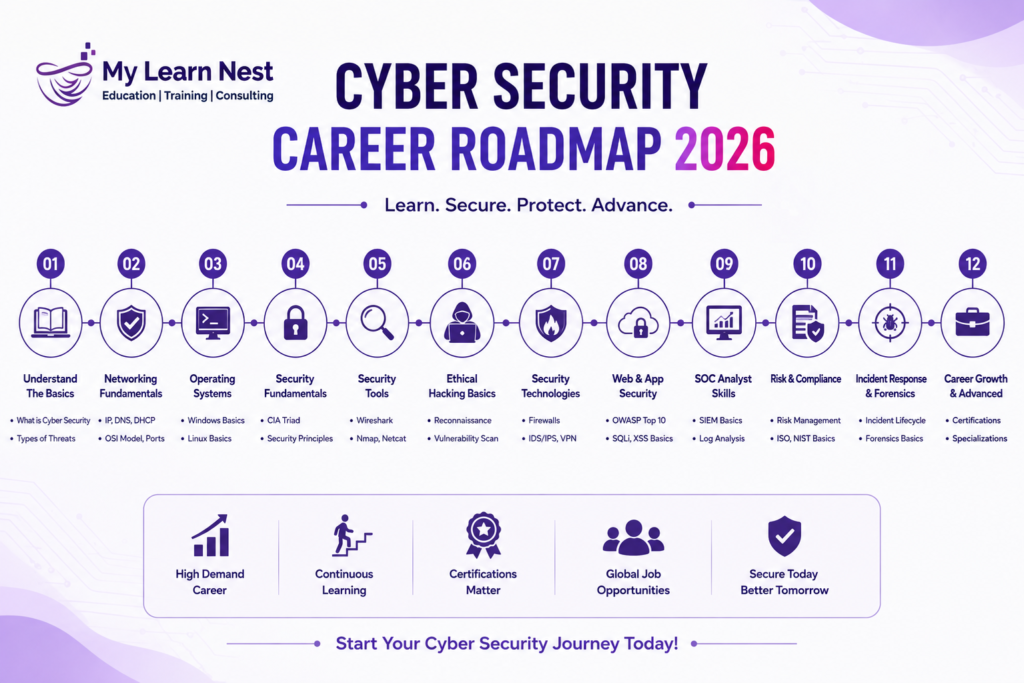
Cyber Security Career Roadmap 2026
Cyber Security has become an important technology career because organizations increasingly depend on applications, cloud platforms, networks, identities, and digital services. A cybersecurity professional helps protect these systems from unauthorized access, malware, data theft, vulnerabilities, and other security threats.
A Cyber Security Career Roadmap 2026 should not focus only on ethical hacking. Modern cybersecurity includes Security Operations Center (SOC) analysis, network security, application security, cloud security, identity and access management, vulnerability management, incident response, security engineering, governance, risk, and compliance.
For beginners, the right approach is to build fundamentals first and specialize later.
Learn Networking Fundamentals
Networking is one of the most important foundations of cybersecurity. Learn concepts such as IP addresses, TCP/IP, DNS, HTTP/HTTPS, ports, firewalls, VPNs, routing, and common network protocols.
Without understanding how systems communicate, it is difficult to analyze security alerts or understand how attacks and defenses work.
Learn Linux and Windows Fundamentals
Security professionals regularly work with operating systems. Learn Linux commands, users and permissions, processes, services, logs, networking commands, and basic shell scripting.
You should also understand Windows users, services, event logs, Active Directory concepts, authentication, and permissions.
Learn Cyber Security Fundamentals
Understand the basic security principles of confidentiality, integrity, and availability. Then move into authentication, authorization, encryption, hashing, vulnerability management, threat intelligence, security monitoring, and incident response.
The objective at this stage is to understand how attacks happen and how organizations detect, prevent, and respond to them.
Choose a Cyber Security Specialization
After learning the fundamentals, select an area that matches your interests.
A beginner interested in monitoring and investigation can explore SOC and SIEM. Someone interested in web applications can move toward Application Security and penetration testing. Professionals interested in infrastructure can explore Network Security or Cloud Security.
Other career paths include digital forensics, vulnerability management, security engineering, identity security, and governance, risk and compliance.
Learn SIEM and Security Monitoring
SIEM platforms collect and analyze security logs and events from different systems. Microsoft Sentinel, for example, provides SIEM capabilities together with security data ingestion, analytics, threat detection, investigation, and response functions.
Learning how to investigate alerts, identify suspicious activity, correlate events, and document incidents is valuable for entry-level SOC roles.
Learn Cloud Security
Modern organizations use Azure, AWS, Google Cloud, and SaaS applications, so cloud security is increasingly important.
Understand identity and access management, permissions, security groups, network controls, logging, encryption, secrets, and cloud security monitoring.
Practice With Labs and Projects
Cybersecurity cannot be learned effectively through theory alone. Build a safe home lab using intentionally vulnerable systems or authorized training environments.
Practice analyzing logs, identifying vulnerabilities, investigating suspicious activity, securing a small network, and documenting your findings.
Build a Cyber Security Career Roadmap
A practical sequence is:
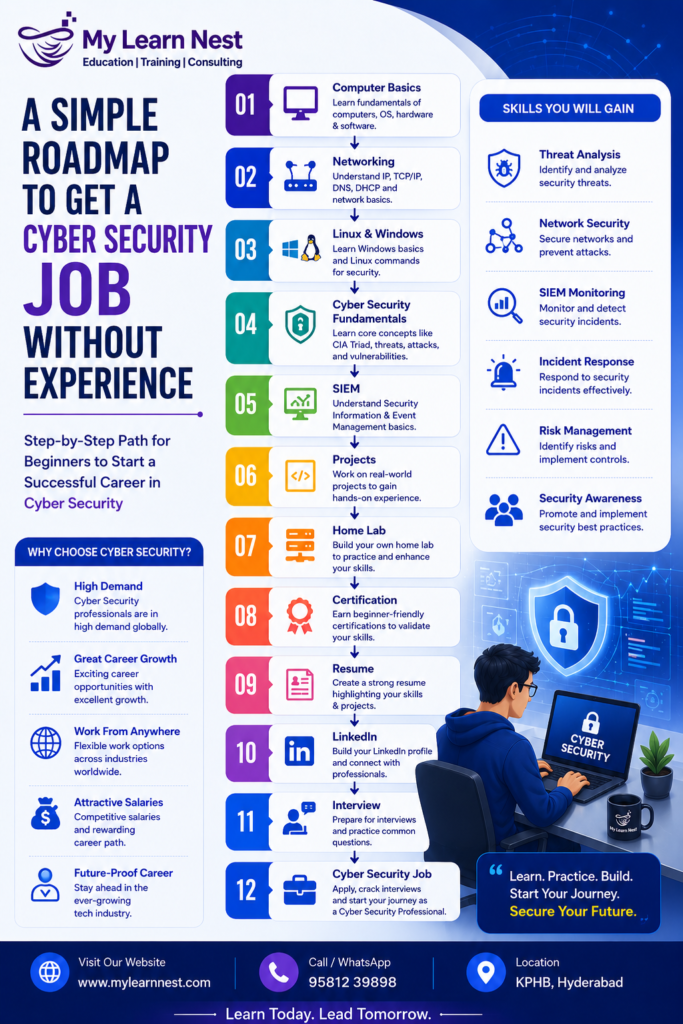
Networking → Linux & Windows → Security Fundamentals → SIEM/SOC → Vulnerability Management → Cloud Security → Specialization → Labs → Real-Time Projects → Certification → Interviews
The important goal is to develop the ability to understand a security problem and explain how it should be investigated and resolved.
Cyber Security Jobs for Freshers
Cybersecurity jobs for freshers exist, but candidates should understand that the entry-level market can be competitive. Current Hyderabad listings include roles such as Cybersecurity Analyst, L1 SOC Analyst, and Cybersecurity Trainee. Some listings specifically mention skills such as SIEM monitoring, security-event analysis, Nmap, Metasploit, Wireshark, Python or Java, and incident documentation.
This means freshers should not limit their preparation to ethical hacking alone.
SOC Analyst Jobs for Freshers
SOC is one of the more recognizable entry points into cybersecurity. A Level 1 SOC Analyst may monitor alerts, investigate suspicious activity, review logs, classify incidents, escalate serious events, and document findings.
Current Hyderabad listings include L1 SOC Analyst positions involving security-event and log analysis and incident investigation.
Cyber Security Analyst Jobs
A junior cybersecurity analyst may assist with security monitoring, vulnerability assessment, incident response, security documentation, and security controls.
An example of a current Hyderabad entry-level listing advertises a Cybersecurity Analyst role with an annual salary range of approximately ₹2.9 lakh to ₹5.8 lakh and mentions monitoring, detection, analysis, incident response, security tools, and reporting responsibilities.
Security Trainee Roles
Training-oriented positions can also provide an entry point. These roles may combine classroom learning with practical security tasks before assigning the employee to a project.
However, candidates should carefully check the employer, responsibilities, compensation, training conditions, and employment terms before accepting any offer.
Skills Freshers Should Show
A fresher does not need to know every cybersecurity tool. A better approach is to show strong fundamentals and practical knowledge.
For example, a candidate could demonstrate:
Networking + Linux + Security Fundamentals + SIEM + Wireshark + Nmap + Basic Python + Incident Analysis
This creates a more credible entry-level profile than listing dozens of tools without practical understanding.
How Freshers Can Build a Strong Resume
Describe projects based on the problem you solved.
Instead of writing only “Cybersecurity Project,” explain that you analyzed security logs, identified suspicious login activity, created detection rules, investigated an incident, or performed vulnerability assessment in an authorized lab.
Projects should be clearly labeled as academic, personal, lab, internship, or professional work.
Cyber Security Salary in Hyderabad
Cybersecurity compensation varies according to specialization, experience, company, certifications, technical skills, and job responsibility.
Recent AmbitionBox salary data for Cyber Security Analyst SOC roles shows Hyderabad/Secunderabad annual salaries ranging from approximately ₹3.9 lakh to ₹12.8 lakh for professionals with 1–7 years of experience. The data was updated in 2025 and is based on submitted salary information, so it should be considered an indicative range rather than a guaranteed market rate.
For comparison, AmbitionBox reports TCS Cyber Security Analyst salaries in Hyderabad/Secunderabad ranging from about ₹1.8 lakh to ₹9.8 lakh per year for experience ranging from fresher to eight years.
Cyber Security Salary for Freshers
Freshers usually start at the junior end of the market. Salary depends heavily on the role. A SOC trainee, cybersecurity intern, junior analyst, vulnerability-management trainee, and application-security trainee may have different compensation levels.
The current Hyderabad market includes entry-level cybersecurity positions, but salary expectations should be based on the actual job responsibility rather than the word “cybersecurity” in the job title.
Cyber Security Salary for Experienced Professionals
With experience, professionals can move into roles such as Senior SOC Analyst, Security Engineer, Incident Response Specialist, Cloud Security Engineer, Application Security Engineer, Penetration Tester, Security Architect, or Security Manager.
Specialized skills can have a significant impact on career growth. Cloud security, detection engineering, incident response, application security, identity security, and security architecture can provide pathways beyond entry-level SOC work.
How to Increase Your Cyber Security Salary
The biggest improvement usually comes from developing deeper technical capability.
For example, a professional who begins with SOC monitoring can progress into detection engineering, threat hunting, incident response, cloud security, or security engineering. The goal should therefore be continuous specialization rather than collecting certifications without practical experience.
Top Cyber Security Tools to Learn
Cybersecurity professionals use different tools depending on their specialization. A beginner does not need to master all of them.
Nmap
Nmap is widely used for network discovery and security auditing. It can help security professionals understand which systems and services are exposed in an authorized environment.
Learning Nmap is useful because it helps beginners connect networking concepts with security assessment. Current Hyderabad entry-level job listings also mention Nmap among desired cybersecurity tools.
Wireshark
Wireshark is a network protocol analyzer used to inspect network traffic. It is particularly useful for understanding packets, protocols, communication patterns, and suspicious network behavior.
For a beginner, learning how to filter traffic and understand common protocols is more important than memorizing every Wireshark feature.
Burp Suite
Burp Suite is widely used for web application security testing. PortSwigger describes Burp Scanner as a dynamic application security testing scanner that crawls applications and audits them for vulnerabilities.
Beginners should practice only against applications they are authorized to test, such as intentionally vulnerable training applications.
Splunk
Splunk Enterprise Security provides SIEM capabilities for collecting, analyzing, detecting, investigating, and responding to security events. It is widely relevant to SOC-oriented learning.
Learning how to search logs, investigate alerts, and build basic security detections is more valuable than simply knowing the product name.
Microsoft Sentinel
Microsoft Sentinel is another important SIEM platform. Microsoft describes it as a security platform with SIEM capabilities, analytics, threat detection, investigation, SOAR, UEBA, and threat-intelligence capabilities.
It is particularly useful for professionals targeting Microsoft security and Azure-related environments.
Kali Linux
Kali Linux is commonly used for authorized security testing and cybersecurity labs. It provides access to many security-testing utilities, but beginners should focus on understanding what each tool does rather than running tools without understanding the underlying security concept.
Which Tools Should a Fresher Learn First?
A practical beginner sequence is:
Wireshark → Nmap → Linux → Burp Suite → SIEM such as Splunk or Microsoft Sentinel
After learning these basics, select additional tools according to your career specialization.
Cyber Security Real-Time Projects
Real-time projects help learners understand how security professionals investigate and respond to problems.
SOC Security Monitoring Project
Create a small lab environment and generate legitimate security events such as failed logins and other controlled activities. Collect the logs into a SIEM, create basic detections, investigate alerts, and document the incident.
The project can demonstrate the SOC workflow:
Log Collection → Detection → Alert → Investigation → Classification → Response → Documentation
Vulnerability Assessment Project
Use an authorized lab environment containing intentionally vulnerable systems. Perform a vulnerability assessment, prioritize the findings, explain the potential security impact, and document remediation recommendations.
The focus should be on understanding risk and remediation rather than simply producing a list of vulnerabilities.
Web Application Security Project
Use a deliberately vulnerable web application to learn how security testers identify common application weaknesses.
The project can demonstrate how a tester documents an issue, explains its impact, provides evidence, and recommends a fix.Burp Suite is particularly relevant for this type of controlled application-security project.
Network Security Monitoring Project
Create a small authorized lab network and capture traffic using Wireshark. Study normal protocol behavior and identify unusual communication patterns.
This project is valuable because it connects networking fundamentals with security analysis.
Phishing Detection Project
Create a safe, simulated phishing-analysis project using sample messages or public training datasets.Analyze sender information, links, language, headers, and other indicators and create a process for classifying suspicious messages.
The purpose should be detection and awareness, not sending phishing messages to unsuspecting users.
Incident Response Project
Build a simulated incident in a lab and document the investigation.
For example, create a scenario involving suspicious authentication activity. Collect evidence, establish a timeline, identify affected accounts or systems, determine the likely cause, and document recommended remediation.
Cloud Security Project
Create a small cloud environment using only authorized resources. Configure identities, permissions, logging, and security controls, then evaluate whether users or services have excessive access.
This introduces cloud security without requiring an enterprise environment.
What Makes a Cyber Security Project Strong?
A good project should show the entire process:
Problem → Evidence → Investigation → Risk → Response → Remediation → Documentation
This is much more valuable than simply showing screenshots of cybersecurity tools.
Cyber Security vs Ethical Hacking
Cyber Security and Ethical Hacking are related, but they are not the same thing.
Cyber Security is the broader field covering prevention, detection, protection, monitoring, response, recovery, governance, and risk management.
Ethical Hacking is focused more specifically on authorized security testing to identify weaknesses before malicious attackers can exploit them.
What Does a Cyber Security Professional Do?
A cybersecurity professional may work with security monitoring, endpoint protection, access control, cloud security, vulnerability management, incident response, threat intelligence, security policies, or compliance.
The goal is to protect organizational systems and information.
What Does an Ethical Hacker Do?
An ethical hacker performs authorized security assessments to identify weaknesses in systems, applications, networks, or environments.
The goal is to find vulnerabilities so they can be fixed.
Cyber Security vs Ethical Hacking Career Choice
A person who enjoys investigation, monitoring, defensive security, and incident response may prefer a SOC or security engineering path.
Someone who enjoys application testing, vulnerability research, and security assessments may prefer ethical hacking or penetration testing. Neither path is universally better. Ethical hacking is one specialization within the wider cybersecurity ecosystem.
Cyber Security Interview Questions
Cybersecurity interviews usually test a combination of fundamentals, troubleshooting ability, tools, communication, and scenario-based thinking.
What Is Cyber Security?
Cybersecurity is the practice of protecting systems, networks, applications, devices, identities, and data from unauthorized access, disruption, misuse, or other security threats.
What Is the CIA Triad?
The CIA triad represents Confidentiality, Integrity, and Availability.
Confidentiality protects information from unauthorized access. Integrity ensures information is not improperly changed. Availability ensures authorized users can access systems and information when required.
What Is a SIEM?
A Security Information and Event Management platform collects and analyzes security events and logs to help security teams detect, investigate, and respond to threats.
Examples include Microsoft Sentinel and Splunk Enterprise Security.
What Is the Difference Between a Vulnerability and a Threat?
A vulnerability is a weakness that could be exploited. A threat is a potential source or event capable of causing harm by exploiting vulnerabilities.
What Is Incident Response?
Incident response is the structured process used to detect, investigate, contain, eradicate, and recover from a security incident, followed by appropriate documentation and lessons learned.
What Would You Do When a SIEM Generates a High-Severity Alert?
First validate the alert and understand what triggered it. Then investigate the relevant user, device, IP address, timestamp, process, authentication activity, and related events.
Determine whether the alert is a false positive or a genuine security incident, then follow the organization’s escalation and response procedures.
How Would You Investigate Multiple Failed Login Attempts?
Look at the source address, affected account, timing, geographic or network context, authentication method, successful logins following the failures, and related events.
The objective is to determine whether the activity represents a normal user error, an automated process problem, or potentially malicious behavior.
What Is the Difference Between IDS and IPS?
An IDS primarily detects and alerts on suspicious activity. An IPS can actively block or prevent traffic according to configured security rules.
What Is Vulnerability Management?
Vulnerability management is the ongoing process of identifying, assessing, prioritizing, remediating, and verifying vulnerabilities across an organization’s environment.
What Is the Purpose of Network Segmentation?
Network segmentation separates systems or workloads into different security zones. This can reduce the potential impact of a compromise by limiting unnecessary communication and access.
What Is the Difference Between Authentication and Authorization?
Authentication determines who a user or system is. Authorization determines what that authenticated identity is allowed to access or perform.
How Would You Handle a Suspected Malware Incident?
Follow the organization’s incident-response process. Establish the affected device or account, collect relevant evidence, isolate systems when appropriate, investigate the source and scope, remove the threat, restore normal operations, and document the incident.
How Do You Approach a Security Incident With Limited Information?
Start with the available evidence and build a timeline. Identify what is known, what is unknown, which systems or identities may be affected, and what additional evidence is required.
A structured investigation is more effective than making assumptions.
Why Do You Want to Work in Cyber Security?
A strong answer should connect your interest with actual cybersecurity activities. Explain whether you enjoy security monitoring, investigation, application security, cloud security, threat analysis, or another specialization, and support that answer with relevant projects or practical learning.
Why Learn Cyber Security With MyLearnNest?
Cybersecurity is a practical field, so training should go beyond definitions and presentations. Learners should understand networking, operating systems, security fundamentals, SIEM, vulnerability management, incident response, cloud security, and defensive security practices.
MyLearnNest can structure cybersecurity training around Cyber Security Fundamentals, Ethical Hacking, Network Security, Web Application Security, Cloud Security, SOC, SIEM, Incident Response, real-time projects, interview preparation, and career guidance.
The strongest learning approach combines concepts with authorized hands-on labs. A learner should be able to explain what happened, identify the evidence, analyze the risk, recommend remediation, and document the result.
Cyber Security Career Opportunities in 2026
Cybersecurity offers several career directions. Beginners may start as SOC Analysts, Security Analysts, Security Operations Trainees, Vulnerability Management Analysts, or Junior Security Engineers. With experience, they can specialize in Cloud Security, Application Security, Threat Hunting, Incident Response, Penetration Testing, Detection Engineering, Digital Forensics, Identity Security, or Security Architecture.
Current Hyderabad job listings demonstrate that entry-level opportunities include SOC and cybersecurity analyst positions, although requirements vary considerably between employers.
The cybersecurity field is also increasingly connected with AI. Modern security platforms such as Microsoft Sentinel and Splunk Enterprise Security are incorporating AI-assisted analysis, automation, detection, and investigation capabilities.
Final Thoughts on Cyber Security Careers in 2026
Cybersecurity can be a strong career choice for learners who enjoy technology, investigation, problem-solving, and continuous learning.
The best starting point is not to learn every hacking tool. Build a foundation in networking, Linux, Windows, security fundamentals, SIEM, vulnerability management, and cloud security. Then choose a specialization and build practical projects in an authorized lab environment.

