Generative AI Roadmap 2026
Generative AI has moved from being mainly a research topic to becoming an important part of software products, enterprise applications, customer support systems, coding assistants, search platforms, content tools, and business automation. In 2026, learning Generative AI is increasingly about building useful AI applications rather than simply learning how to use a chatbot.
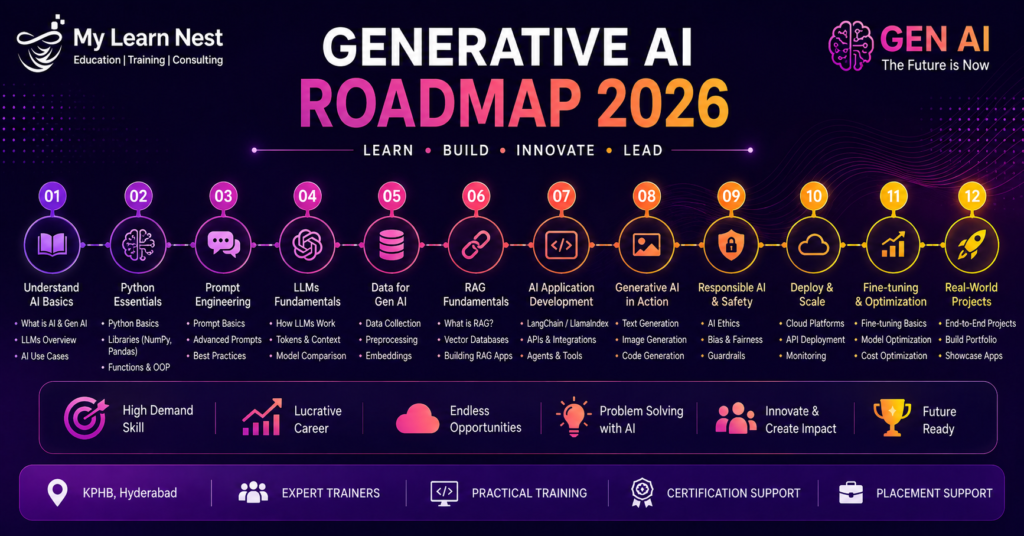
A practical Generative AI roadmap 2026 should begin with programming and AI fundamentals and gradually move toward Large Language Models (LLMs), prompt engineering, embeddings, RAG, vector databases, AI APIs, evaluation, deployment, and agentic AI. The first step is to learn Python. A Gen AI Engineer should be comfortable with functions, classes, APIs, JSON, file handling, error handling, and working with libraries. Python is especially useful because many modern AI frameworks and model APIs provide Python support.
Next, learn the basics of machine learning and deep learning. You do not necessarily need the mathematical depth of an ML researcher, but you should understand concepts such as training, inference, embeddings, tokens, neural networks, transformers, attention, and model evaluation. After that, learn LLMs and prompt engineering. Understand how prompts influence model output, how context windows work, how system and user instructions differ, and how structured outputs can be generated.
The next stage is RAG, embeddings, and vector databases. These technologies allow AI applications to retrieve relevant information from external sources and provide it to an LLM during generation. RAG is particularly useful when an application needs to work with private or frequently changing information.
Once the fundamentals are clear, move to AI application development. Learn how to connect LLM APIs with Python applications, databases, web applications, document processing systems, and business workflows.
Finally, explore AI agents and agentic AI. Modern Gen AI applications are increasingly moving beyond one-question/one-answer interactions toward systems that can use tools, retrieve information, make decisions, and execute multi-step tasks.
A practical roadmap is:
Python → AI/ML Fundamentals → LLMs → Prompt Engineering → Embeddings → RAG → Vector Databases → AI APIs → Evaluation → Deployment → Agents → Real-Time Projects
The important point is not to learn every Gen AI framework available. Learn the fundamentals first and then choose tools according to the projects you want to build.
How to Become a Generative AI Engineer
A Generative AI Engineer develops applications that use generative models to solve practical problems. The role can involve LLM APIs, RAG pipelines, prompt engineering, model evaluation, Python development, vector databases, cloud services, AI agents, and application deployment.
You do not need to train a foundation model from scratch to become a Gen AI Engineer. In most application-development roles, the focus is on taking existing foundation models and building reliable products around them.
Learn Python and Software Development
Good programming fundamentals are essential. Learn how to build APIs, work with databases, handle errors, manage dependencies, write reusable code, and use Git.
A Gen AI application is still a software application. The LLM is one component of the overall system.
Understand LLM Fundamentals
Learn how transformers work at a conceptual level, what tokens are, how embeddings represent information, and how inference differs from training.
You should also understand common LLM limitations such as hallucinations, context limitations, inconsistent outputs, and sensitivity to prompts.
Learn RAG and Vector Databases
RAG is one of the most useful skills for application-focused Gen AI professionals. Instead of expecting the model to contain all required information, a RAG system retrieves relevant information from an external knowledge source and provides it to the model as context.
This approach is commonly used for document assistants, internal knowledge systems, customer-support applications, policy assistants, and enterprise search.
Learn Evaluation and AI Application Reliability
A prototype can produce an impressive answer and still fail in production. Learn how to evaluate retrieval quality, response quality, hallucination rates, latency, cost, and application reliability.
This is becoming increasingly important as organizations move Gen AI systems from demonstrations into production environments. Google Cloud’s current guidance also emphasizes the need to select model-adaptation techniques based on the actual application requirements rather than automatically choosing fine-tuning.
Learn Cloud and Deployment Basics
Understand APIs, containers, authentication, databases, logging, monitoring, and cloud deployment.
Depending on your target organization, you may work with Azure, AWS, Google Cloud, or multiple platforms.
Build a Portfolio
A strong Gen AI portfolio should demonstrate practical problem-solving. Build applications such as a document question-answering system, customer-support assistant, resume analyzer, SQL assistant, or enterprise knowledge chatbot.
The project explanation is as important as the project itself. Be able to describe the architecture, model choice, prompt strategy, retrieval process, evaluation method, and major challenges.
Generative AI Salary in India
Generative AI salaries in India vary widely because the market includes several different roles under the broad AI and Gen AI category. A candidate working primarily as an AI application developer may have a different compensation level from an ML Engineer, AI Research Engineer, or senior Gen AI specialist.
A July 2026 EICTA/IIT Kanpur knowledge-hub report describes AI Engineer compensation ranging from roughly ₹6–8 LPA for freshers at some IT services firms to ₹80 LPA or more for senior specialists at top product companies and GCCs. The same source cites an approximate average of ₹11 LPA while stressing that averages hide substantial differences between experience levels and employers.
These figures should be treated as broad AI-market indicators rather than a guaranteed Generative AI Engineer salary in India.
Generative AI Salary for Freshers
Freshers entering Gen AI should not assume that completing a short Gen AI course automatically leads to a high-paying AI Engineer position.
Companies often look for a combination of Python, software development, machine learning fundamentals, LLM knowledge, problem-solving, and project experience. Current Indian hiring discussions also indicate that foundational skills such as Python, machine learning, SQL, and data analysis remain important alongside Gen AI skills.
Generative AI Salary for Experienced Professionals
Experienced professionals with strong software engineering or ML backgrounds can move into roles such as Gen AI Engineer, AI Engineer, LLM Application Developer, ML Engineer, AI Solutions Engineer, or AI Architect.
Specialization can influence compensation. Skills such as RAG architecture, agentic systems, LLM evaluation, model optimization, cloud AI platforms, and production deployment can be particularly valuable.
What Increases a Gen AI Professional’s Salary?
The strongest profiles usually combine AI knowledge with engineering ability. Building a RAG chatbot is useful, but understanding how to secure it, evaluate it, monitor it, control costs, and deploy it reliably creates much stronger professional value.
Generative AI Real-Time Projects
Real-time projects are one of the best ways to demonstrate Gen AI skills because employers want to understand whether a candidate can build applications rather than only explain AI concepts.
RAG-Based Document Assistant
Create a system that allows users to upload PDF or business documents and ask questions about them.
The application can extract documents, split them into chunks, generate embeddings, store them in a vector database, retrieve relevant content, and send that context to an LLM.
Customer Support AI Assistant
Build a chatbot that answers customer questions using a company knowledge base.
Instead of asking the model to answer entirely from its general knowledge, retrieve relevant product information, policies, FAQs, or support documentation before generating the response.
This project can also introduce conversation history, escalation to human agents, feedback collection, and response evaluation.
Resume and Job Description Analyzer
Build an application that compares a candidate’s resume with a job description and identifies matching skills, missing skills, and relevant experience.
The project can demonstrate document processing, structured output generation, prompt engineering, and LLM API integration.
AI-Powered SQL Assistant
Create an application that allows users to ask questions in natural language and converts them into SQL queries.
A production-oriented version should include schema retrieval, query validation, permissions, error handling, and protections against unsafe queries.
AI Research Assistant
Create an assistant that retrieves information from a controlled knowledge base and generates summaries with references to the source material.
This project demonstrates retrieval, grounding, summarization, and answer evaluation.
Agentic AI Project
An advanced project can use an AI agent that performs a sequence of actions, such as retrieving information, calling an API, checking a database, and generating a final response.
The important lesson is that an agent should be used when a multi-step workflow or tool use is genuinely required. Not every chatbot needs to become an autonomous agent.
Gen AI vs Machine Learning vs Agentic AI
Generative AI, Machine Learning, and Agentic AI are related but represent different concepts.
Machine Learning is the broader field of creating systems that learn patterns from data to make predictions or decisions. Examples include fraud detection, demand forecasting, recommendation systems, and classification.
Generative AI is a category of AI systems designed to generate new content such as text, code, images, audio, or other outputs. LLMs are one of the most visible forms of generative AI.
Agentic AI generally refers to systems that can pursue a goal through multiple steps, use tools, retrieve information, and take actions with varying degrees of autonomy.A simple example makes the difference clearer.
A machine-learning model might predict whether a transaction is fraudulent.A generative AI application might explain the transaction and answer questions about the associated account information.An agentic system might investigate the transaction, call several tools, gather additional information, prepare an analysis, and initiate an approved workflow.
Agentic AI therefore does not replace Gen AI. It can use generative models as part of a larger action-oriented system.
RAG Explained for Beginners
RAG stands for Retrieval-Augmented Generation. It combines information retrieval with an LLM so that the model can generate an answer using relevant external information.
Imagine a company has thousands of internal documents. A normal LLM may not have access to those private documents. A RAG application can search the company’s knowledge base, retrieve relevant passages, and provide those passages to the LLM as context.
The basic process is:
User Question → Search/Retrieval → Relevant Context → LLM → Final Answer
Google Cloud describes RAG as combining traditional information retrieval with the generative capabilities of LLMs, allowing applications to ground responses in external knowledge.
Why Is RAG Useful?
RAG is useful when information changes frequently or when an organization needs an LLM to work with proprietary information.
Examples include company policies, product documentation, technical manuals, customer-support knowledge bases, educational materials, and internal business documents.
What Are Embeddings?
Embeddings convert text or other information into numerical representations that capture semantic relationships.
A user’s question can be converted into an embedding and compared with stored document embeddings to find semantically relevant content.
What Is a Vector Database?
A vector database or vector-search system stores and retrieves embeddings efficiently. It forms an important component of many RAG architectures.
The quality of a RAG application depends heavily on retrieval. Even a powerful LLM can provide a poor answer when the retrieved information is irrelevant or incomplete.
Common RAG Challenges
RAG is not a guaranteed solution to hallucinations. Poor chunking, weak retrieval, outdated documents, incorrect metadata, incomplete context, and poor prompts can still produce incorrect answers.
Therefore, a production RAG system needs evaluation and continuous improvement.
LLM Fine-Tuning vs RAG
Fine-tuning and RAG solve different problems, and choosing between them depends on what the application actually needs.
Fine-tuning changes the model by training it further on task-specific data. It can be useful when an organization needs consistent behavior, specialized terminology, a particular output style, or improved performance on a defined task.
RAG does not fundamentally retrain the model. Instead, it retrieves external information and places relevant context into the model’s input.
A simple way to remember the difference is:
RAG gives the model additional information. Fine-tuning changes how the model behaves.
When Should You Choose RAG?
Consider RAG when the application needs access to frequently changing information, private documents, company knowledge, databases, or external sources.
For example, an employee chatbot answering questions about the latest company policies is usually a strong RAG use case because the knowledge base can be updated without retraining the underlying model.
When Should You Consider Fine-Tuning?
Fine-tuning can be useful when the challenge is model behavior rather than simply providing additional information.
For example, a company may want an LLM to consistently produce a specific structured output or follow a specialized writing style. Google Cloud’s guidance identifies task-specific behavior, specialized language, style, and particular accuracy requirements among potential reasons to consider fine-tuning.
Can RAG and Fine-Tuning Be Used Together?
Yes. They are not mutually exclusive.
A production application may use a fine-tuned model for specialized behavior while also using RAG to provide current or private information. The correct choice should be based on the business requirement, available data, cost, latency, maintenance requirements, and expected model behavior.
Generative AI Interview Questions
Gen AI interviews increasingly combine fundamental AI concepts with practical application-development scenarios.
What Is Generative AI?
Generative AI refers to AI systems capable of producing new content such as text, code, images, audio, or other forms of data based on learned patterns.
What Is an LLM?
A Large Language Model is a model trained on large amounts of language data to understand and generate text. Modern LLM applications can also process other modalities depending on the model.
What Is Prompt Engineering?
Prompt engineering is the process of designing instructions and context to guide a model toward the desired output.
Good prompting involves clear objectives, relevant context, constraints, examples when needed, and appropriate output formats.
What Is RAG?
RAG combines information retrieval with LLM generation. Relevant external information is retrieved and supplied to the model so that the response can be grounded in that information.
What Is the Difference Between RAG and Fine-Tuning?
RAG supplies external context at inference time, while fine-tuning further trains a pre-trained model on task-specific data.
What Causes Hallucinations in LLMs?
An LLM generates probable outputs rather than directly verifying every statement against reality. Hallucinations can therefore occur because of missing context, ambiguous prompts, weak retrieval, incorrect source information, or model limitations.
How Can You Reduce Hallucinations?
Use reliable source data, strong retrieval, clear prompts, constrained outputs, validation, citations where appropriate, and evaluation datasets.
For a RAG application, improving retrieval quality is especially important because irrelevant retrieved information can result in poor or misleading answers.
What Is a Vector Database?
It is a system designed to store and retrieve vector representations such as embeddings, often using similarity search to find semantically related information.
What Is an AI Agent?
An AI agent is an application that can use an LLM together with tools, memory, retrieval, and workflows to accomplish a multi-step objective.
How Would You Design a RAG Application?
A good interview answer should cover document ingestion, chunking, embedding generation, vector storage, retrieval, prompt construction, LLM generation, evaluation, monitoring, and security.
How Would You Reduce the Cost of an LLM Application?
Look at model selection, prompt size, unnecessary context, caching, request frequency, batching, retrieval quality, and task complexity. A smaller model may be sufficient for some tasks, while expensive models should be reserved for cases where their additional capability is actually required.
How Would You Evaluate a Gen AI Application?
Evaluate more than whether the answer “looks good.” Measure factors such as factual correctness, relevance, retrieval quality, response consistency, latency, cost, and task success.
What Project Have You Built Using Generative AI?
Use a structured explanation:
Problem → Users → Architecture → Model → Data → RAG/Prompt Strategy → Application → Evaluation → Challenges → Result
This gives an interviewer evidence that you understand the complete application rather than just individual AI terms.
Why Learn Generative AI With MyLearnNest?
Generative AI is a rapidly changing technology, so effective learning should focus on durable concepts rather than only one AI tool or framework.
MyLearnNest can structure Gen AI training around Python, LLM fundamentals, prompt engineering, RAG, vector databases, AI APIs, real-time projects, agentic AI, model evaluation, and interview preparation.
The goal should be to help learners move from simply using AI tools to actually building AI applications. A learner should be able to explain how an application works, why a particular model was selected, how information is retrieved, how hallucinations are reduced, how performance is evaluated, and how the system can be deployed.
Final Thoughts on Generative AI Careers in 2026
Generative AI is creating opportunities across software development, data, automation, customer experience, enterprise applications, and AI engineering. At the same time, the market should not be approached as though learning a few prompts alone is enough to become an AI Engineer.
The strongest foundation is Python + AI/ML fundamentals + LLMs + RAG + software engineering + real-time projects. From there, professionals can add agentic AI, fine-tuning, evaluation, cloud deployment, and domain specialization.
Current 2026 hiring discussions suggest that Gen AI is valuable, but foundational technical skills such as Python, machine learning, SQL, and data analysis remain important in the broader AI job market.

