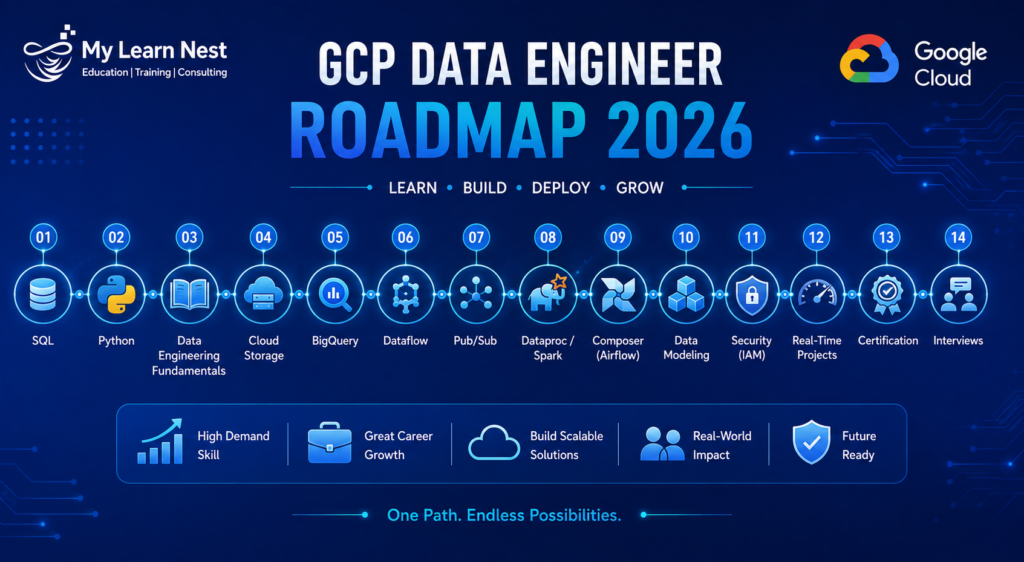
GCP Data Engineer Roadmap 2026
Google Cloud Platform (GCP) provides a broad set of services for building data pipelines, data warehouses, data lakes, analytics platforms, and machine-learning solutions. A GCP Data Engineer in 2026 typically works with technologies such as BigQuery, Cloud Storage, Dataflow, Pub/Sub, Dataproc, Cloud Composer, Dataform, Python, SQL, and sometimes Apache Spark.
Google’s current Professional Data Engineer role definition focuses on designing data-processing systems, ingesting and processing data, storing data, preparing data for analysis, and maintaining and automating data workloads. (Google Cloud)
Start With SQL
SQL is one of the most important skills for a GCP Data Engineer. Learn joins, subqueries, CTEs, window functions, aggregations, views, stored procedures, and query optimization.
BigQuery is heavily SQL-oriented, so strong SQL knowledge makes it easier to work with data transformation and analytical workloads. BigQuery is a fully managed data platform with separate storage and compute layers and support for large-scale analytical workloads. (Google Cloud)
Learn Python
Python is useful for automation, data processing, API integration, testing, and building data pipelines. Start with functions, collections, file handling, exception handling, APIs, and basic object-oriented programming.
For larger processing workloads, learn PySpark after becoming comfortable with Python.
Understand Data Engineering Fundamentals
Before learning individual GCP services, understand ETL and ELT, batch and streaming processing, data lakes, data warehouses, data modeling, partitioning, data quality, orchestration, and incremental loading.
These concepts transfer across GCP, Azure, AWS, Snowflake, and other modern data platforms.
Learn Google Cloud Storage
Cloud Storage is often used as a landing or staging layer for files and data pipelines.Learn buckets, objects, storage classes, IAM, lifecycle management, file formats, and basic data-lake organization.
Learn BigQuery
BigQuery should be a major focus for anyone targeting GCP data engineering roles. Learn tables, views, datasets, partitions, clustering, external data, loading, scheduled queries, and cost-aware SQL.
BigQuery now supports structured and unstructured data, streaming ingestion, governance, data lineage, and analytics capabilities while separating storage and compute. (Google Cloud)
Learn Dataflow
Dataflow is Google’s fully managed service for batch and streaming data processing. It uses Apache Beam and can support ETL, real-time analytics, and other large-scale processing workloads. (Google Cloud)
Learn when Dataflow is appropriate, how pipelines work, and how it can process events from Pub/Sub and write to BigQuery or other destinations.
Learn Pub/Sub
Pub/Sub is used for asynchronous event ingestion and messaging. It is commonly used as part of streaming architectures where events are produced by applications and consumed by processing services.
Google’s current documentation shows Pub/Sub being used to stream events into BigQuery, data lakes, and operational databases. (Google Cloud)
Learn Dataproc and Spark
Dataproc is useful for teams working with Apache Spark and related big-data processing workloads.
Learn Spark fundamentals, PySpark transformations, partitions, joins, caching, and performance concepts before focusing heavily on Dataproc.
Learn Cloud Composer and Orchestration
Cloud Composer is Google’s managed Airflow service. Data engineers can use it to schedule and orchestrate multi-step workflows.
You should understand DAGs, tasks, dependencies, retries, scheduling, and monitoring.
Learn Data Modeling and Data Quality
Understand fact and dimension tables, star schemas, slowly changing dimensions, partitioning, data validation, and reconciliation.
A strong GCP Data Engineer should be able to build reliable datasets, not simply move files between services.
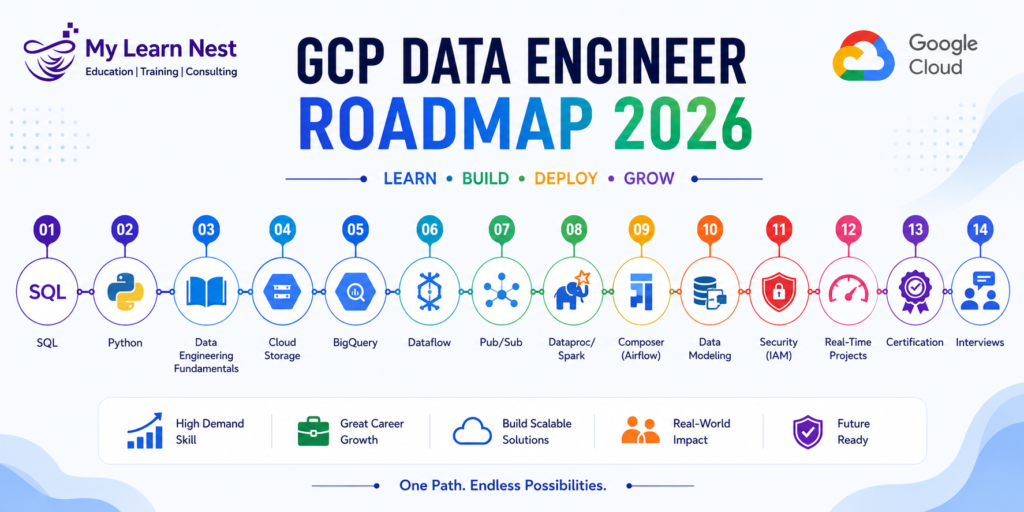
GCP Data Engineer Roadmap in One Line
How to Become a GCP Data Engineer
Becoming a GCP Data Engineer requires a combination of programming, data-engineering concepts, cloud technology, and project experience.
Learn Data Engineering Before Learning Too Many GCP Services
Start with SQL, Python, data warehousing, ETL/ELT, and data modeling.Once these fundamentals are strong, map them to GCP services.
For example, understand orchestration first and then learn Composer. Understand distributed processing first and then learn Dataflow or Dataproc.
Build a BigQuery Foundation
BigQuery should be one of the first GCP data services you learn because it connects closely with SQL, analytics, data warehousing, and reporting.
Practice creating datasets and tables, loading data, writing analytical queries, partitioning large tables, and controlling query costs.
Learn Batch and Streaming
A modern data engineer should understand both batch and streaming architectures.
For batch processing, you may work with files or periodic database extracts. For streaming, you may receive continuous events through Pub/Sub and process them with Dataflow before writing them into BigQuery. Google provides an official example of a Pub/Sub-to-BigQuery streaming pipeline using Dataflow. (Google Cloud)
Learn Cloud Security
Understand IAM, service accounts, roles, encryption concepts, secret management, and access controls.
Data engineering involves business and sometimes sensitive information, so secure data access should be part of the design from the beginning.
Build a Portfolio
Build two or three complete projects rather than many small demonstrations.
For each project, document the architecture, source systems, transformations, data model, testing, monitoring, and business outcome.
Learn to Troubleshoot
Interviewers may ask what you would do if a BigQuery query became expensive, a Dataflow pipeline failed, a Pub/Sub consumer fell behind, or a Composer DAG stopped running.
Your ability to investigate these problems can matter more than memorizing service definitions.
Consider Certification
Google Cloud currently offers the Professional Data Engineer certification. The standard exam has no formal prerequisites, although Google recommends three or more years of industry experience, including at least one year designing and managing data solutions on Google Cloud. (Google Cloud)
For newer learners, Google also offers Associate Data Practitioner, for which Google recommends at least six months of experience working with data on Google Cloud. (Google Cloud)
GCP Data Engineer Salary in Hyderabad
GCP Data Engineer compensation in Hyderabad varies according to experience, company, technical specialization, project responsibilities, and the combination of GCP services a professional knows.
Current Glassdoor data for Hyderabad reports an average GCP Data Engineer salary of approximately ₹8.72 lakh per year, with a typical reported range of about ₹5.48 lakh to ₹14.07 lakh per year. The same source reports that some submitted salaries reach about ₹25.73 lakh at the 90th percentile. The dataset contains 29 submitted salaries and was updated in April 2026. (Glassdoor)
These figures should be treated as indicative market data rather than guaranteed salaries.
GCP Data Engineer Salary for Freshers
Freshers may begin as junior data engineers, ETL developers, cloud-data trainees, or associate engineers. The initial salary depends heavily on the employer and the candidate’s technical foundation.
A fresher with SQL + Python + BigQuery + Dataflow + basic GCP + project experience can build a more relevant profile than someone who knows cloud terminology without practical work.
GCP Data Engineer Salary for Experienced Professionals
With experience, professionals can move toward Senior Data Engineer, Data Engineering Lead, Cloud Data Architect, or specialized platform roles.
Current Hyderabad market discussions and job postings commonly mention combinations such as Python, SQL, BigQuery, Dataflow, Spark/PySpark, and Cloud Composer. (Reddit)
What Influences GCP Data Engineer Salary?
Salary is influenced by experience, GCP expertise, SQL, Python, Spark, data modeling,cloud architecture, streaming, data quality, and production troubleshooting.
Professionals who can design complete data platforms usually have broader opportunities than those limited to basic BigQuery queries.
GCP Real-Time Data Engineering Projects
Real-time projects should demonstrate how GCP services work together to solve practical data problems.
Retail Sales Data Pipeline
Create a retail pipeline where sales files arrive daily in Cloud Storage.
Use a processing layer to clean and transform the data and load curated tables into BigQuery. The final dataset can support dashboards for revenue, product performance, regional sales, and customer trends.
E-Commerce Streaming Project
Build a system that receives customer events such as product views, cart actions, and purchases.
Pub/Sub can ingest the events, Dataflow can transform them, and BigQuery can store the processed data for near-real-time analysis. Google’s current Dataflow documentation explicitly supports streaming data from Pub/Sub into BigQuery. (Google Cloud)
Banking Transaction Analytics
Use synthetic transaction data to build a pipeline for account activity and transaction analytics.
The project can focus on data quality, transformations, partitioned BigQuery tables, and analytical reporting rather than real banking data.
IoT Data Pipeline
Create a simulated sensor-data stream containing device IDs, timestamps, temperature, location, and operational status.
Pub/Sub can receive events, Dataflow can process them, and BigQuery can store the analytical output.This project is useful for learning event-driven architectures and streaming transformations.
Data Migration to BigQuery
Take a sample legacy database or collection of files and design a migration into BigQuery.
The project should include source analysis, schema mapping, data cleansing, loading, validation, and reconciliation.
GCP Data Engineering Project Architecture
A simple batch architecture can be:
Source Files → Cloud Storage → Data Processing → BigQuery → Dashboard
A streaming architecture can be:
Applications/Sensors → Pub/Sub → Dataflow → BigQuery → Real-Time Analytics
The appropriate design depends on latency, data volume, transformation complexity, and operational requirements.
BigQuery vs Snowflake
BigQuery and Snowflake are both widely used cloud data platforms, but they have different platform ecosystems and architecture approaches. BigQuery is Google’s fully managed, serverless analytical data platform. Google describes its architecture as separating the storage and compute layers so they can scale independently. (Google Cloud)
Snowflake uses a different cloud-data architecture with centralized storage and independent massively parallel compute clusters. Snowflake describes its architecture as combining aspects of shared-disk and shared-nothing approaches. (Snowflake)
BigQuery vs Snowflake: Ecosystem
BigQuery is especially attractive for organizations already using Google Cloud services such as Cloud Storage, Dataflow, Pub/Sub, Vertex AI, and Google analytics tools.
Snowflake operates across major cloud environments and can be a strong choice for organizations looking for a cloud-independent data platform strategy.
BigQuery vs Snowflake: Compute Model
BigQuery is serverless from the user’s perspective, which reduces the need to manage traditional compute infrastructure.
Snowflake uses virtual warehouses that provide independent compute resources for workloads.Both approaches can scale, but the user experience and operational model are different.
BigQuery vs Snowflake: SQL and Analytics
Both platforms provide strong SQL analytics capabilities.
The better choice depends on data architecture, workload patterns, existing cloud investments, governance requirements, integrations, and team expertise.
BigQuery vs Snowflake Comparison
Area | BigQuery | Snowflake |
Provider | Google Cloud | Snowflake |
Architecture | Serverless, separated storage/compute | Independent compute warehouses over shared data |
Primary strength | GCP analytics and large-scale SQL | Cloud data platform and multi-cloud deployments |
Streaming | Strong integration with Pub/Sub/Dataflow | Supports streaming and ingestion integrations |
SQL | Strong | Strong |
Administration | Highly managed | Highly managed |
Best ecosystem fit | Google Cloud | Multi-cloud enterprise data environments |
There is no universally better platform. The right decision depends on the organization’s architecture and existing technology ecosystem.
GCP vs Azure for Data Engineers
GCP and Azure both provide mature cloud platforms for data engineering. The decision usually depends on the organization’s existing ecosystem rather than one platform being objectively better.
GCP Data Engineering Stack
A typical GCP data stack may include:
Cloud Storage + BigQuery + Dataflow + Pub/Sub + Dataproc + Composer
Google’s current data-engineering documentation and certification material cover data processing, storage, pipelines, analytics, and workload management across these kinds of services. (Google Cloud)
Azure Data Engineering Stack
A typical Azure environment can include Azure Data Factory, Azure Data Lake Storage, Azure Databricks, Synapse Analytics, and other Microsoft data services.
Microsoft’s current documentation shows Data Factory and Synapse pipelines working with transformation engines such as Azure Databricks. (Microsoft Learn)
GCP vs Azure: Ecosystem Choice
GCP can be a natural choice for organizations already invested in Google Cloud and BigQuery.
Azure may be particularly attractive to organizations that already use Microsoft technologies such as Microsoft Entra ID, Power BI, Microsoft Fabric, Azure services, or enterprise Microsoft applications.
GCP vs Azure: Data Warehouse
GCP is strongly associated with BigQuery.
Azure provides several analytical options, including Synapse Analytics and Microsoft’s evolving Fabric ecosystem.
GCP vs Azure: Data Processing
GCP provides Dataflow for managed batch and streaming processing and Dataproc for Spark-based workloads. (Google Cloud)
Azure commonly uses Data Factory for orchestration and data movement and can integrate with Databricks for transformation workloads. (Microsoft Learn)
For a data engineer, learning one cloud deeply and understanding the concepts behind the other is often more valuable than trying to master both simultaneously.
GCP Data Engineer Interview Questions
GCP Data Engineer interviews usually test SQL, data engineering concepts, GCP services, cloud architecture, troubleshooting, and project experience.
What Is BigQuery?
BigQuery is Google’s fully managed, serverless data platform for large-scale analytics. It separates storage and compute and supports SQL and other analytical workloads. (Google Cloud)
What Is Dataflow?
Dataflow is a fully managed service for batch and streaming data processing based on Apache Beam. It can transform, enrich, and move large volumes of data. (Google Cloud)
What Is Pub/Sub?
Pub/Sub is Google’s messaging service used for asynchronous event ingestion and delivery. It is commonly used in streaming data architectures. (Google Cloud)
What Is the Difference Between BigQuery and Cloud Storage?
Cloud Storage is object storage designed for files and objects, while BigQuery is an analytical data platform designed for querying and analyzing structured and semi-structured data.
How Would You Optimize a BigQuery Query?
Start by examining how much data the query scans. Use appropriate partitioning and clustering, avoid unnecessary columns, filter effectively, simplify joins where possible, and review the query execution details.
What Is Partitioning in BigQuery?
Partitioning divides table data into logical partitions, commonly based on a date or timestamp column. It can reduce the amount of data scanned when queries filter on the partitioning field.
What Is the Difference Between Batch and Streaming Processing?
Batch processing handles accumulated data periodically, while streaming processes data continuously or with low latency as events arrive.
When Would You Use Dataflow?
Use Dataflow when you need managed batch or streaming data processing and transformations, particularly when Apache Beam’s processing model is a good fit. (Google Cloud)
When Would You Use Dataproc?
Dataproc is useful when a workload is based on Hadoop/Spark ecosystems or when existing Spark workloads need to run on Google Cloud.
How Would You Handle a Failed Data Pipeline?
Identify the failed component, inspect logs, check source availability and permissions, validate input data and schema, determine whether the error is transient or structural, correct the root cause, and rerun or recover the affected portion safely.
How Would You Design a Real-Time Data Pipeline on GCP?
A common starting architecture could be:
Event Source → Pub/Sub → Dataflow → BigQuery
Pub/Sub handles event ingestion, Dataflow processes the data, and BigQuery supports analytical storage and querying. Google provides this pattern directly in its Dataflow documentation. (Google Cloud)
How Would You Control BigQuery Costs?
Focus on query efficiency, partitioning, clustering where useful, avoiding unnecessary full-table scans, selecting only required columns, and monitoring workloads.
How Would You Explain Your GCP Data Engineering Project?
Use a structured approach:
Business Problem → Source Data → GCP Services → Pipeline Architecture → Transformations → Data Model → Testing → Monitoring → Challenge → Solution → Business Result
This is much stronger than listing services without explaining what you personally did.
Why Learn GCP Data Engineering With MyLearnNest?
GCP Data Engineering is most effective when learners understand both cloud services and core data-engineering concepts.
MyLearnNest can structure GCP Data Engineer training around SQL, Python, BigQuery, Cloud Storage, Dataflow, Pub/Sub, Dataproc, Cloud Composer, data modeling, real-time projects, interview scenarios, and certification preparation.
The focus should be on end-to-end development rather than isolated service demonstrations. Learners should understand how data enters the platform, how it is processed, where it is stored, how it is validated, and how the final information is made available for analytics.
GCP Data Engineer Career Opportunities in 2026
GCP Data Engineers can work in roles such as Data Engineer, Cloud Data Engineer, BigQuery Developer, Data Platform Engineer, Senior Data Engineer, Analytics Engineer, and Cloud Data Architect.
Current Hyderabad market data and job discussions show demand for combinations such as Python, SQL, BigQuery, Dataflow, Spark/PySpark, and Composer. (Glassdoor)
Google Cloud also continues to update its certification ecosystem and exam content as its data and analytics services evolve. (Google Cloud)
Final Thoughts on GCP Data Engineering in 2026
GCP Data Engineering is a strong career path for professionals interested in SQL, Python, cloud platforms, data pipelines, analytics, and scalable data processing.
The most practical learning sequence is:
SQL → Python → Data Engineering Fundamentals → BigQuery → Cloud Storage → Dataflow → Pub/Sub → Dataproc → Composer → Data Modeling → Real-Time Projects → Certification → Interview Preparation
For MyLearnNest, strong SEO keywords around this topic include GCP Data Engineer, GCP Data Engineer roadmap 2026, GCP Data Engineer training, GCP Data Engineer training in Hyderabad, GCP Data Engineer salary in Hyderabad, GCP real-time projects, BigQuery training, GCP vs Azure for Data Engineers, BigQuery vs Snowflake, GCP Data Engineer interview questions, Google Cloud Data Engineering course, and GCP certification.

