
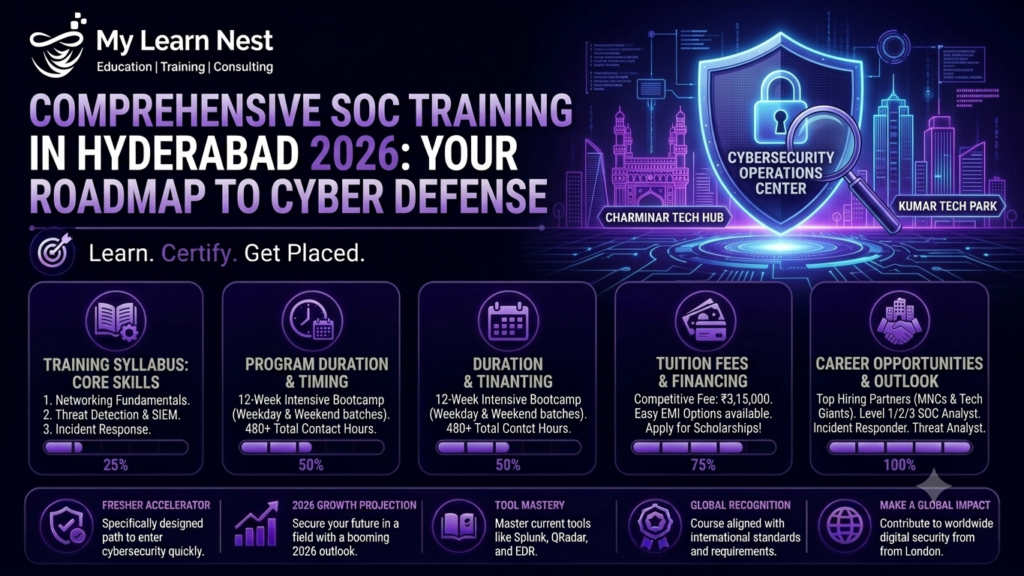
SOC Training in Hyderabad has become a popular choice for students, freshers, and IT professionals who want to build a career in cybersecurity. Modern Security Operations Center (SOC) roles are no longer limited to monitoring alerts. Organizations increasingly expect SOC analysts to work with SIEM, EDR/XDR, cloud security, threat intelligence, incident response, threat hunting, automation, and AI-assisted security operations.
If you are planning to start a cybersecurity career in 2026, choosing the right SOC Analyst Training in Hyderabad can help you develop practical skills that match current industry requirements.
In this guide, we cover the latest SOC course syllabus, duration, fees, hands-on training, career opportunities, required skills, certifications, and how Learnest can help you prepare for a SOC career.
What Is SOC Training?
SOC training is designed to teach students how Security Operations Centers monitor, detect, investigate, and respond to cybersecurity threats.
A modern SOC analyst may investigate:
- Phishing and malicious emails
- Brute-force and suspicious login attempts
- Malware and ransomware activity
- Endpoint security alerts
- Network anomalies
- Data exfiltration attempts
- Cloud security incidents
- Identity and access-related attacks
- Suspicious PowerShell or command-line activity
- Threat intelligence indicators
Modern training therefore needs to go beyond theoretical cybersecurity concepts and provide practical experience with security monitoring and investigation tools. (Breachroad)
5 Highlights of Modern SOC Training in 2026
1. AI-Powered SOC Operations
AI is increasingly being incorporated into security operations to assist with alert triage, investigation, detection, and automation. However, analysts still play an important role in validating alerts and making security decisions. (Express Computer)
2. SIEM + EDR/XDR Skills
A modern SOC analyst should understand both SIEM platforms and endpoint security technologies. Popular technologies include Splunk, Microsoft Sentinel, IBM QRadar, Microsoft Defender, CrowdStrike, and SentinelOne. (Macksofy Trainings)
3. Cloud Security Monitoring
As organizations increasingly use cloud platforms, SOC analysts need to understand cloud logs, identity events, authentication activity, and cloud security alerts. Microsoft Sentinel, Entra ID, and Defender technologies are particularly relevant for Microsoft-focused environments. (SocMasters)
4. Threat Hunting & MITRE ATT&CK
Modern SOC training should teach analysts how to move beyond responding to alerts and proactively search for suspicious behavior. MITRE ATT&CK can help analysts understand attacker tactics, techniques, and procedures.
5. Real-Time Labs & Incident Scenarios
Hands-on practice is one of the most important parts of SOC training. Students should practice investigating alerts, analyzing logs, identifying indicators of compromise, documenting incidents, and following an incident-response workflow.
Latest SOC Analyst Course Syllabus in Hyderabad
A modern SOC Analyst Course in Hyderabad should cover cybersecurity fundamentals as well as practical SOC technologies.
Module 1: Cybersecurity & SOC Fundamentals
- Introduction to cybersecurity
- Security Operations Center architecture
- SOC roles and responsibilities
- SOC L1, L2 and L3 roles
- Security monitoring
- Threat detection fundamentals
- Incident management
- Security operations workflow
Module 2: Networking Fundamentals for SOC Analysts
- TCP/IP
- OSI model
- DNS
- HTTP/HTTPS
- DHCP
- FTP
- SMTP
- SSH
- VPN
- Firewalls
- Proxies
- Network traffic analysis
- Packet analysis with Wireshark
Strong networking fundamentals remain important because SOC analysts need to understand the traffic and systems behind security alerts. (Skillwala Global)
Module 3: Windows & Linux Security
Windows
- Windows architecture
- Event Viewer
- Windows Security Logs
- Event IDs
- Active Directory fundamentals
- PowerShell
- Authentication events
- Process analysis
- Persistence techniques
Linux
- Linux command line
- Authentication logs
- System logs
- Processes
- File permissions
- SSH monitoring
- Suspicious command analysis
Module 4: SIEM Tools
Students can learn how SIEM platforms collect, normalize, correlate, and analyze security events.
Topics include:
- SIEM architecture
- Log collection
- Log normalization
- Correlation rules
- Alert investigation
- Dashboards
- Detection rules
- Search and query techniques
- Alert tuning
- False-positive analysis
Popular platforms include:
- Microsoft Sentinel
- Splunk
- IBM QRadar
- Elastic Security
- Wazuh
KQL and SPL skills can be particularly useful for analysts working with Microsoft Sentinel and Splunk environments. (SocMasters)
Module 5: EDR & XDR
Modern SOC teams increasingly use endpoint detection and response technologies alongside SIEM.
Students can learn:
- EDR fundamentals
- Endpoint telemetry
- Process trees
- File and process investigation
- Malware detection
- Host isolation
- Endpoint investigation
- XDR concepts
- Microsoft Defender
- CrowdStrike fundamentals
- SentinelOne concepts
Module 6: Threat Intelligence
- Threat intelligence fundamentals
- IOC identification
- IP addresses
- Domains
- URLs
- File hashes
- Malware indicators
- Threat intelligence feeds
- IOC enrichment
- Threat actor research
- Threat intelligence platforms
Module 7: MITRE ATT&CK Framework
- MITRE ATT&CK introduction
- Tactics
- Techniques
- Sub-techniques
- Attack mapping
- Detection mapping
- Threat hunting using ATT&CK
- Creating investigation hypotheses
Module 8: Incident Response
Students learn the complete incident-response lifecycle:
- Preparation
- Identification
- Analysis
- Containment
- Eradication
- Recovery
- Lessons learned
Practical scenarios can include phishing, malware, compromised accounts, suspicious logins, and endpoint attacks.
Module 9: Threat Hunting
- Threat hunting fundamentals
- IOC-based hunting
- Behavioral hunting
- Hypothesis-driven hunting
- SIEM-based hunting
- Endpoint hunting
- Suspicious PowerShell investigation
- Authentication anomaly detection
- Lateral movement investigation
Module 10: Cloud Security for SOC Analysts
- Cloud security fundamentals
- Shared responsibility model
- Azure security basics
- AWS security fundamentals
- Cloud identity
- Authentication logs
- Cloud activity logs
- Suspicious cloud activity
- Cloud threat detection
- Microsoft Entra ID
- Microsoft Defender for Cloud
Module 11: Malware & Phishing Investigation
- Malware fundamentals
- Malware indicators
- Hash analysis
- Email header analysis
- Phishing investigation
- Malicious attachments
- URL analysis
- Sandbox concepts
- Safe malware analysis
- IOC extraction
Module 12: SOC Automation & Basic Scripting
- Python fundamentals for security
- PowerShell basics
- Log parsing
- IOC enrichment
- Automation concepts
- SOAR fundamentals
- Security playbooks
- Automated alert enrichment
Basic scripting is increasingly useful for SOC analysts because it can automate repetitive investigation and log-analysis tasks. (Skillwala Global)
SOC Training Course Duration in Hyderabad
The duration depends on the training format and depth of the curriculum.
Typical formats include:
Training Format | Typical Duration |
Fast-track SOC Training | 6–8 weeks |
Regular SOC Training | 2–3 months |
Advanced SOC Program | 3–4 months |
SOC + Advanced Cybersecurity | 4–6 months |
For beginners, a 2–3 month structured program with practical labs can provide a better balance between fundamentals, tools, investigation skills, and interview preparation.
SOC Analyst Course Fees in Hyderabad
SOC training fees vary depending on the institute, trainer experience, course duration, training mode, lab access, projects, and career support.
As a broad 2026 market reference, publicly listed Hyderabad SOC programs range from roughly ₹15,000 to ₹40,000+, depending on the format and inclusions. (SocMasters)
Training Type | Approximate Fee Range |
Self-Paced / Recorded | ₹10,000 – ₹20,000 |
Live Online | ₹15,000 – ₹30,000 |
Classroom Training | ₹20,000 – ₹40,000+ |
Advanced SOC Program | ₹30,000 – ₹50,000+ |
Important: Course fees can change based on batches, offers, lab access, certifications, and placement-support packages. Students should check the latest fee directly with the training institute before enrolling.
What Skills Do You Need to Become a SOC Analyst?
You don’t need to master every cybersecurity technology before starting. Focus on building these core skills:
Technical Skills
- Networking
- Windows security
- Linux fundamentals
- SIEM
- Log analysis
- Alert triage
- Incident response
- EDR/XDR
- Threat intelligence
- MITRE ATT&CK
- Threat hunting
- Cloud security
- Basic Python or PowerShell
- Security documentation
Professional Skills
- Analytical thinking
- Problem-solving
- Attention to detail
- Incident documentation
- Communication
- Team collaboration
- Ability to work under pressure
- Willingness to work in shifts
Career Opportunities After SOC Training
SOC training can provide a foundation for several cybersecurity career paths.
SOC Analyst L1
Entry-level analysts generally focus on monitoring alerts, initial investigation, categorizing incidents, and escalating confirmed or complex threats.
SOC Analyst L2
L2 analysts handle deeper investigations, correlation, incident analysis, and more complex security events.
SOC Analyst L3
L3 analysts typically work on advanced investigation, threat hunting, detection engineering, and complex incidents.
Threat Hunter
Threat hunters proactively search for signs of compromise that automated detections may miss.
Incident Response Analyst
Incident responders investigate and help contain cybersecurity incidents.
Detection Engineer
Detection engineers create and improve security detections, rules, queries, and monitoring logic.
Security Operations Engineer
Security operations engineers help maintain and improve the technologies used by security teams.
The SOC career path can therefore progress from L1 → L2 → L3 → Threat Hunter / Detection Engineer / Incident Responder → SOC Lead or Manager. (SocMasters)
SOC Analyst Salary in Hyderabad
Salary depends on skills, experience, company, certifications, interview performance, and the type of organization.
Recent 2026 industry training guides commonly place entry-level SOC roles around ₹3.5–8 LPA, with experienced L2/L3, threat-hunting, detection-engineering, and management roles potentially reaching significantly higher ranges. These figures should be treated as indicative rather than guaranteed salary offers. (SocMasters)
A candidate with practical SIEM experience, strong investigation skills, cloud exposure, and good interview performance can have an advantage over candidates whose knowledge is limited to theory.
Certifications That Can Support a SOC Career
Certifications are useful, but they should complement practical skills rather than replace hands-on experience.
Depending on your career stage, you can explore:
- CompTIA Security+
- CompTIA CySA+
- Microsoft security certifications
- Splunk certifications
- IBM security certifications
- Vendor-specific SOC certifications
- Other recognized cybersecurity certifications
The most important factor is being able to demonstrate what you can actually investigate and solve in a SOC environment.
Why Choose Learnest for SOC Training in Hyderabad?
At Learnest, the focus should be on helping learners move from cybersecurity fundamentals to practical SOC skills that can be demonstrated during interviews.
A strong Learnest SOC program can combine:
- Industry-focused SOC syllabus
- Hands-on security labs
- SIEM practice
- EDR/XDR concepts
- Realistic security alerts
- Log-analysis exercises
- Incident-response scenarios
- Threat-hunting practice
- MITRE ATT&CK
- Cloud security fundamentals
- Resume preparation
- Mock interviews
- Career guidance
- Practical projects
Instead of learning cybersecurity only through theory, learners can build experience around the complete SOC investigation process — from receiving an alert to analyzing evidence, identifying the threat, documenting findings, and recommending a response.
For students searching for SOC Analyst Training in Hyderabad, this practical approach can make the learning experience more relevant to real-world security operations.
Who Should Join SOC Analyst Training?
SOC training can be suitable for:
- B.Tech / BE graduates
- BCA / MCA graduates
- Computer science students
- IT professionals
- Network engineers
- System administrators
- Technical support professionals
- Cybersecurity beginners
- Career switchers
- Freshers interested in cybersecurity
You don’t necessarily need previous SOC experience to start. However, basic knowledge of networking, operating systems, and computers can make the learning process easier.
How to Start a SOC Analyst Career in 2026
A practical learning roadmap can look like this:
- Step 1: Learn networking fundamentals
↓
Step 2: Understand Windows and Linux security
↓
Step 3: Learn SIEM and log analysis
↓
Step 4: Practice alert investigation
↓
Step 5: Learn EDR/XDR
↓
Step 6: Study MITRE ATT&CK and threat intelligence
↓
Step 7: Practice incident response
↓
Step 8: Add threat hunting and cloud security
↓
Step 9: Build practical SOC projects
↓
Step 10: Prepare for SOC Analyst interviews - This approach is more aligned with modern SOC expectations than simply collecting certificates or memorizing interview questions.
Final Thoughts
SOC Training in Hyderabad is evolving rapidly in 2026. The modern SOC analyst needs more than basic alert monitoring. Employers increasingly value candidates who understand SIEM, EDR/XDR, cloud security, threat intelligence, incident response, threat hunting, MITRE ATT&CK, automation, and security investigation.
If your goal is to enter cybersecurity, choose a course that provides hands-on labs, realistic incident scenarios, practical projects, current tools, and interview preparation.
With the right training and consistent practice, SOC can provide a strong starting point for a long-term cybersecurity career.
Looking for practical SOC Analyst Training in Hyderabad? Explore Learnest’s latest SOC training program and start building the skills required for modern Security Operations Center roles.

