
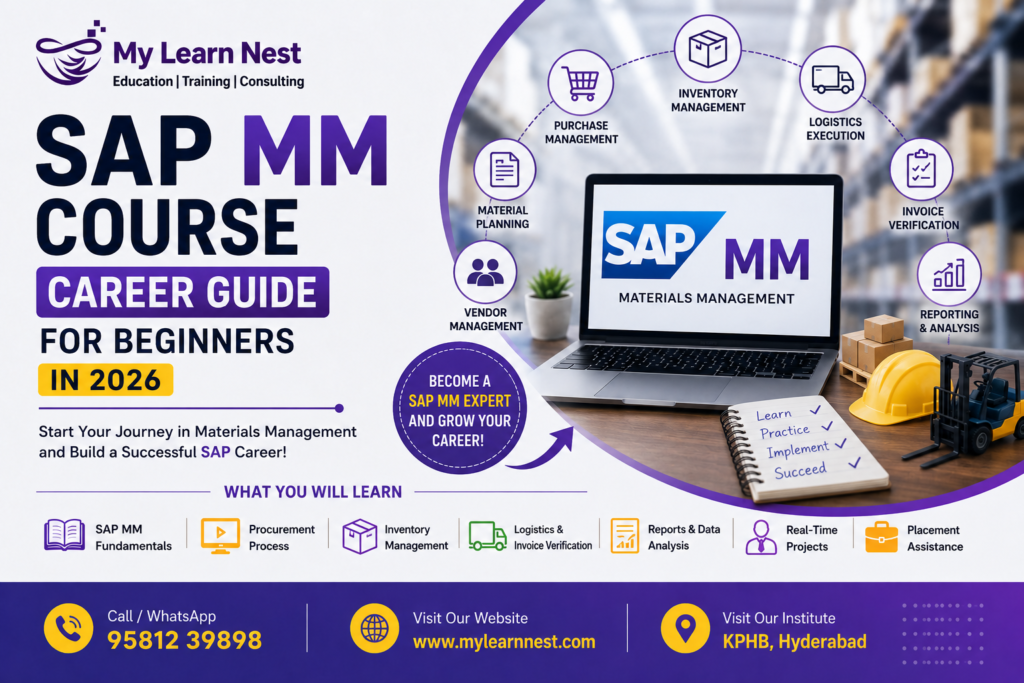
Complete Career Guide for Beginners
SAP Materials Management (SAP MM) is one of the most popular functional modules in SAP ERP. It helps organizations manage procurement, purchasing, inventory, material planning, vendor management, and invoice verification from a single platform. Almost every manufacturing, retail, healthcare, logistics, automobile, pharmaceutical, and e-commerce company uses material management processes to keep business operations running efficiently.
If you are planning to start your career in SAP, SAP MM can be an excellent choice. Whether you are a graduate, working professional, or someone looking to switch careers, learning SAP MM can open opportunities in industries that rely on efficient supply chain and procurement management.
This guide explains everything you need to know about SAP MM, including career opportunities, required skills, eligibility, salary, roadmap, certifications, projects, interview preparation, and how to become job-ready. The purpose of this guide is to help beginners understand SAP MM in simple language while providing practical insights for professionals who want to build a successful career in SAP.
What is SAP MM?
SAP MM (Materials Management) is a functional module in SAP ERP and SAP S/4HANA that helps organizations manage the complete procurement and inventory management process. It enables businesses to purchase materials, manage suppliers, monitor stock levels, process goods receipts, verify invoices, and ensure that materials are available whenever required.
SAP MM integrates with other SAP modules such as Finance (FI), Sales and Distribution (SD), Production Planning (PP), Warehouse Management (WM), and Quality Management (QM), making it an essential part of enterprise resource planning.
In simple words, SAP MM helps companies purchase the right materials at the right time, from the right supplier, at the right price.
Why is SAP MM Important?
Every business needs raw materials, products, equipment, or services to operate efficiently. Without proper material management, organizations may face stock shortages, excess inventory, delayed production, or increased operational costs.
SAP MM helps organizations by:
- Managing procurement processes efficiently
- Reducing inventory costs
- Improving supplier relationships
- Tracking material movement
- Automating purchasing activities
- Maintaining accurate inventory records
- Supporting production planning
- Improving business decision-making
- Reducing manual work through automation
- Increasing overall operational efficiency
Because of these benefits, SAP MM is widely used across industries around the world.
Who Should Learn SAP MM?
SAP MM is suitable for both freshers and experienced professionals who want to build a career in ERP and supply chain management.
This course is ideal for:
- Fresh graduates
- B.Com graduates
- BBA graduates
- MBA students
- Engineering graduates
- Supply Chain professionals
- Purchase Executives
- Procurement Officers
- Inventory Managers
- Warehouse Executives
- Logistics Professionals
- ERP Professionals
- Working professionals looking for career growth
- Career changers interested in SAP
Even if you do not have prior SAP experience, you can start learning SAP MM by understanding basic business and procurement concepts.
Can You Get an SAP MM Job Without Experience?
Yes, getting an SAP MM job without prior professional experience is possible.
Many companies hire freshers who have completed quality SAP MM training, worked on real-time projects, and developed a good understanding of procurement and inventory processes.
Although employers value experience, they also look for candidates who can demonstrate:
- Strong SAP MM fundamentals
- Business process knowledge
- Practical project experience
- Good communication skills
- Problem-solving ability
- Interview confidence
- Continuous learning mindset
Freshers can improve their chances of getting hired by completing practical SAP MM projects, building a professional resume, preparing for interviews, and gaining hands-on practice.
What Does an SAP MM Consultant Do?
An SAP MM Consultant is responsible for implementing, configuring, supporting, and optimizing the Materials Management module according to business requirements.
Their responsibilities may include:
- Understanding business procurement processes
- Gathering client requirements
- Configuring SAP MM settings
- Creating material master data
- Managing vendor master records
- Configuring purchasing processes
- Managing purchase requisitions
- Creating purchase orders
- Monitoring goods receipt processes
- Supporting invoice verification
- Managing inventory transactions
- Resolving user issues
- Preparing documentation
- Supporting SAP implementation projects
- Collaborating with functional and technical teams
An SAP MM Consultant acts as a bridge between business users and technical teams.
Industries That Use SAP MM
SAP MM is used across almost every major industry because procurement and inventory management are essential business functions.
Some industries using SAP MM include:
- Manufacturing
- Automobile
- Retail
- Healthcare
- Pharmaceuticals
- Logistics
- E-commerce
- Oil and Gas
- Construction
- FMCG
- Electronics
- Telecommunications
- Food Processing
- Aviation
- Textile
- Government Organizations
- Banking
- Chemicals
- Mining
- Energy
This wide industry adoption creates numerous career opportunities for SAP MM professionals.
Key Features of SAP MM
SAP MM offers several features that help businesses manage procurement and inventory efficiently.
Major features include:
- Material Master Management
- Vendor Master Management
- Purchasing
- Procurement Process
- Inventory Management
- Invoice Verification
- Material Requirement Planning Support
- Source Determination
- Vendor Evaluation
- Purchase Requisition Management
- Purchase Order Management
- Goods Receipt Processing
- Goods Issue Processing
- Stock Transfers
- Physical Inventory
- Automatic Account Determination
These features help organizations streamline procurement operations and reduce manual work.
Benefits of Learning SAP MM
Learning SAP MM can provide several career and professional advantages.
Some major benefits include:
- High demand across industries
- Excellent career growth
- Opportunities in India and abroad
- Attractive salary packages
- Strong ERP career foundation
- Opportunities in multinational companies
- Better job stability
- Exposure to real business processes
- Continuous learning opportunities
- Easy transition into advanced SAP roles
As more organizations migrate to SAP S/4HANA, the demand for skilled SAP MM professionals is expected to continue growing.
Skills Required to Become an SAP MM Consultant
Technical knowledge alone is not enough to become a successful SAP MM Consultant.
Professionals should develop a combination of business knowledge and technical skills.
Important skills include:
- Procurement knowledge
- Purchasing process understanding
- Inventory Management
- Vendor Management
- Material Master Management
- SAP Navigation
- Business Process Analysis
- Supply Chain Fundamentals
- Communication Skills
- Analytical Thinking
- Problem Solving
- Documentation Skills
- Team Collaboration
- Client Interaction
- Requirement Gathering
Continuous learning and practical experience help strengthen these skills over time.
Career Opportunities After Learning SAP MM
Completing an SAP MM course can open doors to various career opportunities.
Some common job roles include:
- SAP MM Consultant
- SAP MM Functional Consultant
- Junior SAP Consultant
- Procurement Consultant
- Purchase Executive
- Inventory Analyst
- Material Planner
- Supply Chain Analyst
- SAP Support Consultant
- SAP Business Analyst
- ERP Consultant
- SAP S/4HANA MM Consultant
- Warehouse Management Executive
- Vendor Management Specialist
- Logistics Coordinator
As professionals gain experience, they can move into senior consulting, solution architecture, project management, or SAP leadership roles.
SAP MM Modules Explained
SAP MM consists of multiple sub-modules that work together to manage procurement and inventory processes. Understanding these modules is essential for becoming an SAP MM Consultant.
The major SAP MM modules include:
Material Master
Stores complete information about materials such as descriptions, units of measure, valuation, purchasing data, and inventory details.
Vendor Master
Maintains supplier information including contact details, payment terms, purchasing data, and communication details.
Purchasing
Handles procurement activities including purchase requisitions, quotations, purchase orders, contracts, and scheduling agreements.
Inventory Management
Tracks stock movements such as goods receipt, goods issue, stock transfer, stock adjustment, and inventory balances.
Invoice Verification
Verifies vendor invoices against purchase orders and goods receipts before payment processing.
Valuation and Account Determination
Manages material valuation and automatically posts accounting entries by integrating with SAP Finance (FI).
Learning these modules helps professionals understand the complete procurement lifecycle.
SAP MM Eligibility
One of the biggest advantages of SAP MM is that professionals from different educational backgrounds can learn it.
The course is suitable for:
- B.Com Graduates
- BBA Graduates
- B.Sc Graduates
- MBA Students
- BE/B.Tech Graduates
- MCA Graduates
- M.Com Graduates
- Supply Chain Professionals
- Procurement Executives
- Warehouse Professionals
- Inventory Controllers
- Working Professionals
- Career Changers
There is no strict educational requirement. However, understanding basic business processes and procurement concepts can make learning easier.
SAP MM Prerequisites
You do not need advanced technical knowledge before starting SAP MM. However, having a basic understanding of business operations can be helpful.
Recommended prerequisites include:
- Basic Computer Knowledge
- Business Process Fundamentals
- Procurement Basics
- Inventory Concepts
- Supply Chain Fundamentals
- Microsoft Excel Basics
- ERP Fundamentals
- Good Communication Skills
- Analytical Thinking
- Willingness to Learn
Most beginners can start SAP MM training without prior SAP experience.
SAP MM Learning Roadmap
A structured learning roadmap helps beginners become job-ready more efficiently.
A recommended SAP MM roadmap is:
Step 1
Learn ERP and SAP Fundamentals
Step 2
Understand Business Processes
Step 3
Study Procurement Cycle
Step 4
Learn Material Master
Step 5
Learn Vendor Master
Step 6
Master Purchasing Process
Step 7
Learn Inventory Management
Step 8
Understand Invoice Verification
Step 9
Learn Pricing Procedure
Step 10
Study Release Strategy
Step 11
Understand Integration with FI, SD, PP, and WM
Step 12
Practice SAP S/4HANA MM
Step 13
Complete Real-Time Projects
Step 14
Prepare Resume and LinkedIn Profile
Step 15
Practice SAP MM Interview Questions
Following a roadmap helps learners build knowledge step by step instead of trying to learn everything at once.
SAP MM Course Syllabus
A complete SAP MM course generally covers both theoretical concepts and practical implementation.
Common topics include:
- Introduction to SAP ERP
- SAP Navigation
- Enterprise Structure
- Organizational Units
- Material Master
- Vendor Master
- Purchasing Information Record
- Source Determination
- Purchase Requisition
- Request for Quotation (RFQ)
- Quotation Management
- Purchase Orders
- Outline Agreements
- Pricing Procedure
- Release Strategy
- Goods Receipt
- Goods Issue
- Transfer Posting
- Physical Inventory
- Invoice Verification
- Stock Transport Orders
- Automatic Account Determination
- SAP S/4HANA MM
- Real-Time Business Scenarios
- End-to-End Procurement Cycle
A project-based syllabus helps learners understand how SAP MM is used in real organizations.
Real-Time SAP MM Projects
Practical experience is one of the most important factors in becoming job-ready.
Some beginner-friendly SAP MM projects include:
- End-to-End Procurement Process
- Vendor Onboarding Project
- Material Master Creation
- Purchase Order Lifecycle
- Inventory Tracking System
- Warehouse Stock Management
- Invoice Verification Process
- Vendor Evaluation Report
- Stock Transfer Process
- SAP S/4HANA Procurement Simulation
Each project should include:
- Project Objective
- Business Scenario
- SAP Configuration
- Transaction Codes Used
- Steps Performed
- Expected Results
- Challenges Faced
- Final Outcome
Real-time projects improve practical knowledge and interview confidence.
SAP MM Certifications
Although certifications are not always mandatory, they can strengthen your resume and validate your knowledge.
Popular certification areas include:
- SAP Certified Associate – SAP S/4HANA Sourcing and Procurement
- SAP S/4HANA Materials Management
- Procurement Fundamentals
- Supply Chain Management
- ERP Fundamentals
Before attempting certification, learners should gain practical knowledge through projects and hands-on practice.
Knowledge combined with certification and project experience creates a stronger profile than certification alone.
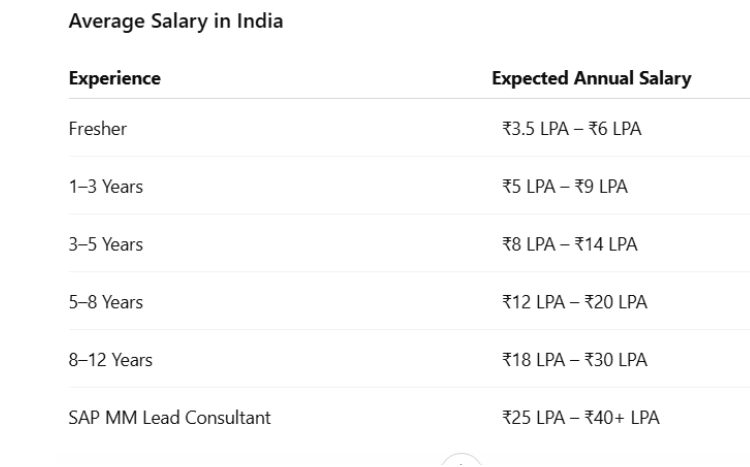
Average SAP MM Salary by Experience
SAP MM professionals enjoy competitive salaries depending on their experience, skills, company, and location.
Salaries may vary depending on certifications, project experience, industry, and company size.
Top Companies Hiring SAP MM Professionals
Many multinational companies and large enterprises regularly hire SAP MM professionals for implementation, support, migration, and consulting projects.
Some of the leading companies include:
- Accenture
- Deloitte
- Capgemini
- Cognizant
- Tata Consultancy Services (TCS)
- Infosys
- Wipro
- HCLTech
- IBM
- Tech Mahindra
- LTIMindtree
- DXC Technology
- EY
- KPMG
- PwC
- Genpact
- NTT DATA
- Hexaware
- Birlasoft
- YASH Technologies
- Bosch
- Siemens
- Shell
- Reliance Industries
- Tata Steel
- JSW Steel
- Adani Group
- Amazon
- Flipkart
- PepsiCo
- Nestlé
- Unilever
- Hyundai
- Toyota
- Mahindra & Mahindra
- Larsen & Toubro (L&T)
These organizations hire SAP MM professionals for roles such as SAP MM Consultant, Functional Consultant, Procurement Consultant, ERP Analyst, SAP Support Consultant, and SAP S/4HANA Consultant.
Why Choose MyLearnNest for SAP MM Training?
Learning SAP MM requires more than understanding theoretical concepts. Employers look for candidates who can confidently manage procurement processes, inventory management, vendor management, purchasing, and real-time business scenarios. A structured training program that combines practical learning with career guidance can help you build the skills needed to become job-ready.
At MyLearnNest, our SAP MM training is designed to help students, graduates, working professionals, and career changers develop both technical knowledge and practical experience. The learning approach focuses on understanding real business processes, working with SAP S/4HANA, and preparing learners for industry requirements.
Hands-on practice is a key part of the learning process. Learners work on practical assignments, real-time business scenarios, and project-based training that help them understand how organizations manage procurement and supply chain operations using SAP. This practical exposure also helps build confidence during interviews.
In addition to technical training, MyLearnNest supports learners with resume building, LinkedIn profile optimization, interview preparation, mock interviews, and career guidance. These resources help candidates present their skills effectively while applying for SAP MM roles.
Final Thoughts
SAP MM is one of the most valuable SAP functional modules for professionals who want to build a long-term career in enterprise resource planning, procurement, inventory management, and supply chain operations. As organizations continue to adopt SAP S/4HANA and modern ERP technologies, the demand for skilled SAP MM professionals is expected to grow across industries in India and around the world.
Whether your goal is to become an SAP MM Consultant, Functional Consultant, Procurement Consultant, Inventory Analyst, Supply Chain Specialist, or SAP S/4HANA Consultant, the right combination of technical knowledge, hands-on experience, certifications, and interview preparation can help you achieve your career goals.
If you are serious about starting or advancing your SAP career, begin with strong fundamentals, follow a structured learning roadmap, complete practical projects, and keep improving your skills as SAP technologies evolve. With the right training, consistent practice, and career guidance from MyLearnNest, you can confidently prepare for exciting opportunities in the rapidly growing SAP ecosystem and take the next step toward a rewarding professional career.

