
Introduction
The world of data is evolving faster than ever, and businesses are investing heavily in cloud technologies to manage, analyze, and transform massive volumes of information. Among the leading cloud data platforms, Snowflake has emerged as one of the most trusted and widely adopted solutions for modern data warehousing, data engineering, business intelligence, and advanced analytics. As organizations continue their digital transformation journey, the demand for skilled Snowflake professionals is growing across industries, making it one of the most promising career choices for aspiring data engineers and cloud professionals.
If you are planning to build a successful Snowflake Data Engineering Career in 2026, now is the ideal time to learn this in-demand technology. Companies around the world are looking for professionals who can design scalable data pipelines, manage cloud-based data warehouses, optimize data performance, and support real-time analytics using Snowflake. Whether you are a fresher looking for your first IT job or an experienced software professional planning to upgrade your skills, learning Snowflake can open the door to exciting career opportunities in India and abroad.
Hyderabad has become one of India’s fastest-growing technology hubs, attracting leading multinational companies, startups, and global capability centers. Organizations such as Accenture, Deloitte, Infosys, TCS, IBM, Cognizant, Capgemini, Wipro, HCLTech, and many others are actively hiring Snowflake Developers, Data Engineers, Cloud Engineers, Analytics Engineers, and Data Warehouse Specialists. This increasing demand has also created a strong need for high-quality Snowflake Training in Hyderabad, especially for learners seeking practical knowledge, real-time projects, and placement-oriented programs.
Unlike traditional databases, Snowflake is built specifically for the cloud. It supports seamless integration with platforms like AWS, Microsoft Azure, and Google Cloud Platform (GCP), allowing organizations to process massive datasets with speed, security, and flexibility. Its unique architecture separates storage from computing, enabling businesses to scale resources independently while reducing infrastructure costs. These capabilities have made Snowflake a preferred choice for enterprises in banking, healthcare, retail, manufacturing, telecommunications, insurance, e-commerce, and finance.
One of the biggest advantages of learning Snowflake today is its growing role within the modern data ecosystem. Data engineers frequently combine Snowflake with technologies such as SQL, Python, Apache Airflow, dbt, PySpark, Kafka, Tableau, and Power BI to build complete, cloud-native data solutions. Employers increasingly value professionals who understand not only Snowflake but also how it fits into end-to-end data engineering workflows. Developing these complementary skills can significantly improve your employability and prepare you for real-world project environments.
Whether you are searching for a Snowflake Course in Hyderabad, Snowflake Online Training, Snowflake Training in Kukatpally, Snowflake Training in Ameerpet, or a placement-focused program that includes practical implementation, selecting the right learning path is essential. A comprehensive training program should go beyond theory by offering hands-on exercises, industry case studies, real-time projects, interview preparation, resume guidance, certification support, and mentorship from experienced trainers. These practical components help learners build confidence and become job-ready for competitive recruitment processes.
This complete beginner’s guide has been created to answer the most common questions asked by aspiring Snowflake professionals and individuals exploring a Snowflake Data Engineering Career in 2026. Throughout this guide, you will learn what Snowflake is, why it has become one of the most sought-after cloud data platforms, who can learn it, the skills and prerequisites you need, the latest course syllabus, real-time industry projects, commonly used tools, interview questions, certification pathways, salary trends in Hyderabad, and the leading companies hiring Snowflake professionals. You’ll also discover why Hyderabad continues to be one of the best cities to launch a successful career in cloud data engineering.
If your goal is to secure a rewarding career in cloud data engineering, improve your technical expertise, or transition into one of the fastest-growing technology domains, this guide will provide the knowledge and direction you need. By the end, you’ll have a clear understanding of the learning roadmap, industry expectations, and practical steps required to become a successful Snowflake professional in 2026 and beyond.
What is Snowflake?
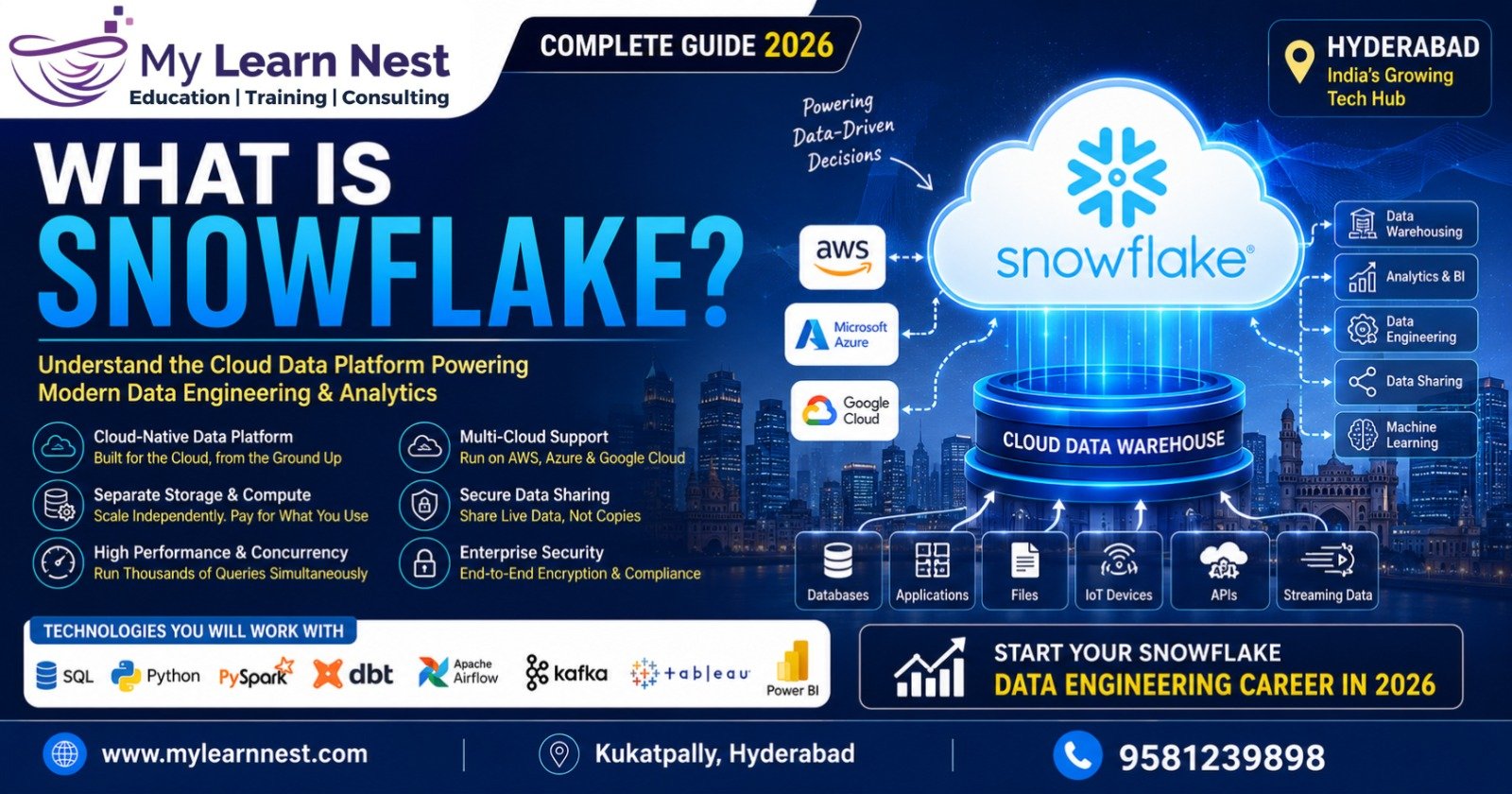
Snowflake is a cloud-native data platform that enables organizations to store, manage, process, and analyze large volumes of structured, semi-structured, and unstructured data. Unlike traditional databases that rely on fixed hardware or on-premises infrastructure, Snowflake is built exclusively for the cloud, allowing businesses to scale resources on demand while maintaining high performance, security, and cost efficiency.
Today, Snowflake has become one of the world’s leading cloud data platforms and is widely used by global enterprises for data warehousing, business intelligence, data engineering, data lakes, data sharing, and advanced analytics. Organizations across industries—including banking, healthcare, retail, e-commerce, insurance, manufacturing, and telecommunications—use Snowflake to make faster, data-driven business decisions.
For anyone planning a Snowflake Data Engineering Career in 2026, understanding the Snowflake platform is the first and most important step. As more organizations migrate their data infrastructure to the cloud, professionals with Snowflake expertise are becoming highly sought after in India and across the globe.
Snowflake Explained in Simple Words
Imagine a company storing millions of customer records, sales transactions, website clicks, product details, and financial reports every day. Processing this data using traditional databases can become slow, expensive, and difficult to scale.
Snowflake solves this challenge by providing a cloud-based platform where organizations can:
- Store unlimited amounts of data
- Process large datasets quickly
- Scale computing power whenever needed
- Share data securely with teams and partners
- Perform real-time analytics
- Support business intelligence dashboards
- Build modern data engineering pipelines
Because everything runs in the cloud, businesses no longer need to purchase expensive servers or spend significant time managing infrastructure. Snowflake automatically handles many administrative tasks, allowing teams to focus on extracting value from their data rather than maintaining systems.
Why is Snowflake Different from Traditional Databases?
Traditional databases such as Oracle, SQL Server, or MySQL were designed primarily for on-premises environments. Scaling these systems often requires additional hardware, infrastructure planning, and downtime.
Snowflake follows a modern cloud-first architecture that separates storage, compute, and cloud services. This unique design provides several important advantages:
- Independent scaling of storage and compute resources
- High-speed query processing for large datasets
- Support for multiple users without performance bottlenecks
- Automatic infrastructure management
- Pay only for the resources you use
- Built-in security and encryption
- High availability with minimal maintenance
These capabilities help organizations reduce operational costs while improving performance and flexibility.
Key Features of Snowflake
Snowflake includes several powerful features that make it one of the most preferred cloud data platforms.
Cloud-Native Architecture
Snowflake was built specifically for cloud environments instead of being adapted from traditional database technologies. This allows businesses to fully leverage cloud scalability and reliability.
Multi-Cloud Support
One of Snowflake’s biggest strengths is its ability to run on multiple cloud providers, including:
- Amazon Web Services (AWS)
- Microsoft Azure
- Google Cloud Platform (GCP)
This flexibility allows organizations to choose the cloud provider that best fits their business needs.
Separate Storage and Compute
Snowflake separates data storage from processing power. This means organizations can increase computing resources for heavy workloads without affecting stored data or paying for unnecessary infrastructure.
High Performance
Snowflake processes billions of records efficiently through automatic optimization and parallel execution. Multiple teams can run queries simultaneously without significant performance degradation.
Secure Data Sharing
Businesses can securely share live datasets with customers, suppliers, or partners without creating duplicate copies of the data. This improves collaboration while maintaining strong security controls.
Support for Multiple Data Types
Snowflake supports:
- Structured data
- Semi-structured data
- JSON
- XML
- Avro
- Parquet
- ORC
- CSV
- Unstructured data
This versatility makes it suitable for modern enterprise data engineering projects.
How Snowflake Fits into Data Engineering
Modern organizations collect data from websites, mobile applications, ERP systems, CRM platforms, IoT devices, APIs, and third-party services. A data engineer is responsible for moving, transforming, storing, and preparing this data for analysis.
Snowflake serves as the central platform where cleaned and transformed data is stored for reporting, dashboards, machine learning, and business analytics.
A typical data engineering workflow may include:
- Collecting data from various sources
- Loading data into cloud storage
- Transforming data using SQL or ETL/ELT tools
- Storing processed data in Snowflake
- Building dashboards with Tableau or Power BI
- Generating business insights for decision-makers
This workflow is why Snowflake has become an essential skill for today’s data engineering professionals.
Industries Using Snowflake
Snowflake is trusted by organizations across a wide range of industries, including:
- Banking and Financial Services
- Healthcare and Life Sciences
- Retail and E-commerce
- Insurance
- Manufacturing
- Telecommunications
- Logistics and Supply Chain
- Media and Entertainment
- Government Organizations
- Technology Companies
Because nearly every industry relies on data, Snowflake professionals have opportunities across diverse business domains.
Why Learn Snowflake?
Learning Snowflake offers several career advantages:
- High demand in the global job market
- Attractive salary packages
- Strong demand for cloud data engineers
- Opportunities with multinational companies
- Integration with AWS, Azure, and GCP
- Supports modern data engineering practices
- Excellent long-term career growth
Whether you are a fresher, software developer, SQL professional, ETL developer, cloud engineer, or data analyst, Snowflake can help you transition into one of the fastest-growing technology domains.
Why Learn Snowflake in 2026?
The technology industry is experiencing a significant shift toward cloud computing, artificial intelligence, big data, and real-time analytics. Organizations are collecting more data than ever before and need modern platforms that can store, process, and analyze this information efficiently. This growing demand has made Snowflake one of the fastest-growing cloud data platforms in the world and one of the most valuable skills for aspiring data professionals.
If you are planning to build a successful Snowflake Data Engineering Career in 2026, learning Snowflake is one of the smartest career investments you can make. From fresh graduates to experienced software professionals, Snowflake offers outstanding opportunities to work with leading multinational companies, high-paying projects, and cutting-edge cloud technologies.
Snowflake Demand is Growing Worldwide
Over the last few years, organizations have rapidly moved away from traditional on-premises databases and adopted cloud-native data platforms. Businesses now require scalable, secure, and high-performance solutions that support data engineering, business intelligence, artificial intelligence, and machine learning workloads.
Snowflake has become the preferred platform because it offers:
- High-performance cloud data warehousing
- Automatic scalability
- Multi-cloud compatibility
- Secure data sharing
- Real-time analytics
- Simplified infrastructure management
As more companies adopt digital transformation strategies, the demand for Snowflake professionals continues to increase across India, the United States, Europe, the Middle East, Australia, and many other regions.
Excellent Career Opportunities
One of the biggest reasons to learn Snowflake in 2026 is the wide range of career opportunities available across different industries.
After completing professional Snowflake Training in Hyderabad, you can explore roles such as:
- Snowflake Developer
- Snowflake Data Engineer
- Cloud Data Engineer
- Data Warehouse Developer
- Data Engineer
- ETL Developer
- Analytics Engineer
- Business Intelligence Developer
- Cloud Solutions Engineer
- Data Platform Engineer
- Data Architect
- Big Data Engineer
These roles are available across banking, healthcare, insurance, retail, e-commerce, telecommunications, manufacturing, logistics, and technology companies.
High Salary Packages
Snowflake professionals are among the highest-paid specialists in the data engineering domain. Since skilled professionals are still relatively limited compared to market demand, employers are willing to offer competitive salary packages.
Approximate salary ranges in India include:
- Freshers: ₹4–7 LPA
- 2–4 Years Experience: ₹8–15 LPA
- 5–8 Years Experience: ₹16–28 LPA
- Senior Professionals: ₹30–50+ LPA
Professionals who combine Snowflake with SQL, Python, Apache Airflow, dbt, AWS, Azure, or Google Cloud Platform often command even higher salaries due to their broader technical expertise.
Snowflake is a Core Skill for Modern Data Engineering
Today’s data engineers are expected to build scalable cloud-based data pipelines rather than maintain traditional databases.
Snowflake plays a central role in modern data engineering by enabling professionals to:
- Build cloud-native data warehouses
- Design ELT pipelines
- Process structured and semi-structured data
- Integrate data from multiple sources
- Create enterprise reporting solutions
- Support machine learning workflows
- Optimize cloud storage and compute resources
Learning Snowflake prepares you for real-world enterprise environments where cloud-first architecture has become the industry standard.
Multi-Cloud Expertise Increases Your Value
Unlike many platforms that are tied to a single cloud provider, Snowflake works seamlessly with:
- Amazon Web Services (AWS)
- Microsoft Azure
- Google Cloud Platform (GCP)
This multi-cloud capability gives professionals greater flexibility and makes them attractive to organizations using different cloud ecosystems. Employers increasingly value candidates who understand cloud integration alongside Snowflake.
Strong Integration with Modern Technologies
Snowflake is rarely used in isolation. It integrates with many popular tools that are widely adopted in enterprise projects, including:
- SQL
- Python
- PySpark
- Apache Airflow
- dbt
- Kafka
- Tableau
- Power BI
- AWS S3
- Azure Blob Storage
- Google Cloud Storage
Learning these technologies alongside Snowflake allows you to build complete data engineering solutions and significantly improves your career prospects.
Growing Demand Across Hyderabad
Hyderabad has become one of India’s leading destinations for cloud computing and data engineering careers. Global capability centers, IT service companies, and product-based organizations are expanding rapidly and hiring professionals with Snowflake expertise.
Many companies in Hyderabad are actively recruiting for Snowflake-related roles, making Snowflake Training in Hyderabad an excellent choice for learners who want access to local opportunities while also preparing for national and international positions.
Whether you are searching for Snowflake Training in Kukatpally, Snowflake Training in Ameerpet, or online instructor-led programs, choosing a practical, placement-focused course can help you gain the skills employers expect.
Future-Proof Your Career
Technology changes quickly, but cloud data engineering continues to grow year after year. Organizations are investing heavily in cloud migration, artificial intelligence, predictive analytics, and enterprise data platforms.
Snowflake is positioned at the center of this transformation because it supports:
- Artificial Intelligence (AI)
- Machine Learning (ML)
- Advanced Analytics
- Data Lakes
- Data Warehousing
- Real-Time Reporting
- Enterprise Data Sharing
- Cloud Data Engineering
Learning Snowflake today means preparing yourself for technologies that will continue to evolve and remain relevant for years to come.
Certification Adds More Value
Earning a Snowflake certification demonstrates your technical knowledge and commitment to professional growth. Combined with real-time project experience, certification can strengthen your resume and improve your chances of clearing technical interviews.
A quality training program should include certification guidance, practical assignments, mock interviews, and project-based learning to help you become job-ready.
Why Start Learning Now?
The demand for Snowflake professionals is growing faster than the supply of skilled candidates. Starting your learning journey now allows you to build practical experience before competition increases further.
Who Can Learn Snowflake?
One of the biggest advantages of Snowflake is that it is suitable for learners from different educational and professional backgrounds. Whether you are a fresher, an experienced IT professional, or someone looking to switch careers, Snowflake offers excellent opportunities to build a successful career in cloud data engineering.
As organizations continue to migrate their data platforms to the cloud, the demand for Snowflake professionals is increasing across industries. This makes Snowflake Training in Hyderabad an ideal choice for anyone who wants to build future-ready technical skills and work on modern cloud data platforms.
The best part is that you do not need to be an expert programmer to begin learning Snowflake. With a basic understanding of databases, SQL, and cloud concepts, you can gradually develop the skills required to become a successful Snowflake Developer or Data Engineer.
Fresh Graduates Looking for IT Jobs
Freshers are among the biggest beneficiaries of learning Snowflake. Many graduates complete engineering or degree programs but struggle to find opportunities because they lack industry-relevant technical skills.
Learning Snowflake helps freshers gain practical knowledge in:
- Cloud Data Warehousing
- SQL
- Data Engineering
- Cloud Technologies
- Data Analytics
- Modern Enterprise Projects
With hands-on projects, interview preparation, and placement support, fresh graduates can significantly improve their employability and confidently apply for entry-level data engineering roles.
Software Developers
Software developers who want to transition into cloud technologies can greatly benefit from Snowflake.
Developers working with Java, .NET, Python, or other programming languages can expand their career opportunities by learning:
- Snowflake Architecture
- Data Warehousing
- Data Pipelines
- ELT Development
- Cloud Integration
- Query Optimization
Adding Snowflake to your skill set makes you more valuable for enterprise cloud projects and opens opportunities in data engineering and analytics teams.
SQL Developers
SQL is one of the most important skills used in Snowflake. Professionals with experience in SQL already have a strong foundation for learning Snowflake quickly.
SQL developers can use Snowflake to:
- Write advanced SQL queries
- Build analytical datasets
- Optimize query performance
- Design enterprise reporting systems
- Support business intelligence solutions
For SQL professionals, learning Snowflake is a natural career progression toward cloud data engineering.
ETL Developers
ETL professionals working with tools such as Informatica, Talend, SSIS, DataStage, or ODI can significantly enhance their careers by learning Snowflake.
Modern organizations are replacing traditional ETL architectures with cloud-based ELT solutions. Snowflake allows ETL developers to process large datasets more efficiently while reducing infrastructure complexity.
Combining Snowflake with ETL experience creates excellent opportunities in cloud migration and enterprise data transformation projects.
Data Engineers
Data engineers are among the primary users of Snowflake.
If you already work with technologies such as:
- Apache Spark
- PySpark
- Apache Airflow
- Kafka
- Hadoop
- Databricks
learning Snowflake will strengthen your cloud data engineering expertise and prepare you for more advanced enterprise projects.
Many organizations now expect data engineers to understand cloud-native data warehouses alongside distributed data processing frameworks.
Data Analysts
Data analysts who work with dashboards and reporting tools can also benefit from learning Snowflake.
Since Snowflake stores large volumes of analytical data, analysts frequently use it alongside:
- Tableau
- Power BI
- Looker
- Excel
- SQL
Learning Snowflake helps analysts access enterprise datasets more efficiently and build scalable reporting solutions.
Business Intelligence Professionals
Business Intelligence (BI) developers rely heavily on high-quality data to build dashboards and reports.
Snowflake provides:
- Fast query performance
- Secure data access
- Real-time reporting
- High scalability
This makes it an excellent platform for BI professionals working with enterprise reporting solutions.
Cloud Professionals
If you already work with cloud platforms such as:
- Amazon Web Services (AWS)
- Microsoft Azure
- Google Cloud Platform (GCP)
Snowflake is an excellent complementary skill.
Because Snowflake supports all three major cloud providers, cloud professionals can expand their expertise by learning:
- Cloud Storage Integration
- Data Warehousing
- Data Lakes
- Cloud Security
- Data Sharing
- Enterprise Analytics
This combination is highly valued by multinational companies.
Database Administrators (DBAs)
Database administrators who have experience with Oracle, SQL Server, PostgreSQL, MySQL, or other relational databases can transition smoothly into Snowflake.
Their existing knowledge of:
- Database Design
- SQL
- Performance Optimization
- Security
- Backup Strategies
provides a strong foundation for learning cloud-native data platforms.
Snowflake enables DBAs to modernize their skills and stay relevant in today’s cloud-first technology landscape.
Working Professionals Looking for Career Growth
Many IT professionals eventually reach a point where career growth slows because their technology stack becomes outdated.
Learning Snowflake helps professionals:
- Upgrade their technical skills
- Transition into cloud data engineering
- Increase salary potential
- Work on international projects
- Explore better job opportunities
For professionals with 2–10 years of experience, Snowflake is one of the most valuable technologies for long-term career growth.
Career Switchers
Many professionals from testing, support, operations, and other IT domains successfully transition into data engineering after learning Snowflake.
With proper training, practical assignments, and real-time projects, career switchers can gradually build the confidence required to work as Snowflake Developers or Cloud Data Engineers.
Is Snowflake Suitable for Non-IT Professionals?
Yes—but with preparation.
Graduates from B.Sc., B.Com., BCA, MCA, MBA, M.Tech., or other academic backgrounds can learn Snowflake if they are willing to first understand basic concepts such as:
- SQL
- Databases
- Cloud Computing
- Data Warehousing
A structured learning path with expert guidance can help non-IT learners enter the cloud data engineering field successfully.
Why Choose Professional Snowflake Training?
Although many free learning resources are available online, professional training provides a much faster and more practical learning experience.
A quality Snowflake Training in Hyderabad program should include:
- Industry-experienced trainers
- Real-time projects
- Hands-on assignments
- Resume preparation
- Mock interviews
- Certification guidance
- Placement assistance
- Lifetime learning support
Whether you are a fresher, working professional, cloud engineer, SQL developer, or someone planning a career change, structured training helps you gain practical skills that employers expect.
Prerequisites to Learn Snowflake
One of the most common questions beginners ask is, “What are the prerequisites to learn Snowflake?” The good news is that Snowflake is designed to be easy to learn compared to many traditional data warehouse technologies. While having prior technical knowledge can make learning faster, it is not mandatory to be an experienced programmer or cloud engineer before starting your Snowflake journey.
Whether you are a fresher, software developer, SQL professional, data analyst, or someone planning a career transition into cloud data engineering, you can learn Snowflake successfully by building a few foundational skills. A structured learning approach combined with practical projects makes it easier to understand how Snowflake works in real-world enterprise environments.
If you are planning to join Snowflake Training in Hyderabad, understanding these prerequisites will help you prepare better and complete the course with confidence.
1. Basic SQL Knowledge
SQL (Structured Query Language) is the most important prerequisite for learning Snowflake.
Almost every activity in Snowflake involves SQL, including:
- Creating databases and schemas
- Creating tables
- Inserting and updating data
- Writing SELECT queries
- Filtering records
- Joining multiple tables
- Using aggregate functions
- Creating views
- Performing analytical queries
You don’t need to be an SQL expert before starting, but understanding basic SQL concepts will make learning Snowflake much easier.
Some important SQL topics include:
- SELECT statements
- WHERE clause
- GROUP BY
- ORDER BY
- HAVING
- INNER JOIN
- LEFT JOIN
- RIGHT JOIN
- UNION
- Subqueries
- Common Table Expressions (CTEs)
- Window Functions
Most professional Snowflake Course in Hyderabad programs also include SQL revision for beginners before moving into advanced Snowflake concepts.
2. Understanding Database Concepts
Before working with Snowflake, it is helpful to understand how databases are organized.
Basic concepts include:
- Tables
- Rows and Columns
- Primary Keys
- Foreign Keys
- Relationships
- Constraints
- Indexes
- Views
- Data Types
These concepts form the foundation of data management and help learners understand how Snowflake stores and organizes information.
If you have previously worked with MySQL, Oracle, SQL Server, PostgreSQL, or any relational database, you’ll find Snowflake much easier to learn.
3. Basic Knowledge of Data Warehousing
Snowflake is primarily a cloud data warehouse, so understanding basic data warehousing concepts is highly recommended.
Important topics include:
- Data Warehouse
- Data Mart
- OLTP vs OLAP
- Fact Tables
- Dimension Tables
- Star Schema
- Snowflake Schema
- Data Modeling
- ETL
- ELT
You don’t need to master these concepts before beginning, but having a basic understanding helps you appreciate why Snowflake is widely used in enterprise environments.
Professional training programs usually explain these topics using real-world business examples.
4. Basic Cloud Computing Awareness
Snowflake is a cloud-native platform, so having a general understanding of cloud computing is beneficial.
You should know:
- What is Cloud Computing?
- Public Cloud
- Private Cloud
- Hybrid Cloud
- Cloud Storage
- Virtual Machines
- Scalability
- Elastic Computing
Snowflake works seamlessly with:
- Amazon Web Services (AWS)
- Microsoft Azure
- Google Cloud Platform (GCP)
Understanding these platforms helps learners see how Snowflake integrates into modern cloud ecosystems.
5. Basic Computer Skills
You don’t need advanced programming knowledge to start learning Snowflake, but you should be comfortable using a computer for everyday tasks.
Basic skills include:
- File management
- Internet browsing
- Downloading datasets
- Uploading files
- Using spreadsheets
- Basic command-line familiarity (optional)
These skills are sufficient for most beginners.
6. Analytical Thinking
Snowflake professionals solve business problems using data.
Therefore, analytical thinking is an important skill.
You should be interested in:
- Finding patterns in data
- Solving business challenges
- Understanding customer behavior
- Improving business decisions
- Working with reports and dashboards
This mindset helps learners become effective data engineers and analytics professionals.
7. Programming Knowledge (Optional)
Many beginners believe they must know programming before learning Snowflake.
The reality is different.
You can start learning Snowflake with only SQL.
However, learning programming languages such as:
- Python
- PySpark
will significantly improve your career opportunities.
Python is commonly used for:
- Data Processing
- Automation
- API Integration
- ETL Development
- Data Engineering
Many employers prefer professionals who combine Snowflake with Python because it enables them to build complete cloud data engineering solutions.
8. Familiarity with Data Engineering Concepts
If your goal is to become a Data Engineer, understanding the data engineering lifecycle will help you learn Snowflake more effectively.
Key concepts include:
- Data Collection
- Data Ingestion
- Data Transformation
- Data Validation
- Data Storage
- Data Pipelines
- Data Quality
- Data Governance
- Data Security
These topics are covered in most real-time Snowflake training programs and become easier to understand through practical projects.
Do Freshers Need Experience?
No.
One of the biggest misconceptions is that Snowflake is only for experienced professionals.
Fresh graduates can learn Snowflake successfully if they have:
- Basic SQL knowledge
- Interest in cloud technologies
- Willingness to practice
- Commitment to learning
With proper guidance, freshers can become job-ready through hands-on assignments, real-time projects, and interview preparation.
Can Non-IT Students Learn Snowflake?
Yes.
Graduates from B.Sc., B.Com., BCA, MCA, MBA, M.Tech., or other educational backgrounds can learn Snowflake.
If you are from a non-technical background, start with:
- SQL Basics
- Database Fundamentals
- Data Warehouse Concepts
- Cloud Computing Basics
- Snowflake Fundamentals
Following this roadmap makes the learning process much easier and builds confidence gradually.
Recommended Learning Path
If you’re starting from scratch, this simple roadmap can help:
- Learn SQL Fundamentals
- Understand Database Concepts
- Study Data Warehousing Basics
- Learn Cloud Computing Fundamentals
- Master Snowflake Core Concepts
- Practice with Real-Time Projects
- Learn Python and dbt (Optional but Recommended)
- Prepare for Snowflake Certification
- Attend Mock Interviews
- Apply for Snowflake Data Engineering Roles
This structured approach ensures you gain both theoretical knowledge and practical skills.
Why Choose Professional Training?
While you can find tutorials online, professional training provides a more organized and practical learning experience.
A quality Snowflake Training in Hyderabad program should include:
- Beginner-friendly learning path
- Experienced industry trainers
- Real-time cloud projects
- SQL revision sessions
- Hands-on labs
- Resume preparation
- Mock technical interviews
- Certification guidance
- Placement assistance
These features help learners become job-ready much faster than self-study alone.
Snowflake Course Syllabus
A well-structured Snowflake course should go beyond theoretical concepts and prepare learners for real-world enterprise projects. Modern organizations expect professionals to understand cloud data warehousing, data engineering workflows, cloud storage integration, security, performance optimization, and automation. Therefore, choosing a comprehensive Snowflake Training in Hyderabad program is essential for building a successful Snowflake Data Engineering Career in 2026.
At MyLearnNest, our Snowflake curriculum is designed by industry experts based on the latest enterprise requirements. The syllabus combines theoretical concepts, practical labs, real-time assignments, and interview-oriented training to help students become job-ready.
Module 1: Introduction to Cloud Data Warehousing
Every learner begins by understanding the fundamentals of cloud computing and modern data warehousing.
Topics Covered:
- Introduction to Snowflake
- Cloud Data Warehouse Concepts
- Traditional vs Cloud Data Warehouse
- Snowflake Architecture
- Multi-Cluster Shared Data Architecture
- Benefits of Snowflake
- Snowflake Editions
- Snowflake Pricing Model
By the end of this module, learners understand why enterprises are rapidly adopting Snowflake over traditional databases.
Module 2: Snowflake Account Setup
Students learn how to configure and use the Snowflake environment.
Topics Covered:
- Creating Snowflake Account
- User Interface Overview
- Worksheets
- Roles
- Warehouses
- Databases
- Schemas
- Objects
- Query History
Hands-on Practice:
- Creating databases
- Creating schemas
- Managing users
Module 3: Snowflake SQL Fundamentals
SQL forms the backbone of Snowflake.
Topics Covered:
- SELECT
- INSERT
- UPDATE
- DELETE
- MERGE
- JOINS
- Window Functions
- CTE
- Subqueries
- Aggregate Functions
- Analytical Queries
Students solve practical business scenarios using SQL.
Module 4: Tables & Data Management
Understanding data storage is critical.
Topics Covered:
- Permanent Tables
- Temporary Tables
- Transient Tables
- External Tables
- Cloning Tables
- Constraints
- Sequences
- Views
- Materialized Views
Hands-on exercises help learners understand enterprise data management.
Module 5: Data Loading
One of Snowflake’s most important features is loading enterprise data efficiently.
Topics Covered:
- Internal Stage
- External Stage
- Named Stage
- File Formats
- CSV
- JSON
- XML
- PARQUET
- AVRO
- ORC
Commands Covered:
- PUT
- GET
- COPY INTO
Students load structured and semi-structured datasets into Snowflake.
Module 6: Cloud Storage Integration
Snowflake integrates with major cloud providers.
Topics Covered:
- AWS S3 Integration
- Azure Blob Storage
- Google Cloud Storage
- Storage Integration
- IAM Roles
- Secure Credentials
Students learn how enterprise companies move cloud data into Snowflake.
Module 7: Semi-Structured Data
Modern businesses work with JSON and API data.
Topics Covered:
- VARIANT Data Type
- OBJECT
- ARRAY
- FLATTEN
- JSON Parsing
- XML Processing
- Nested Data
Practical exercises focus on transforming real-world JSON datasets.
Module 8: Snowflake Performance Optimization
Performance tuning is an essential skill.
Topics Covered:
- Virtual Warehouses
- Auto Suspend
- Auto Resume
- Scaling
- Query Profile
- Clustering Keys
- Micro-Partitions
- Search Optimization
- Resource Monitors
Students learn how to reduce query execution time and optimize costs.
Module 9: Security & Access Management
Enterprise security is a core part of Snowflake.
Topics Covered:
- Users
- Roles
- Privileges
- Grants
- Future Grants
- Network Policies
- Data Encryption
- Secure Views
- Data Masking
Security best practices are demonstrated using real-world scenarios.
Module 10: Time Travel & Zero Copy Cloning
Advanced Snowflake capabilities include:
- Time Travel
- Fail-safe
- Data Recovery
- Zero Copy Cloning
- Database Cloning
- Schema Cloning
These features are widely used in production environments.
Module 11: Streams & Tasks
Automation is one of Snowflake’s most powerful capabilities.
Topics Covered:
- Streams
- Change Data Capture (CDC)
- Tasks
- Scheduling
- Incremental Loading
- Pipeline Automation
Students build automated ETL pipelines using enterprise use cases.
Module 12: Snowpipe
Topics Covered:
- Continuous Data Loading
- Event-Based Loading
- Auto Ingestion
- Cloud Notifications
- Snowpipe Architecture
Students implement real-time ingestion pipelines.
Module 13: Real-Time Project Development
The final module focuses entirely on practical implementation.
Students build complete enterprise projects by integrating:
- AWS
- Azure
- GCP
- SQL
- Snowflake
- Python
- dbt
- Airflow
- Tableau
- Power BI
Module 14: Resume, Interview & Placement Preparation
A professional training program should also prepare learners for job opportunities.
Included:
- Resume Building
- LinkedIn Optimization
- Mock Interviews
- HR Interview Preparation
- Technical Interview Questions
- Certification Guidance
- Placement Assistance
By the end of the course, students gain the practical knowledge required to work confidently as Snowflake Developers or Data Engineers in enterprise environments.
Real-Time Snowflake Projects
Learning concepts alone is not enough to become job-ready. Most recruiters look for candidates who have practical experience solving business problems using Snowflake. That is why real-time projects play a crucial role in every professional Snowflake Training in Hyderabad program.
At MyLearnNest, learners work on industry-oriented projects inspired by real enterprise implementations. These projects help students understand complete data engineering workflows, cloud integrations, automation, security, and reporting while building a portfolio that strengthens their resume and interview performance.
Project 1: Retail Sales Analytics
Industry: Retail & E-commerce
Project Objectives:
- Load sales data from AWS S3
- Process daily transactions
- Build dimensional models
- Create analytical reports
- Optimize warehouse performance
Skills Covered:
- COPY INTO
- File Formats
- SQL
- Virtual Warehouses
- Clustering
Project 2: Banking Customer Analytics
Industry: Banking & Financial Services
Project Objectives:
- Process customer transactions
- Identify high-value customers
- Build secure reporting datasets
- Implement role-based access
Skills Covered:
- Security
- Roles
- Views
- Time Travel
- Data Sharing
Project 3: Healthcare Data Warehouse
Industry: Healthcare
Students work with:
- Patient Records
- Hospital Admissions
- Insurance Claims
- Medical Reports
Skills Covered:
- JSON
- VARIANT
- Secure Views
- Data Masking
- Semi-Structured Data
Project 4: E-Commerce Customer Behavior Analysis
Industry: Online Shopping
Objectives:
- Website Clickstream Analysis
- Purchase Tracking
- Customer Segmentation
- Product Recommendations
Students learn how businesses use Snowflake for customer analytics.
Project 5: Telecom Data Processing
Industry: Telecommunications
Datasets Include:
- Call Detail Records
- Usage Reports
- Billing Data
- Customer Activity
Skills Covered:
- Large Data Processing
- Performance Optimization
- Query Tuning
- Partition Strategy
Project 6: Insurance Claims Analytics
Students process:
- Claims
- Customer Policies
- Agent Performance
- Fraud Detection
Skills Covered:
- SQL
- Streams
- Tasks
- Incremental Loading
Project 7: Manufacturing Supply Chain Dashboard
Objectives:
- Inventory Management
- Supplier Analytics
- Warehouse Tracking
- Shipment Reports
Students integrate Snowflake with Power BI and Tableau dashboards.
Project 8: HR Analytics Dashboard
Students analyze:
- Employee Data
- Attendance
- Payroll
- Performance Reviews
- Attrition Reports
Skills Covered:
- Data Modeling
- Reporting
- Warehouses
- Analytical SQL
Project 9: Social Media Analytics
Students process:
- Twitter/X Data
- Facebook Insights
- Instagram Metrics
- API Data
Skills Covered:
- JSON
- API Integration
- VARIANT
- FLATTEN
- Semi-Structured Data
Project 10: End-to-End Enterprise Data Engineering Pipeline
This capstone project simulates a real enterprise implementation.
Workflow:
- Data Collection
- AWS S3 / Azure Blob / GCS
- Snowflake Data Loading
- SQL Transformation
- dbt Models
- Airflow Scheduling
- Streams & Tasks
- Reporting using Tableau and Power BI
Students experience the complete lifecycle of a cloud data engineering solution from ingestion to business reporting.
Why Real-Time Projects Matter
Working on real-time projects helps learners:
- Gain practical experience
- Build confidence
- Understand enterprise workflows
- Improve problem-solving skills
- Strengthen resumes
- Prepare for technical interviews
- Showcase project experience during job interviews
Employers consistently prefer candidates who can explain practical implementations rather than only theoretical concepts. Completing multiple real-time projects during your Snowflake Course in Hyderabad demonstrates that you are ready to contribute to enterprise cloud data engineering teams from day one.
Tools You Will Learn Along with Snowflake
Learning Snowflake alone is not enough to become a successful cloud data engineer. Modern organizations expect professionals to understand the complete data engineering ecosystem and how different tools work together to build scalable, secure, and high-performance data pipelines. A professional Snowflake Training in Hyderabad program should therefore include practical exposure to the most widely used technologies in the industry.
The first and most important skill is SQL, which is used to create databases, write queries, transform data, and build analytical reports. Along with SQL, you’ll learn Python, one of the most popular programming languages for automation, ETL development, API integration, and data processing. As your learning progresses, you’ll work with AWS S3, Microsoft Azure Blob Storage, and Google Cloud Storage to understand how enterprise data is stored and integrated with Snowflake.
Modern data engineering also requires knowledge of orchestration and transformation tools. That’s why students are introduced to Apache Airflow for scheduling workflows and dbt (Data Build Tool) for transforming data inside Snowflake using SQL. You’ll also gain exposure to Kafka for streaming data, along with visualization platforms like Power BI and Tableau for creating interactive dashboards and business reports.
By learning Snowflake alongside these industry-standard tools, you develop practical skills that employers look for in Data Engineers, Snowflake Developers, Cloud Engineers, and Analytics Engineers. This integrated approach prepares you for real enterprise projects rather than just theoretical concepts.
Snowflake Interview Questions
Preparing for technical interviews is one of the most important steps toward building a successful Snowflake Data Engineering Career in 2026. Recruiters not only evaluate your theoretical knowledge but also expect you to explain how Snowflake is used in real-world business environments.
Some of the most commonly asked beginner-level questions include:
- What is Snowflake?
- Explain Snowflake Architecture.
- What are Virtual Warehouses?
- What is the difference between a Database and a Schema?
- What are Permanent, Temporary, and Transient Tables?
- Explain Micro-Partitions.
- What is Time Travel?
- What is Zero Copy Cloning?
- What are Streams and Tasks?
- What is Snowpipe?
For experienced professionals, interviewers focus more on practical implementation and optimization. Typical questions include:
- How did you optimize query performance?
- Explain a real-time project you worked on.
- How do you implement Change Data Capture (CDC)?
- How do you secure enterprise data in Snowflake?
- How do you integrate AWS S3 or Azure Blob Storage with Snowflake?
- What strategies do you use to reduce compute costs?
A quality Snowflake Course in Hyderabad should include mock interviews, resume preparation, real-time scenarios, coding exercises, and project discussions. Practical experience combined with interview preparation significantly improves your confidence and increases your chances of securing job offers from leading IT companies.
Top 100 Snowflake Interview Questions & Answers
Snowflake Certification Guide
A Snowflake certification validates your technical knowledge and demonstrates your commitment to learning one of the world’s leading cloud data platforms. Although certification is not always mandatory, many organizations prefer certified professionals because it reflects an understanding of Snowflake fundamentals and best practices.
Before attempting certification, learners should develop a strong foundation in SQL, cloud computing, data warehousing, and Snowflake architecture. Practical experience through assignments and real-time projects is equally important because certification exams often test conceptual understanding as well as practical application.
A recommended preparation strategy includes:
- Master Snowflake fundamentals
- Practice SQL extensively
- Understand data loading techniques
- Learn security and access management
- Study Time Travel, Cloning, Streams, Tasks, and Snowpipe
- Complete multiple real-time projects
- Take mock tests
- Review official documentation and hands-on labs
Certification should not be viewed as the final goal. Instead, it should complement practical skills and project experience. Candidates who combine certification with hands-on implementation, interview preparation, and cloud integration knowledge generally have better career opportunities and stronger resumes.
If your objective is to build a successful Snowflake Data Engineering Career in 2026, certification together with real-time experience can help you stand out in a competitive job market.
Snowflake Salary in Hyderabad
One of the biggest reasons professionals choose Snowflake is the excellent salary potential. As more organizations migrate their data platforms to the cloud, the demand for skilled Snowflake professionals continues to grow. Hyderabad, being one of India’s largest technology hubs, offers numerous opportunities with multinational companies, consulting firms, product-based organizations, and Global Capability Centers (GCCs).
Approximate salary ranges may vary depending on experience, technical skills, certifications, project exposure, and the employer.
Freshers (0–2 Years): ₹4–7 LPA
Professionals with strong SQL knowledge, real-time projects, and interview preparation often receive better entry-level opportunities.
Intermediate Professionals (2–5 Years): ₹8–15 LPA
Candidates with practical experience in Snowflake, Python, dbt, Airflow, cloud platforms, and data engineering workflows are in high demand.
Experienced Professionals (5–8 Years): ₹16–28 LPA
Professionals who have worked on enterprise cloud migration, performance optimization, security implementation, and end-to-end data pipelines generally command higher salary packages.
Senior Professionals (8+ Years): ₹30 LPA and above
Architects and Lead Data Engineers with expertise in Snowflake, AWS, Azure, GCP, enterprise data architecture, and team leadership often receive premium compensation packages.
Beyond salary, Snowflake professionals also benefit from excellent career growth, opportunities to work on global projects, and exposure to cutting-edge cloud technologies. Continuous learning, certification, and practical experience further enhance long-term career prospects.
Top Companies Hiring Snowflake Professionals
The demand for Snowflake professionals has grown significantly over the last few years as organizations accelerate their cloud transformation and modernize their data platforms. Businesses across banking, healthcare, retail, e-commerce, telecommunications, manufacturing, insurance, and technology sectors are replacing traditional data warehouses with Snowflake because of its scalability, performance, and cloud-native architecture. This rapid adoption has created thousands of career opportunities for professionals who possess practical Snowflake skills, cloud knowledge, and real-world project experience.
Hyderabad has become one of India’s leading technology hubs, with multinational corporations, product-based companies, consulting firms, Global Capability Centers (GCCs), and startups actively hiring Snowflake Developers, Data Engineers, Cloud Engineers, Analytics Engineers, BI Developers, and Data Architects. Candidates who have completed professional Snowflake Training in Hyderabad along with hands-on projects, SQL, Python, and cloud platform experience are highly preferred by recruiters.
Some of the top companies regularly hiring Snowflake professionals include:
- Accenture
- Deloitte
- Capgemini
- Infosys
- Tata Consultancy Services (TCS)
- Wipro
- Cognizant
- IBM
- HCLTech
- Tech Mahindra
- LTIMindtree
- Genpact
- PwC
- EY
- KPMG
- Oracle
- Microsoft
- Amazon Web Services (AWS)
- Salesforce
- JPMorgan Chase
- HSBC
- Wells Fargo
- Bank of America
- American Express
- Qualcomm
- Intel
- ADP
- Optum
- UnitedHealth Group
These organizations recruit professionals for roles such as:
- Snowflake Developer
- Snowflake Data Engineer
- Cloud Data Engineer
- ETL Developer
- Data Warehouse Engineer
- BI Developer
- Analytics Engineer
- Data Migration Specialist
- Data Platform Engineer
- Data Architect
Recruiters look beyond certifications and expect candidates to demonstrate practical implementation experience. During interviews, they often evaluate SQL proficiency, Snowflake architecture, cloud integration, performance optimization, security concepts, and project execution. Completing multiple real-time projects, participating in mock interviews, and developing strong problem-solving skills can significantly improve placement opportunities.
Whether you are a fresher looking for your first IT job or an experienced professional planning a career transition, mastering Snowflake with practical training opens doors to opportunities in some of the world’s most respected technology companies.
Why Hyderabad is the Best Place to Learn Snowflake?
Hyderabad has established itself as one of India’s fastest-growing IT destinations and is often called the “Data Engineering Capital” for aspiring cloud professionals. The city hosts hundreds of multinational corporations, Fortune 500 companies, Global Capability Centers, and technology startups that continuously recruit skilled Data Engineers and Snowflake Developers. This makes Hyderabad one of the best places to begin or accelerate a career in cloud data engineering.
One of the biggest advantages of learning Snowflake in Hyderabad is direct access to a vibrant technology ecosystem. Areas such as Kukatpally, Ameerpet, HITEC City, Madhapur, Gachibowli, and the Financial District are home to numerous IT companies where Snowflake skills are in high demand. Learners benefit from networking opportunities, industry events, and a competitive job market that offers excellent career growth.
Hyderabad is also known for its high-quality training institutes, experienced trainers, affordable learning options, and strong placement ecosystem. Students can choose classroom training, online instructor-led sessions, weekend batches, or fast-track programs based on their schedules. Working professionals especially appreciate the flexibility to upskill without interrupting their careers.
Another major advantage is the availability of real-world project exposure. Many training institutes collaborate with industry experts to provide hands-on assignments, mock interviews, resume preparation, and career guidance. This practical learning approach bridges the gap between academic knowledge and industry expectations.
Compared to many other metropolitan cities, Hyderabad also offers a better balance of career opportunities and living costs. Professionals can access high-paying jobs while enjoying a relatively affordable lifestyle, making it an attractive destination for both fresh graduates and experienced IT professionals.
If you’re searching for the best place to build a long-term cloud data engineering career, enrolling in a professional Snowflake Course in Hyderabad provides the technical knowledge, practical experience, and placement support needed to succeed in today’s competitive job market.
Why Choose MyLearnNest?
Selecting the right training institute plays a crucial role in your career journey. At MyLearnNest Training Academy, our goal is not only to teach Snowflake concepts but also to prepare students for successful careers in cloud data engineering. Our curriculum is designed according to current industry requirements, ensuring that learners acquire both technical expertise and practical implementation skills.
Our training is delivered by experienced industry professionals who have worked on enterprise-level Snowflake implementations across domains such as banking, healthcare, retail, telecommunications, insurance, and e-commerce. Instead of focusing only on theory, we emphasize hands-on learning through live demonstrations, assignments, case studies, and multiple real-time projects.
Why thousands of learners choose MyLearnNest:
- Experienced industry trainers
- Updated 2026 industry-focused curriculum
- Comprehensive SQL and Snowflake training
- Real-time projects based on enterprise scenarios
- AWS, Azure, and GCP integration
- Python, dbt, Airflow, Power BI, and Tableau exposure
- Interview-focused learning approach
- Resume building and LinkedIn profile optimization
- Mock technical and HR interviews
- Certification guidance
- Placement assistance
- Flexible online and classroom training
- Weekend and weekday batches
- Lifetime access to learning resources
- Continuous doubt-clearing sessions
- Personalized career mentoring
At MyLearnNest, we believe that every learner should graduate with the confidence to handle real business challenges from day one. Our practical approach ensures that students understand not only how Snowflake works but also why organizations implement specific architectures, optimization strategies, and cloud integrations.
Whether you are a fresher, software developer, database administrator, data analyst, ETL developer, or working professional planning a career switch, our Snowflake Training in Hyderabad is designed to help you become job-ready. From your first SQL query to your final mock interview, we support you throughout your learning journey with expert guidance, real-time experience, and dedicated placement assistance.
Start your cloud data engineering journey with MyLearnNest and gain the skills, confidence, and industry exposure required to secure rewarding opportunities with leading technology companies in Hyderabad, across India, and globally.
Frequently Asked Questions About Snowflake Training in Hyderabad
Find answers about the Snowflake course syllabus, eligibility, fees, certification, projects, career opportunities, salaries, online classes and placement assistance at MyLearnNest Training Academy.
Snowflake is a cloud-based data platform used for data warehousing, data engineering, analytics, secure data sharing and application development. It separates storage and computing resources, helping businesses scale their workloads based on demand.
Snowflake Training in Hyderabad is a job-oriented learning program that covers Snowflake architecture, SQL, data loading, cloud integration, security, performance optimization, Streams, Tasks, Snowpipe and real-time data engineering projects.
Freshers, graduates, SQL developers, ETL developers, data analysts, database administrators, software professionals and career switchers can learn Snowflake. Basic computer knowledge and an interest in data technologies are helpful.
Yes. Freshers can learn Snowflake by first understanding SQL, database fundamentals, cloud concepts and data warehousing. A structured course with hands-on assignments and projects can help beginners become ready for entry-level data roles.
Yes. Non-IT graduates can learn Snowflake with step-by-step guidance. They should begin with SQL, databases and basic cloud computing before moving to advanced Snowflake features and real-time data engineering projects.
Basic SQL and database knowledge are recommended. Understanding data warehousing and cloud concepts is helpful but not compulsory, as these topics can be included in beginner-level Snowflake training.
Advanced programming is not compulsory for beginners. However, SQL is essential, and basic Python knowledge can be valuable for automation, API integration, data processing and data engineering workflows.
The learning duration depends on the course structure, class frequency and the learner's background. Most students can understand the core concepts within several weeks, followed by additional project practice and interview preparation.
The syllabus generally covers Snowflake architecture, databases, schemas, tables, virtual warehouses, SQL, data loading, cloud stages, semi-structured data, security, Time Travel, Zero Copy Cloning, Streams, Tasks, Snowpipe and performance tuning.
Yes. MyLearnNest focuses on project-based learning using practical scenarios from industries such as retail, banking, healthcare, telecommunications, insurance and e-commerce.
Depending on the learning track, students may gain exposure to SQL, Python, AWS S3, Azure Blob Storage, Google Cloud Storage, dbt, Apache Airflow, Power BI, Tableau and data pipeline concepts.
Yes. MyLearnNest offers instructor-led online Snowflake training suitable for students and working professionals who prefer to attend classes remotely.
Classroom learning options may be available through MyLearnNest in Hyderabad. Students should contact the academy for the latest batch schedule, classroom location and seat availability.
MyLearnNest provides flexible batch options based on trainer and learner availability. Weekday, weekend and suitable online batches may be offered for students and working professionals.
MyLearnNest provides placement-oriented support such as resume guidance, mock interviews, technical question preparation, LinkedIn profile suggestions and job-search guidance. Job placement ultimately depends on the learner's skills, performance, experience and available opportunities.
Yes. The learning process can include frequently asked Snowflake interview questions, scenario-based discussions, project explanations, SQL practice, mock interviews and resume preparation.
Learners can explore roles such as Snowflake Developer, Snowflake Data Engineer, Cloud Data Engineer, ETL Developer, Analytics Engineer, Data Warehouse Developer, BI Developer and Data Platform Engineer.
Salaries vary based on experience, SQL proficiency, cloud knowledge, project exposure, certifications and the hiring company. Entry-level professionals may begin with moderate packages, while experienced Snowflake Data Engineers and Architects can earn significantly higher salaries.
Snowflake professionals are recruited by IT services firms, consulting companies, banks, healthcare organizations, product companies and Global Capability Centers. Opportunities may be available with companies such as Accenture, Deloitte, Infosys, TCS, Capgemini, Cognizant, IBM and other employers.
Certification is not compulsory for every role, but it can strengthen a resume and validate foundational Snowflake knowledge. Practical skills, SQL proficiency, project knowledge and interview performance remain equally important.
Yes. Learners can receive guidance on certification preparation, important Snowflake concepts, practice areas, study planning and hands-on topics that support exam readiness.
Snowflake can be a strong career option for professionals interested in cloud data engineering, analytics and modern data platforms. Career success depends on combining Snowflake with SQL, cloud services, data engineering fundamentals and project experience.
Hyderabad has a large technology ecosystem, experienced trainers, multinational companies, IT service organizations, startups and Global Capability Centers. This creates a valuable environment for learning, networking and exploring Snowflake-related job opportunities.
MyLearnNest offers an industry-focused curriculum, trainer-led sessions, hands-on exercises, real-time projects, interview preparation, certification guidance and placement-oriented support for learners planning a career in Snowflake and cloud data engineering.
You can contact MyLearnNest Training Academy to enquire about upcoming demo sessions, course fees, batch timings, online or classroom options, trainer availability and the admission process.
Start Your Snowflake Career with MyLearnNest
Join practical Snowflake Training in Hyderabad with industry-focused learning, real-time projects, interview preparation and career guidance.
Book a Free Demo


