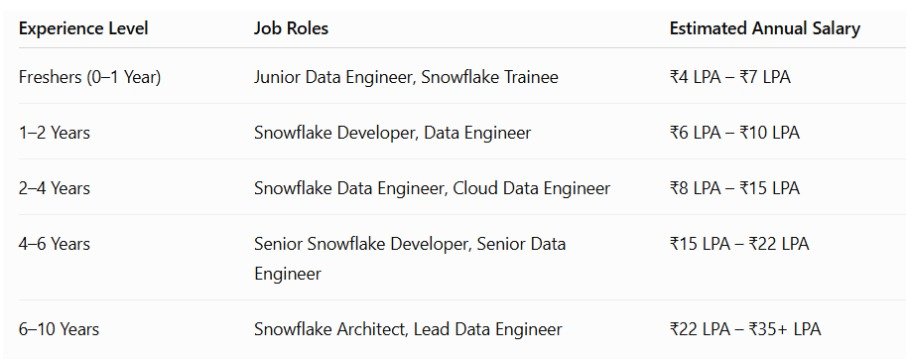
Snowflake Salary in India 2026
- Data storage
- Data querying
- Data preparation
- Data warehousing
- Large datasets
- Data engineering workflows
This knowledge can improve collaboration between data scientists, data engineers, and analytics teams.
Can Software Developers Learn Snowflake?
Software developers can learn Snowflake if they are interested in moving toward data-focused careers.
Developers often have experience with programming, databases, APIs, and application architecture.
These skills can help them transition toward data engineering or data platform roles.
A software developer interested in Snowflake can consider learning:
- SQL
- Python
- Data warehousing
- ETL
- ELT
- Cloud computing
- Snowflake
This combination can help developers expand their career options.
Can QA Professionals Learn Snowflake?
QA and testing professionals can also explore Snowflake.
Modern data environments require data testing and data quality validation.
QA professionals can apply their testing experience to areas such as:
- ETL testing
- Data validation
- Data reconciliation
- Data pipeline testing
- Data quality
- Database testing
- Data transformation testing
Professionals with SQL and database knowledge may find this transition easier.
Learning Snowflake can help QA professionals understand modern cloud data environments and explore data testing opportunities.
Can Experienced IT Professionals Learn Snowflake?
Experienced IT professionals from different backgrounds can learn Snowflake.
This includes professionals working in:
- Database administration
- Software development
- Data analytics
- Business intelligence
- ETL development
- Cloud computing
- Data engineering
For experienced professionals, the learning process may be faster because they already understand many fundamental technology concepts.
The main goal is to understand how these concepts work within Snowflake’s cloud-based architecture.
This is where Snowflake certification courses and hands-on training can help professionals structure their learning.
Can Career Changers Learn Snowflake?
Career changers can learn Snowflake, but they should approach the transition with a clear plan.
Learning one technology alone may not be enough to move into a new career.
For example, someone interested in data engineering may need to learn:
- SQL
- Python
- Databases
- Data warehousing
- ETL
- ELT
- Cloud computing
- Snowflake
- Data pipelines
- Someone interested in data analytics may focus more on:
- SQL
- Snowflake
- Data analysis
- Power BI
- Tableau
- Business intelligence
- The best roadmap depends on the career goal.
What Are the Prerequisites for Learning Snowflake?
Snowflake does not have one universal prerequisite list for every learner.
However, the following skills can make the learning journey easier:
- Basic SQL knowledge
- Database fundamentals
- Data warehousing concepts
- Cloud computing basics
- Analytical thinking
- Problem-solving skills
- Programming knowledge
Not every learner needs to master all these skills before starting.
For beginners, the best approach is to learn the fundamentals gradually.
Is SQL Mandatory to Learn Snowflake?
SQL is not necessarily a strict requirement for beginning Snowflake training, but it is highly recommended.
SQL is an important language for querying and working with data.
Beginners should become comfortable with concepts such as:
- SELECT statements
- Filtering
- Sorting
- Joins
- Grouping
- Aggregate functions
- Subqueries
- Common table expressions
- Window functions
Strong SQL knowledge can make it easier to understand Snowflake’s data-related capabilities.
Is Coding Required for Snowflake?
The amount of coding required depends on the role.
A data analyst may primarily work with SQL.
A data engineer may need SQL and Python.
A cloud professional may focus more on architecture and infrastructure concepts.
Therefore, advanced programming is not mandatory for everyone.
However, Python can be a valuable complementary skill for learners interested in data engineering and automation.
Do You Need AWS or Azure Experience Before Learning Snowflake?
No, previous AWS or Azure experience is not mandatory.
However, understanding basic cloud concepts can be helpful.
Learners should understand the general ideas of:
- Cloud computing
- Storage
- Compute
- Scalability
- Security
- Identity and access management
Snowflake can then be studied as part of the broader cloud data ecosystem.
What Career Opportunities Can Snowflake Skills Support?
Snowflake skills can support different career paths depending on your overall technical background.
Potential roles include:
- Snowflake Developer
- Snowflake Data Engineer
- Data Engineer
- Cloud Data Engineer
- Data Analyst
- Analytics Engineer
- ETL Developer
- Data Warehouse Developer
- Business Intelligence Developer
- Data Platform Engineer
- Data Architect
The specific role you qualify for depends on your complete skill set, experience, projects, and interview performance.
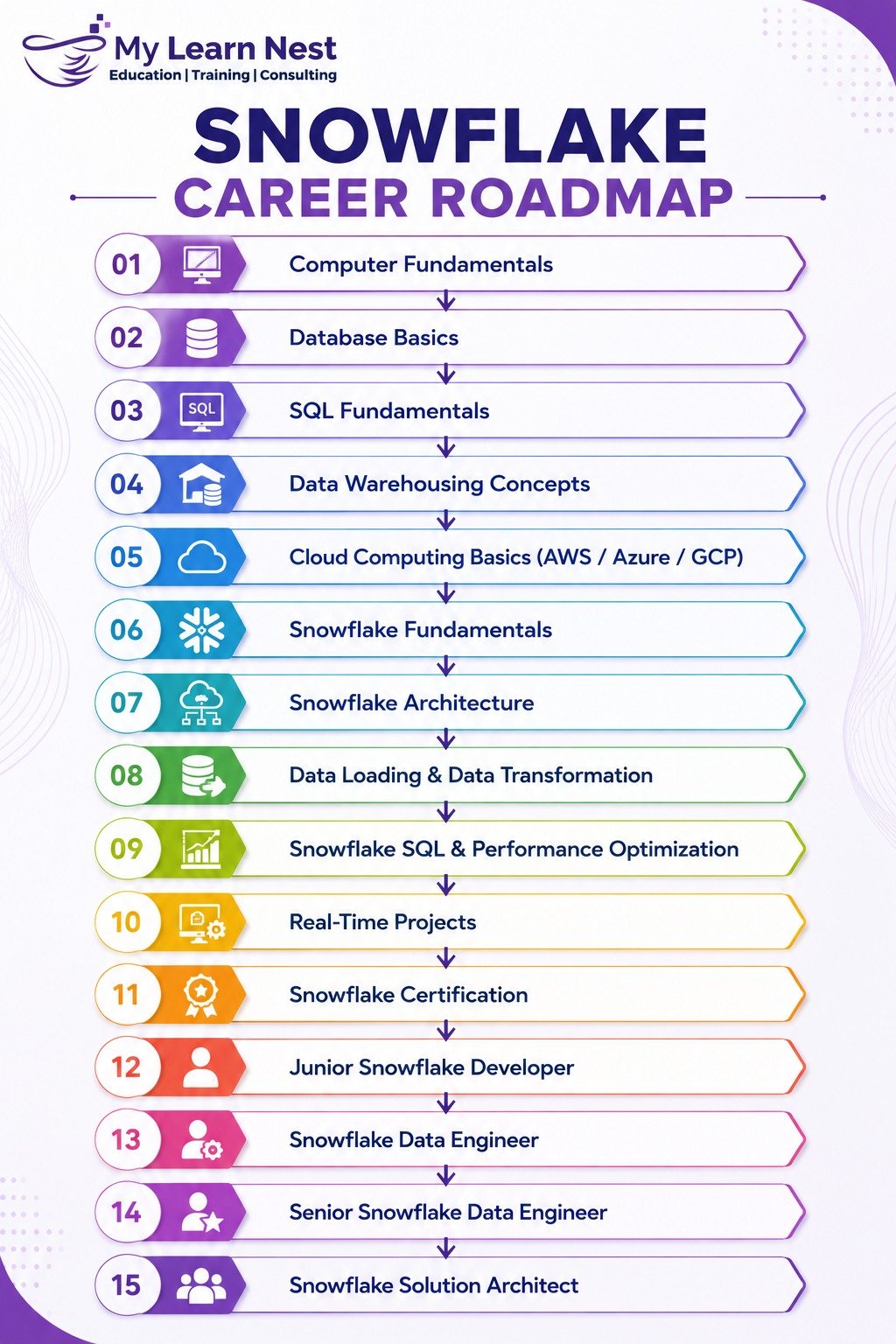
Snowflake Career Roadmap
What Skills Should You Learn Alongside Snowflake?
Learning Snowflake alongside complementary technologies can help create a stronger technical profile.
Important supporting skills include:
- SQL
- Python
- Data Warehousing
- ETL
- ELT
- Data Integration
- Data Transformation
- Cloud Computing
- AWS
- Microsoft Azure
- Google Cloud
- Power BI
- Tableau
- Data Engineering
- Data Analytics
The combination should be selected according to your target career.
Why Choose MyLearnNest for Snowflake Training?
Choosing the right training institute can make a significant difference when learning a technical platform.
MyLearnNest focuses on helping students, freshers, and professionals develop practical technology skills through structured learning and industry-oriented training.
For learners interested in Snowflake training in Hyderabad, the objective should be to understand both the fundamentals and practical applications of the platform.
A useful learning experience should include:
- Conceptual understanding
- SQL practice
- Hands-on exercises
- Real-world datasets
- Project-based learning
- Industry-oriented scenarios
- Interview preparation
- Career guidance
At MyLearnNest, learners can focus on developing practical knowledge rather than simply memorizing theoretical definitions.
The goal is to help learners understand how Snowflake fits into modern data engineering, cloud data warehousing, data analytics, and business intelligence environments.
Snowflake Training for Freshers at MyLearnNest
Freshers often need a structured learning path to move from academic knowledge to industry-oriented skills.
MyLearnNest provides a learning environment where freshers can gradually build their knowledge of SQL, databases, data warehousing, and Snowflake.
Practical exercises can help learners understand how data is loaded, stored, transformed, and analyzed.
Project-based learning can also help freshers understand real-world data scenarios.
For a fresher, the goal should be to build genuine technical knowledge and confidence rather than simply adding a technology name to a resume.
Snowflake Training for Working Professionals at MyLearnNest
Working professionals often already have technical experience.
An SQL developer may want to move toward cloud data platforms.
A database administrator may want to understand cloud-native data architecture.
A data analyst may want to strengthen technical data skills.
An ETL developer may want to explore ELT and modern data pipelines.
A cloud professional may want to understand data workloads.
MyLearnNest can help learners connect their existing skills with Snowflake concepts and modern data technologies.
Importance of Hands-On Snowflake Training
Practical experience is one of the most important parts of learning Snowflake.
Reading documentation and watching tutorials can provide theoretical knowledge, but hands-on practice helps learners understand how the technology works.
Learners should practice tasks such as:
- Creating databases
- Creating schemas
- Creating tables
- Loading data
- Writing SQL queries
- Transforming data
- Managing data access
- Working with datasets
- Analyzing business information
Real-world projects can make the learning experience more meaningful.
For example, learners can work with sales, customer, banking, healthcare, retail, or e-commerce datasets.
Through these projects, they can understand how data platforms are used to answer real business questions.
Snowflake Course Curriculum for Beginners
A structured Snowflake course curriculum may include the following areas:
- Introduction to Snowflake
- Cloud data warehousing
- Snowflake architecture
- Databases and schemas
- Tables and views
- Virtual warehouses
- SQL
- Data loading
- Stages
- File formats
- Data transformation
- Structured data
- Semi-structured data
- Data security
- Roles and privileges
- Performance optimization
- Data sharing
- Data integration
- Real-world projects
The exact curriculum may vary depending on the learner’s experience and career objective.
Who Should Join Snowflake Training?
Snowflake training can be considered by:
- Students
- Freshers
- BTech graduates
- SQL developers
- Database administrators
- Data analysts
- Data engineers
- ETL developers
- Cloud professionals
- BI professionals
- Python developers
- Data scientists
- Software developers
- Experienced IT professionals
- Career changers
The ideal learner is someone who is interested in data, cloud technologies, analytics, or data engineering and is willing to develop the necessary skills.
Who Should Not Rush Into Advanced Snowflake Topics?
Beginners should avoid jumping directly into advanced Snowflake concepts without understanding the fundamentals.
If you have never worked with databases, start with database concepts.
If you do not know SQL, begin with SQL fundamentals.
If cloud computing is new to you, learn basic cloud concepts.
If data warehousing is unfamiliar, understand its purpose first.
Building a strong foundation can make advanced Snowflake learning much easier.
How to Start Learning Snowflake
Your learning roadmap should depend on your current background.
If you are a student, begin with SQL and database fundamentals.
If you are a fresher, focus on SQL, data warehousing, and cloud basics.
If you are an SQL developer, move toward Snowflake architecture and cloud data concepts.
If you are a data analyst, combine Snowflake with SQL and business intelligence.
If you are a data engineer, learn Snowflake alongside Python, ETL, ELT, and cloud platforms.
If you are a career changer, begin with fundamentals and gradually develop a complete data skill set.
A structured Snowflake training program can help learners follow the right sequence.
Common Mistakes to Avoid While Learning Snowflake
One common mistake is trying to learn too many technologies simultaneously.
Another is ignoring SQL.
Some learners focus only on theoretical concepts and avoid hands-on practice.
Others memorize interview questions without understanding the underlying concepts.
A better approach is to:
- Learn the fundamentals
- Practice regularly
- Work with real datasets
- Build projects
- Understand concepts deeply
- Revise consistently
Prepare for interviews after developing practical knowledge
This approach can create stronger and more useful skills.
Is Snowflake a Good Skill for Freshers?
Snowflake can be a useful skill for freshers interested in modern data technologies.
However, freshers should avoid depending on Snowflake alone.
A stronger profile may include:
- SQL
- Python
- Data Warehousing
- ETL and ELT
- Cloud Fundamentals
- Snowflake
- Data Analytics
- Projects
- Communication Skills
- Interview Preparation
Combining these skills can help freshers develop a broader understanding of the data ecosystem.
Is Snowflake a Good Skill for Career Growth?
Snowflake can be a valuable skill for professionals working in data-related fields.
However, career growth depends on several factors.
Professionals should continuously improve their:
- Technical knowledge
- Problem-solving skills
- Communication
- Project experience
- Domain knowledge
- Cloud skills
- Data engineering knowledge
The technology industry changes continuously, so professionals should maintain a habit of continuous learning.
Snowflake can be one important component of a broader professional skill set.
Frequently Asked Questions About Who Can Learn Snowflake
Can a Fresher Learn Snowflake?
Yes. Freshers can learn Snowflake by developing foundational skills in SQL, databases, data warehousing, and cloud concepts.
Can a Non-IT Student Learn Snowflake?
Yes. Non-IT students can learn Snowflake if they are willing to develop the required technical fundamentals.
Is Coding Required to Learn Snowflake?
Advanced coding is not required for every Snowflake role. SQL is highly important, while Python can be useful for data engineering and automation.
Is SQL Required for Snowflake?
SQL knowledge is strongly recommended because SQL is widely used to query and work with data.
Can Data Analysts Learn Snowflake?
Yes. Data analysts can use Snowflake to work with large datasets and support analytical and business intelligence workflows.
Can Data Engineers Learn Snowflake?
Yes. Snowflake is relevant to modern data engineering environments and can complement SQL, Python, ETL, ELT, and cloud skills.
Can Students Learn Snowflake?
Yes. Students can start with SQL and database fundamentals and gradually progress toward Snowflake.
Can Working Professionals Learn Snowflake?
Yes. Working professionals can learn Snowflake to upgrade their cloud data, analytics, and data engineering skills.
Do I Need AWS or Azure Experience?
No. Previous AWS or Azure experience is not mandatory, although basic cloud knowledge can be helpful.
Can I Learn Snowflake Online?
Yes. Snowflake online training can be a convenient option for students and working professionals who prefer flexible learning.
Final Conclusion: Who Can Learn Snowflake?
The answer to “Who can learn Snowflake?” is broader than many people expect.
- Students can learn Snowflake.
- Freshers can learn Snowflake.
- BTech graduates can learn Snowflake.
- SQL developers can learn Snowflake.
- Database administrators can learn Snowflake.
- Data analysts can learn Snowflake.
- Data engineers can learn Snowflake.
- ETL developers can learn Snowflake.
- Cloud professionals can learn Snowflake.
- Business intelligence professionals can learn Snowflake.
- Python developers can learn Snowflake.
- Data scientists can learn Snowflake.
- Software developers can learn Snowflake.
- Experienced IT professionals can learn Snowflake.
- Career changers can also explore Snowflake by following a structured learning roadmap.
Choosing the right training institute is an important step in your learning journey. If you are looking for the Best Snowflake Training Institute in Hyderabad, MyLearnNest offers industry-focused training with hands-on practical sessions, real-time projects, interview preparation, and career guidance to help learners build job-ready skills.
If you are interested in cloud data platforms, data engineering, data analytics, or modern data warehousing, learning Snowflake with MyLearnNest can be a valuable step in building your technology skill set and preparing for the evolving world of data.
Start your Snowflake learning journey with MyLearnNest and take the first step toward a successful career in cloud data and analytics.

