
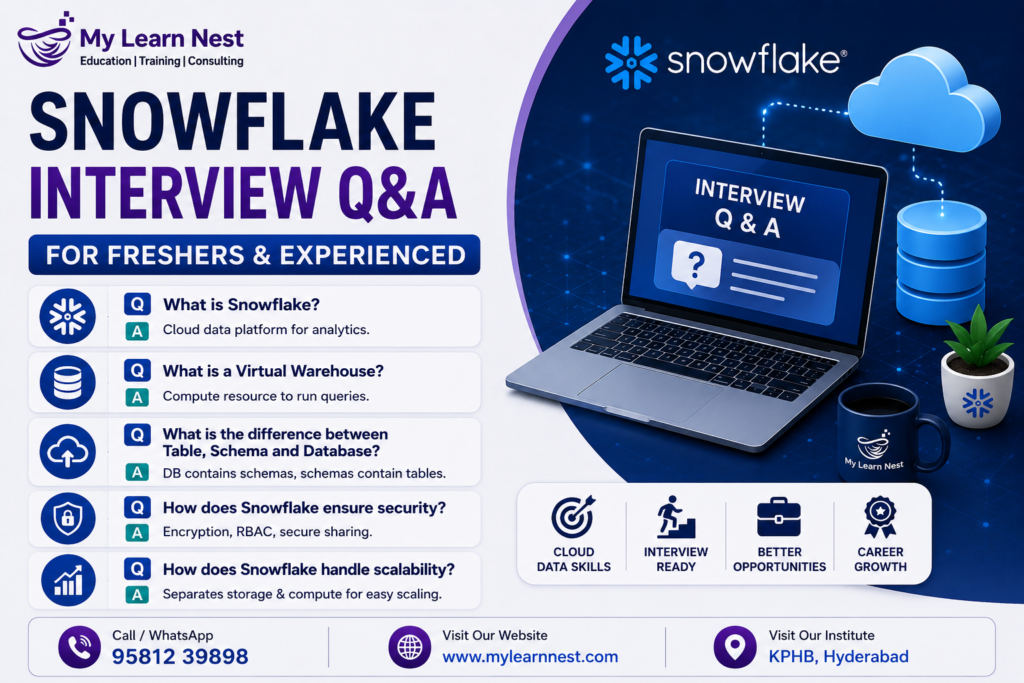
Introduction to Snowflake Interview Questions
Snowflake has become an important technology for companies building modern cloud data platforms. As organizations move their data warehouses to the cloud, the demand for professionals with Snowflake, SQL, data engineering, ETL, ELT, and cloud data warehouse skills continues to grow.
If you are preparing for a Snowflake interview, you should understand more than basic SQL. Interviewers may ask questions about Snowflake architecture, virtual warehouses, micro-partitions, Snowpipe, Streams, Tasks, security, RBAC, performance tuning, and real-time data engineering scenarios.
Freshers are generally asked fundamental questions to check their understanding of Snowflake and SQL. Experienced candidates may be asked scenario-based questions that test their ability to design pipelines, optimize queries, control costs, manage security, and solve production problems.
This guide covers important Snowflake interview questions and answers for freshers and experienced professionals.
Snowflake Basic Interview Questions for Freshers
What is Snowflake?
Snowflake is a cloud-based data platform that provides data warehousing, data engineering, analytics, data sharing, and data management capabilities.
It uses a cloud-native architecture in which storage and compute are separated. This allows organizations to store large amounts of data and scale computing resources independently.
Snowflake can run on major cloud platforms and supports structured and semi-structured data.
What are the main features of Snowflake?
Snowflake provides several features that make it suitable for modern data workloads. Its major capabilities include scalable storage, independent compute, virtual warehouses, automatic micro-partitioning, secure data sharing, Time Travel, data loading, and support for SQL-based analytics.
What is a Snowflake data warehouse?
A Snowflake data warehouse is a cloud-based environment used to store, transform, and analyze organizational data.
Unlike many traditional data warehouses, Snowflake separates storage from compute. This makes it possible to scale computing resources based on workload requirements.
What is a Snowflake database?
A database in Snowflake is a logical container for schemas and other database objects.
For example, an organization could create a database called SALES_DB and organize its data into schemas such as RAW, STAGING, and ANALYTICS.
What is a schema in Snowflake?
A schema is a logical container inside a database. It can contain tables, views, stages, file formats, procedures, and other Snowflake objects.
Databases and schemas help organizations organize data and control access.
SQL Interview Questions for Snowflake
Why is SQL important in Snowflake?
SQL is one of the primary languages used to interact with Snowflake. Data engineers and analysts use SQL to create tables, load and transform data, query datasets, create views, and manage database objects.
Strong SQL knowledge is therefore essential for a Snowflake data engineer.
What is the difference between WHERE and HAVING?
WHERE filters individual rows before grouping, while HAVING filters grouped results after an aggregation.
For example, if you want to find customers whose total purchases are greater than a specific amount, you can use GROUP BY with HAVING.
What is a JOIN in SQL?
A JOIN combines data from two or more tables using a related column. Common joins include INNER JOIN, LEFT JOIN, RIGHT JOIN, and FULL OUTER JOIN.
In Snowflake interviews, candidates may be asked to write SQL queries involving multiple tables, aggregations, subqueries, CTEs, and window functions.
What are window functions?
Window functions perform calculations across a set of rows while retaining individual row-level results.
Examples include ROW_NUMBER(), RANK(), DENSE_RANK(), LEAD(), and LAG().Window functions are frequently used in data engineering and analytics projects.
Snowflake Architecture Interview Questions
Explain Snowflake architecture.
Snowflake architecture is commonly explained using three major layers: the storage layer, compute layer, and Cloud Services layer.
The storage layer manages data storage. The compute layer processes queries through virtual warehouses. The Cloud Services layer handles services such as authentication, metadata management, access control, and query coordination.
The separation of storage and compute is one of the most important concepts to understand for a Snowflake interview.
How is Snowflake different from a traditional data warehouse?
Traditional data warehouses often have storage and compute resources that are closely connected.
Snowflake separates these resources. Data is stored independently, while virtual warehouses provide computing power when workloads need to be processed.This architecture provides greater flexibility for scaling and workload isolation.
What are micro-partitions?
Snowflake automatically organizes table data into small storage units called micro-partitions.
Snowflake maintains metadata about these partitions. During query processing, the platform can use this metadata to avoid scanning unnecessary data when applicable.
This behavior contributes to Snowflake query performance.
Snowflake Virtual Warehouse Interview Questions
What is a virtual warehouse?
A Snowflake virtual warehouse is a cluster of compute resources used to execute SQL queries, data loading operations, transformations, and other workloads.
A virtual warehouse does not permanently store the data. The data remains in Snowflake’s storage layer.
Why are virtual warehouses important?
Virtual warehouses provide compute resources independently of storage.
For example, a company can create separate warehouses for data engineering, reporting, and data science workloads. This helps isolate workloads and manage compute resources more effectively.
What happens when a virtual warehouse is suspended?
When a warehouse is suspended, its computer resources are stopped. The data remains available in the storage layer.
The warehouse can be resumed when another workload needs it. Automatic suspension and resume can help organizations manage computer usage.
How can you reduce Snowflake warehouse costs?
Cost management can involve selecting an appropriate warehouse size, using auto-suspend, avoiding unnecessary warehouse usage, monitoring workloads, and optimizing expensive queries.
Increasing warehouse size is not always the best solution for slow queries. SQL optimization and data-access patterns should also be reviewed.
Snowpipe Interview Questions
What is Snowpipe?
Snowpipe is a Snowflake service used for continuous or near-real-time data ingestion.
It allows data to be loaded into Snowflake as files become available in supported cloud storage environments.
Snowpipe is useful when organizations want new data to become available without relying entirely on large scheduled batch loads.
What is the difference between Snowpipe and bulk loading?
Bulk loading is generally used to load a larger set of files through a controlled loading process.
Snowpipe is designed for continuous ingestion of new files as they arrive.
The appropriate approach depends on the data volume, latency requirements, and architecture of the project.
When would you use a Snowpipe?
Snowpipe can be useful when a business receives data continuously and wants to load new files into Snowflake with lower latency.
For example, an application may generate transaction files throughout the day. Snowpipe can be used as part of a pipeline that detects and loads those files into Snowflake.
Streams and Tasks Interview Questions
What is a Snowflake Stream?
A Snowflake Stream records information about changes made to data. It can help identify inserted, updated, or deleted records for changing data capture workflows.
Streams are commonly used when building incremental data pipelines.
What is a Snowflake Task?
A Snowflake Task is used to execute SQL statements or stored procedures according to a schedule or dependency-based workflow.
Tasks can be used to automate data transformation and processing.
How do Streams and Tasks work together?
Streams can identify changes in source data, while Tasks can process those changes automatically.
For example, a Stream can capture newly changed records in a table and a Task can periodically process those records and load them into a target table.
This combination is commonly used in incremental ETL and ELT pipelines.
Snowflake Performance Tuning Interview Questions
How do you improve Snowflake query performance?
Performance tuning starts by identifying the reason for the slow query.
An engineer may review the query profile, SQL structure, filtering conditions, joins, warehouse size, data volume, and data-access patterns.
Snowflake also uses micro-partitions and metadata to improve data scanning efficiency.
What is partition pruning?
Partition pruning refers to reducing the amount of data that needs to be scanned by identifying relevant micro-partitions.
Good filtering conditions can help Snowflake avoid unnecessary scanning.
Does increasing the warehouse size always improve performance?
No.
Increasing warehouse size can provide additional compute resources, but it does not automatically solve every performance problem.
A slow query may be caused by inefficient SQL, large joins, unnecessary data scans, poor filtering, or other factors. The query itself should be investigated before simply increasing the warehouse size.
What is caching in Snowflake?
Snowflake uses caching mechanisms that can help improve response times for certain workloads.
When applicable, cached results or data can reduce the amount of processing required for repeated operations.Understanding caching can be useful when analyzing query performance and Snowflake cost.
Snowflake Security and RBAC Interview Questions
What is RBAC in Snowflake?
RBAC, or Role-Based Access Control, is a security approach where permissions are assigned to roles, and roles are assigned to users.
Instead of giving permissions individually to every user, organizations can create roles based on job responsibilities.
For example, an analyst role may have permission to query reporting tables but may not have permission to modify production data.
What is a role in Snowflake?
A role is a collection of privileges that determines what actions a user can perform.
Roles can be assigned to users and can also be organized through role hierarchies.
What are privileges?
Privileges define the operations a role can perform on Snowflake objects.
For example, a role may receive permission to SELECT data from a table or USAGE permission on a database or schema.
Why is RBAC important?
RBAC helps organizations implement the principle of least privilege.
Users should receive only the permissions required to perform their responsibilities. This reduces unnecessary access and improves security management.
Scenario-Based Snowflake Interview Questions
Scenario-based questions are especially important for experienced Snowflake candidates. These questions test whether you can apply Snowflake concepts to real business problems rather than simply define terms.
Your Snowflake query is running slowly. What will you check?
First, I would identify the query and review its execution details.
I would check the query profile, amount of data scanned, joins, filtering conditions, warehouse size, and whether unnecessary data is being processed.
I would then optimize the SQL and review whether the warehouse configuration is appropriate.
A company has separate reporting and ETL workloads. How would you design the Snowflake environment?
I would consider using separate virtual warehouses for ETL and reporting.
The ETL warehouse could process data ingestion and transformations, while the reporting warehouse could support analysts and dashboards.
This separation helps prevent heavy ETL workloads from affecting business reporting workloads.
A user accidentally deleted important data. What Snowflake feature would you consider?
I would first consider Time Travel, provided the data is still within the applicable retention period.
Time Travel can allow access to previous versions of data and may help recover accidentally deleted information.
Your Snowflake costs are increasing. What would you investigate?
I would review warehouse usage, warehouse sizes, auto-suspend settings, query patterns, long-running queries, unnecessary workloads, and usage across teams.
I would also identify expensive queries and determine whether SQL optimization could reduce compute consumption.
A company needs to load files continuously into Snowflake. Which feature could be useful?
Snowpipe could be considered for continuous or near-real-time file ingestion.
The final architecture would depend on the source system, file arrival pattern, latency requirements, and cloud storage environment.
Real-Time Snowflake Interview Questions
How would you design a real-time data pipeline using Snowflake?
I would begin by identifying the source system and required data latency.
The architecture could include an ingestion mechanism, Snowflake staging or landing areas, Streams for tracking changes where appropriate, Tasks or another orchestration mechanism for processing, and analytical tables for downstream users.
The design should also consider data quality, error handling, monitoring, security, and cost management.
How would you implement incremental data loading?
Instead of processing the entire dataset every time, I would identify new or changed records and process only the required data.
Snowflake Streams can be useful for change tracking, while Tasks can automate downstream processing.
This can reduce unnecessary processing and improve pipeline efficiency.
How would you handle duplicate records in a Snowflake pipeline?
I would first identify the business key or unique identifier for the records.
Depending on the use case, SQL techniques such as ROW_NUMBER() can be used to identify duplicate records. The pipeline can then retain the required record based on timestamp, source priority, or another business rule.
How would you handle failed data pipelines?
I would include monitoring and error-handling mechanisms in the pipeline.
The first step would be to identify whether the failure occurred during ingestion, transformation, data quality validation, or downstream processing.
Logs, query history, task status, load history, and other monitoring information can help identify the root cause.
Snowflake Interview Questions for Freshers vs Experienced Professionals
The difficulty of Snowflake interview questions usually depends on the candidate’s experience. Freshers should focus on understanding fundamental concepts such as Snowflake architecture, databases, schemas, tables, SQL, virtual warehouses, micro-partitions, Snowpipe, Streams, Tasks, and basic security.
Experienced professionals should be prepared for deeper discussions about data pipeline design, performance tuning, cost optimization, RBAC, security, data modeling, incremental processing, real-time ingestion, troubleshooting, and production scenarios.
For experienced candidates, interviewers often focus less on definitions and more on how you would solve a real business problem using Snowflake.
Common Mistakes to Avoid in a Snowflake Interview
Candidates sometimes memorize definitions without understanding how Snowflake works in a real project.
For example, knowing that a virtual warehouse provides compute resources is useful, but an interviewer may ask why you would create multiple warehouses or how you would control their costs.
Similarly, knowing what Snowpipe is may not be enough. You should understand when continuous ingestion is appropriate and how it fits into a complete data pipeline.
Before attending an interview, make sure you can explain concepts using simple examples and connect different Snowflake features together.
How to Prepare for a Snowflake Interview
A good preparation strategy should combine SQL practice, Snowflake concepts, hands-on exercises, and scenario-based questions.
Start with SQL fundamentals and then move toward Snowflake architecture. After understanding virtual warehouses and storage, learn data loading, Snowpipe, Streams, Tasks, security, RBAC, and performance tuning.
You should also practice creating tables, loading data, writing transformations, creating roles, managing warehouses, and building simple incremental pipelines.
For experienced candidates, working on real-time Snowflake projects can be especially helpful because project experience makes it easier to answer scenario-based interview questions.
Snowflake Interview Preparation with MyLearnNest
For learners planning to build a career in Snowflake and data engineering, structured training can help connect theoretical concepts with practical work.
At MyLearnNest, learners can focus on Snowflake concepts along with SQL, data engineering workflows, hands-on practice, and real-time project-based learning.
A good Snowflake training program should not focus only on interview questions. It should help learners understand how Snowflake is used in real projects, including data loading, transformations, virtual warehouses, Snowpipe, Streams, Tasks, security, and performance optimization.
For interview preparation, learners should combine training with regular SQL practice, Snowflake hands-on exercises, project work, and mock interview practice.
Conclusion
Preparing for Snowflake interview questions and answers requires a combination of theoretical knowledge and practical understanding.
Freshers should build a strong foundation in SQL, databases, Snowflake architecture, virtual warehouses, micro-partitions, Snowpipe, Streams, Tasks, and security.
Experienced professionals should go beyond definitions and prepare for scenario-based Snowflake interview questions, including performance tuning, cost optimization, RBAC, real-time data ingestion, incremental processing, troubleshooting, and data pipeline design.
The best way to prepare is to practice SQL regularly, work on real-world Snowflake projects, understand the reasoning behind each feature, and learn how different Snowflake components work together.
With strong SQL skills, hands-on Snowflake experience, and proper interview preparation, candidates can confidently approach opportunities in Snowflake data engineering, cloud data warehousing, ETL/ELT, analytics, and data engineering.

