
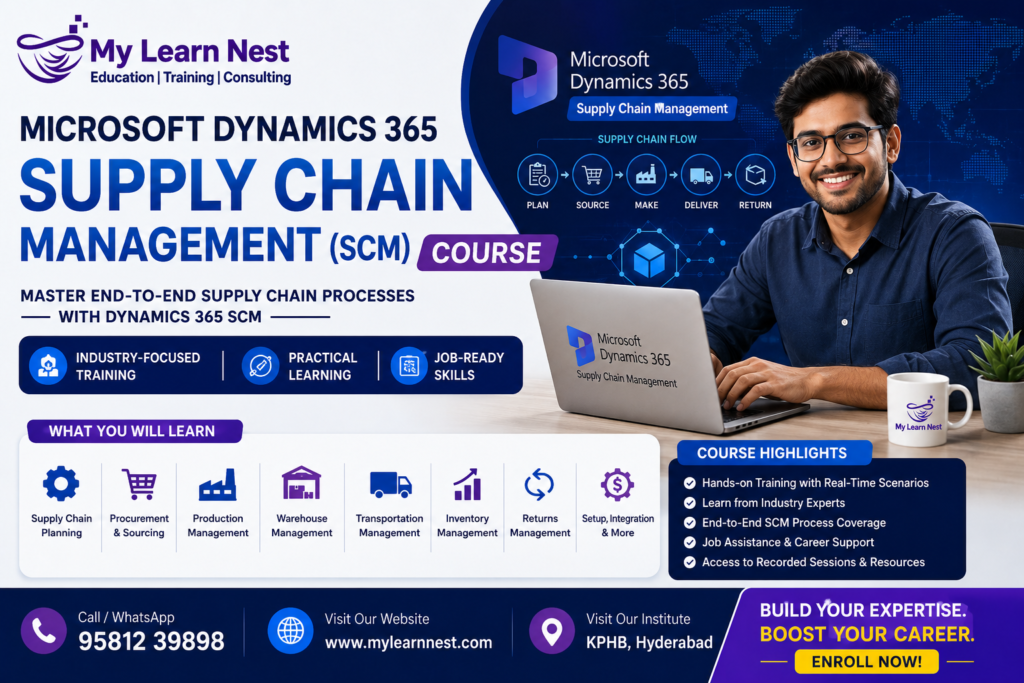
Dynamics 365 Supply Chain Management
Supply chain management plays an important role in the success of modern businesses. Companies need to purchase materials, manage inventory, process customer orders, operate warehouses, plan production, coordinate transportation, and work closely with suppliers. When these activities are managed through disconnected systems, businesses can face delays, inaccurate information, higher costs, and poor visibility.
Microsoft Dynamics 365 Supply Chain Management provides an integrated solution for managing many of these business processes. It helps organizations connect procurement, inventory, warehouse operations, sales orders, production, planning, transportation, and supplier collaboration within a unified enterprise environment.
For professionals interested in ERP and enterprise technology, learning Dynamics 365 Supply Chain Management can provide valuable knowledge of how technology supports real-world supply chain operations.
At MyLearnNest, learners can build practical knowledge of D365 Supply Chain Management through structured training, business scenarios, and hands-on learning. The objective is to help learners understand not only individual modules but also how supply chain processes work together from procurement to delivery.
What Is Dynamics 365 Supply Chain Management?
Dynamics 365 Supply Chain Management is a Microsoft business application designed to help organizations manage supply chain and operational processes.
It can support activities such as product information management, procurement, inventory management, sales and order processing, warehouse management, planning, transportation, vendor collaboration, and production control.
A company may use the platform to manage the movement of products and materials from suppliers through warehouses and production facilities to customers.The system can also help organizations improve visibility into inventory levels, supply requirements, purchasing activities, warehouse operations, and production planning.
For learners beginning D365 Supply Chain Management training, understanding this complete business flow is an important first step.
Why Learn Dynamics 365 Supply Chain Management?
Supply chains have become increasingly complex. Businesses may purchase materials from suppliers in different countries, manufacture products in multiple locations, store goods in several warehouses, and sell products to customers through different channels.
Managing these processes requires accurate and timely information.An ERP solution such as Dynamics 365 Supply Chain Management can help organizations connect different operational activities and create a more consistent flow of information.
Learning D365 SCM can therefore be useful for supply chain professionals, procurement specialists, warehouse professionals, business analysts, ERP consultants, developers, students, and graduates interested in enterprise applications.
Product Information Management
Product Information Management is an important foundation of Dynamics 365 Supply Chain Management.
Before a business can purchase, store, manufacture, or sell a product, it needs accurate information about that product.Product information may include product names, descriptions, units, categories, dimensions, configurations, variants, and other attributes required for business processes.
A well-managed product information structure helps organizations maintain consistency across procurement, inventory, sales, warehouse management, and production.
For example, a manufacturing company may have thousands of products and product variants. Without a centralized approach to product information, different departments could maintain inconsistent descriptions or product details.D365 Supply Chain Management helps organizations establish structured product information that can be used across business processes.
Product Categories and Variants
Businesses often sell products in different sizes, colors, models, configurations, or packaging options.
Managing these variations efficiently is important because each variant may have different inventory, pricing, purchasing, or production requirements.Understanding products, product variants, units of measure, and product categories is therefore an important part of Dynamics 365 SCM training.
A strong product information structure can also make downstream processes more reliable because purchasing, inventory, sales, and warehouse activities depend on accurate product data.
Inventory Management in Dynamics 365
Inventory is one of the most important areas of supply chain operations.
Businesses need to know what products they have, how much stock is available, where products are located, and when additional inventory is required.Dynamics 365 Supply Chain Management provides functionality for managing inventory transactions and inventory-related information.
Inventory can be tracked across different warehouses, locations, sites, and other organizational structures.The system can support activities such as receiving products, transferring inventory, adjusting stock, counting inventory, and issuing products for sales or production.
Inventory Visibility and Control
Poor inventory management can create significant business problems.If a company holds too much inventory, it may increase storage costs and tie up capital. If inventory is too low, the company may be unable to meet customer demand.
Effective inventory management requires a balance between availability and cost.
D365 Supply Chain Management helps organizations maintain better visibility into inventory so that business teams can make more informed decisions.For learners, inventory management provides an excellent example of how an ERP system connects physical business activities with digital information.
Procurement and Sourcing
Procurement is the process of obtaining products and services from suppliers.
A typical procurement process may begin when an organization identifies a requirement and continues through supplier selection, purchase requisition, purchase order, receipt of goods, invoice processing, and payment.
Dynamics 365 Supply Chain Management provides tools to support these processes. Procurement teams can manage suppliers, purchasing activities, purchase orders, and related business information within the system.The objective is to make purchasing more organized, transparent, and aligned with business requirements.
Supplier Management in D365 SCM
Organizations often work with many suppliers. Managing supplier information effectively is important because supplier performance can influence cost, quality, delivery time, and business continuity.
D365 Supply Chain Management allows organizations to maintain supplier-related information and manage purchasing relationships.Procurement professionals can use business processes to support supplier selection, purchasing, and ongoing supplier management.
For an aspiring Dynamics 365 Supply Chain Management consultant, understanding procurement is essential because it connects purchasing decisions with inventory, finance, and supplier operations.
Sales and Order Management
Sales and order management connects customer demand with the organization’s ability to provide products.
When a customer places an order, several processes may follow. The organization may need to check product availability, reserve inventory, prepare the order, ship the goods, and update financial information.
Dynamics 365 Supply Chain Management supports sales-related operational processes and connects them with inventory and warehouse activities.This helps businesses understand how customer orders affect inventory and fulfillment.
Order Fulfillment Process
Order fulfillment is more than simply recording a customer order.
A business needs to determine whether products are available, where they are stored, how they should be picked, and how they should be delivered.
For example, if a customer orders products that are available in a warehouse, the order may move through picking, packing, shipping, and delivery processes.Understanding this complete flow helps learners see how sales, inventory, warehouse management, and transportation are interconnected.
Warehouse Management in Dynamics 365
Warehouse operations involve the physical movement and storage of products. A warehouse may receive goods from suppliers, store inventory, pick products for customer orders, move goods between locations, pack shipments, and prepare products for transportation.
Dynamics 365 Supply Chain Management provides warehouse management functionality to help organizations organize these activities.Warehouse processes can become complex when companies handle thousands of products and large numbers of daily transactions.
Technology can help warehouse teams improve visibility and coordinate activities more effectively.
Warehouse Operations and Mobile Processes
Modern warehouses often use mobile devices to record inventory movements and operational activities.
Warehouse employees may scan products, locations, containers, or shipments during receiving, picking, packing, and other processes.Accurate data capture is important because warehouse information affects inventory availability, customer orders, procurement, and financial processes.
Learning warehouse management in D365 SCM gives professionals a practical understanding of how physical warehouse operations can be represented inside an ERP system.
Master Planning in Dynamics 365 SCM
Master planning helps organizations determine what products and materials may be required to meet expected demand.
Businesses need to consider current inventory, open purchase orders, production requirements, sales demand, lead times, and other planning factors.
The purpose of planning is to help organizations determine when they may need to purchase, manufacture, or replenish products.Master planning is therefore an important part of supply chain management because it connects demand with supply.
Supply Planning and Replenishment
Imagine a company selling thousands of products. If the company waits until inventory reaches zero before ordering more products, customers may experience delays.
Supply planning helps organizations anticipate future requirements.
Planning processes can consider expected demand and existing supply to help determine potential shortages and replenishment requirements.
Understanding these concepts is valuable for learners preparing for D365 Supply Chain Management training because planning is one of the core functions of modern supply chain operations.
Demand Planning
Demand planning focuses on understanding expected future demand for products. Businesses use demand information to support purchasing, inventory management, production, and distribution decisions.
Accurate demand planning can help organizations avoid excessive inventory while maintaining sufficient product availability.
For example, a retailer may expect higher demand for certain products during a festival season. Planning teams can use historical information, market expectations, and other relevant data to prepare inventory and supply activities.Demand planning therefore plays an important role in connecting business expectations with operational decisions.
Demand and Supply Balance
One of the biggest challenges in supply chain management is balancing demand and supply.
If demand is higher than available supply, the organization may face stock shortages. If supply is significantly higher than demand, the organization may have excess inventory.
Dynamics 365 Supply Chain Management provides planning capabilities that help organizations work toward a better balance.For learners, understanding this relationship is more important than memorizing individual planning features because it represents a fundamental supply chain business challenge.
Transportation Management
Once products are purchased, manufactured, or sold, they often need to be transported between locations.
Transportation Management supports activities associated with moving goods from one location to another.Organizations may need to manage carriers, routes, shipments, freight, transportation costs, and delivery requirements.
Transportation can have a significant impact on supply chain performance. Delays, high transportation costs, or inefficient routing can affect customer satisfaction and profitability.D365 Supply Chain Management helps organizations manage transportation-related processes as part of the broader supply chain.
Transportation and Delivery Efficiency
A successful supply chain is not only about having inventory available. Products also need to reach the correct location at the right time.Transportation planning helps organizations coordinate shipments and improve delivery processes.
For example, a company may need to transport products from a central warehouse to regional distribution centers. Efficient transportation planning can help reduce unnecessary costs and improve delivery reliability.
This makes transportation management an important area for professionals studying Microsoft Dynamics 365 Supply Chain Management.
Vendor Collaboration
Strong supplier relationships are important for maintaining a reliable supply chain. Organizations need to communicate with suppliers about purchase orders, product requirements, deliveries, confirmations, and other business activities.
Vendor collaboration capabilities can help businesses provide suppliers with appropriate information and allow suppliers to participate in relevant processes.This can improve transparency between organizations and their suppliers.
For example, a supplier may need to confirm an order or provide information about an expected delivery. Better communication can help purchasing and supply chain teams respond more quickly to changes.
Benefits of Vendor Collaboration
Vendor collaboration can reduce communication gaps and improve visibility into supplier activities.
When suppliers and purchasing teams have access to appropriate information, organizations can better understand order status and expected deliveries.This can be especially useful for companies working with large supplier networks or complex global supply chains.
For professionals learning D365 SCM, vendor collaboration demonstrates how an ERP system can connect an organization with external business partners.
Production Control in Dynamics 365
Manufacturing organizations need to plan and control the production of goods.
Production Control helps organizations manage activities related to manufacturing, production orders, materials, resources, and production processes.A production process may begin with a demand for a finished product. The organization then needs to determine which raw materials and resources are required to manufacture it.
Production processes need to be coordinated with inventory and planning because shortages of materials can delay manufacturing.Dynamics 365 Supply Chain Management connects production-related processes with other supply chain activities.
Production Planning and Execution
Manufacturing businesses need accurate information about what should be produced, when it should be produced, and what resources are required. Production planning helps organizations organize manufacturing activities, while execution processes track what actually happens on the production floor.
For example, a company manufacturing electronic equipment may need to plan production based on customer orders and expected demand.
The organization needs sufficient raw materials, appropriate production capacity, and timely inventory availability.D365 Supply Chain Management can help bring these processes together.
How D365 Supply Chain Management Modules Work Together
The real value of Dynamics 365 Supply Chain Management becomes clear when its modules are viewed as connected business processes.
Consider a manufacturing company receiving a large customer order.The order creates demand. Planning processes evaluate whether sufficient inventory and production capacity are available.
Procurement may be required to purchase additional raw materials. Warehouse teams receive and store those materials. Production uses them to manufacture the finished product. The warehouse then prepares the finished goods for shipment, and transportation processes help deliver them to the customer.
This example demonstrates how product information, procurement, inventory, planning, production, warehouse management, sales, and transportation can work together.
Real-World Example of Dynamics 365 SCM
Imagine an automobile parts manufacturer that supplies components to several vehicle manufacturers.
The company needs to manage thousands of products, multiple suppliers, raw materials, production schedules, warehouses, customer orders, and transportation activities. Product Information Management can maintain accurate product details. Procurement manages supplier purchases, while Inventory Management tracks materials and finished goods.
Master Planning and Demand Planning help determine future requirements. Production Control manages manufacturing processes, while Warehouse Management supports receiving, storage, picking, and shipment.
Transportation Management then supports the movement of products to customers.This connected approach can help the organization improve visibility and coordinate supply chain activities more effectively. Who Can Learn Dynamics 365 Supply Chain Management?
D365 Supply Chain Management can be useful for professionals from both business and technical backgrounds.
Supply chain professionals can learn how ERP technology supports operational processes. Procurement and warehouse professionals can understand how their daily activities are represented within an enterprise application.
Business analysts and functional consultants can learn how to translate business requirements into D365 SCM processes.
Students and graduates interested in ERP careers can also start with the fundamentals before specializing in areas such as procurement, inventory, warehouse management, planning, or manufacturing.
Career Opportunities in Dynamics 365 Supply Chain Management
Learning D365 Supply Chain Management can support several career paths in ERP and enterprise technology.
Common career directions include:
- Dynamics 365 Supply Chain Management Functional Consultant
- D365 SCM Consultant
- Supply Chain Business Analyst
- ERP Functional Analyst
- Dynamics 365 Implementation Consultant
- Procurement or Supply Chain Systems Consultant
- Dynamics 365 SCM Support Professional
Career progression generally depends on practical skills, project experience, functional specialization, implementation knowledge, and understanding of related Microsoft technologies.
Why Choose MyLearnNest for D365 Supply Chain Management Training?
Learning supply chain management through theory alone may not provide enough understanding for real-world ERP projects. Learners need to see how business processes connect and how different departments depend on each other.
MyLearnNest focuses on practical and career-oriented technology education. A structured Dynamics 365 Supply Chain Management training program can help learners move from basic concepts to practical business scenarios.
Learners can develop an understanding of procurement, inventory, product information, warehouse management, planning, transportation, vendor collaboration, sales orders, and production control.
The goal is to help learners build skills that can be applied to project discussions, interviews, implementation scenarios, and professional environments.
Benefits of Learning D365 Supply Chain Management
Learning Dynamics 365 SCM can help professionals understand the complete supply chain lifecycle.
Instead of focusing on a single department, learners can understand how procurement, inventory, warehouse operations, planning, production, sales, and transportation influence one another.
This broader perspective can be particularly valuable for functional consultants and business analysts because supply chain projects often involve multiple teams and business processes. It can also help professionals communicate more effectively with business stakeholders and technical teams during ERP implementations.
Start Learning Dynamics 365 Supply Chain Management with MyLearnNest
Modern supply chains require more than purchasing products and storing inventory. Organizations need to coordinate suppliers, products, warehouses, production, customer orders, transportation, and future demand.
Microsoft Dynamics 365 Supply Chain Management provides an integrated environment for managing these important processes.
Learning D365 SCM fundamentals gives professionals a strong understanding of how supply chain activities connect from procurement and planning through production, warehouse operations, and final delivery.
For students, supply chain professionals, business analysts, and aspiring ERP consultants, Dynamics 365 Supply Chain Management training can be a valuable step toward building a career in enterprise technology.
With structured learning, practical scenarios, and hands-on exposure, MyLearnNest can help learners develop the skills needed to understand D365 SCM and progress toward advanced Dynamics 365 Finance & Operations capabilities.

