
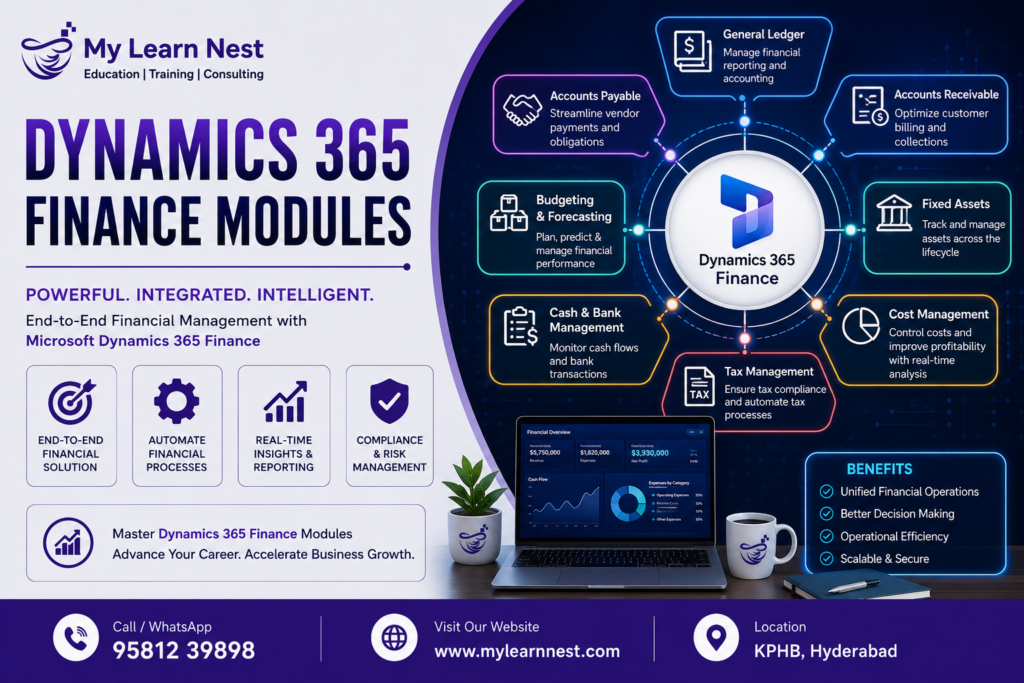
Dynamics 365 Finance Modules
Microsoft Dynamics 365 Finance is an important part of the Dynamics 365 Finance & Operations ecosystem. It helps organizations manage financial transactions, accounting processes, payments, receivables, assets, budgets, taxes, reporting, and financial analysis from a connected business platform.
As organizations move away from traditional accounting systems and adopt cloud-based enterprise applications, professionals with knowledge of Dynamics 365 Finance are becoming increasingly valuable. The platform provides tools that help finance teams manage day-to-day accounting activities while also giving management better visibility into financial performance.
For anyone planning to build a career in ERP, finance technology, or Microsoft business applications, learning the major Dynamics 365 Finance modules is an important step. Understanding how General Ledger, Accounts Payable, Accounts Receivable, Cash and Bank Management, Fixed Assets, Budgeting, Tax Management, and Financial Reporting work together provides a strong foundation for working with D365 Finance.
At MyLearnNest, learners can develop practical knowledge of Dynamics 365 Finance through structured training, business scenarios, and hands-on learning. The focus is on understanding how the platform supports real financial processes rather than simply learning individual features.
What Is Microsoft Dynamics 365 Finance?
Microsoft Dynamics 365 Finance is a cloud-based enterprise finance application that helps businesses manage and control their financial operations. It supports accounting, financial reporting, budgeting, cash management, taxation, accounts payable, accounts receivable, fixed assets, and other finance-related activities.
The platform can support organizations operating across different countries, currencies, departments, and legal entities. This makes it suitable for businesses with complex financial structures and growing operational requirements.
A key advantage of D365 Finance is its ability to connect financial activities with broader business operations. Transactions generated through procurement, sales, inventory, projects, and other processes can contribute to the organization’s financial data.This connected approach allows finance teams to work with more consistent information and helps management make decisions using current financial data.
Why Learn Dynamics 365 Finance Modules?
Finance is at the center of almost every organization. Companies need accurate information about revenue, expenses, assets, liabilities, cash flow, taxes, and profitability to make effective business decisions.
Learning Dynamics 365 Finance modules helps professionals understand how these financial processes can be managed through an enterprise application.
For example, Accounts Payable focuses on money the organization owes to suppliers, while Accounts Receivable focuses on money customers owe to the organization. General Ledger brings financial transactions together for accounting and reporting.Learning these modules individually is useful, but understanding how they interact is even more important for a Dynamics 365 professional. Professionals can use this knowledge when working as functional consultants, finance consultants, business analysts, ERP specialists, or implementation professionals.
General Ledger in Dynamics 365 Finance
General Ledger is one of the most important components of Dynamics 365 Finance. It provides the foundation for recording and managing an organization’s financial transactions.
The General Ledger contains information about accounts, financial transactions, accounting entries, and financial dimensions. It helps organizations maintain their accounting structure and produce financial information for reporting.
Businesses can configure a chart of accounts according to their financial requirements. Transactions from different areas of the organization can eventually contribute to the General Ledger. For example, purchasing activities may generate accounting entries related to expenses and vendors, while sales transactions can contribute to revenue and customer-related accounting.
Chart of Accounts and Financial Dimensions
A chart of accounts defines the main accounts used by an organization to record financial transactions. These accounts can represent expenses, revenue, assets, liabilities, and other financial categories.
Financial dimensions provide additional information that helps organizations analyze transactions.A business might want to analyze an expense by department, cost center, business unit, location, or project. Financial dimensions can provide this additional level of classification.
Understanding the relationship between the chart of accounts and financial dimensions is essential for professionals learning Microsoft Dynamics 365 Finance.
Accounts Payable in Dynamics 365 Finance
Accounts Payable, commonly called AP, manages the money an organization owes to its suppliers and vendors.
When a business purchases products or services from a supplier, the resulting invoice needs to be recorded, reviewed, approved, and eventually paid. Dynamics 365 Finance provides functionality to support these processes.Accounts Payable can help organizations manage vendor information, invoices, payments, settlements, and related financial transactions.
A typical AP process may begin with a purchase transaction and continue through invoice processing, approval, payment, and accounting.This makes Accounts Payable an important module for finance teams and professionals pursuing a career in Dynamics 365 Finance.
Vendor Invoice Management
Vendor invoices need to be recorded accurately because they directly affect expenses, liabilities, cash flow, and financial reporting.Dynamics 365 Finance provides tools to help organizations manage vendor invoices and related accounting information.
Businesses can establish approval processes to ensure invoices are reviewed before payment. This can improve financial control and reduce the possibility of incorrect or unauthorized payments.
For a D365 Finance consultant, understanding the complete vendor invoice lifecycle is more important than simply knowing where an invoice screen is located.
Accounts Receivable in Dynamics 365 Finance
Accounts Receivable, or AR, focuses on money owed to a company by its customers.
When a company sells products or services on credit, the customer may pay at a later date. Accounts Receivable helps organizations record customer transactions, manage invoices, track outstanding balances, and process payments.
Effective accounts receivable management is important for maintaining healthy cash flow.Finance teams need to know which customers have outstanding balances, which invoices are overdue, and how much money is expected to be collected.Dynamics 365 Finance provides functionality that supports these activities within the broader financial management system.
Customer Invoicing and Collections
Customer invoicing is an important part of the Accounts Receivable process. Once a sale or service transaction occurs, the organization may generate an invoice that contains details about the amount due and payment requirements.
Organizations can then track customer payments and outstanding balances.Collections activities are also important when customers do not pay within the agreed payment period. Businesses can monitor overdue invoices and take appropriate action to improve collections.
Understanding this process helps D365 Finance learners connect accounting functionality with real business requirements.
Cash and Bank Management
Cash flow is one of the most important financial concerns for any business. Organizations need to know how much cash they have, what payments are expected, and what money is coming into the business.
The Cash and Bank Management functionality in Dynamics 365 Finance helps organizations manage bank accounts, cash transactions, payments, deposits, and related activitieFinance teams can use the system to maintain information about company bank accounts and monitor financial transactions.
Bank reconciliation is another important activity. It involves comparing transactions recorded in the organization’s financial system with information provided by the bank.Accurate reconciliation helps identify differences and improves the reliability of financial information.
Why Cash Management Matters
Strong cash management helps businesses maintain financial stability.
A company may be profitable but still face challenges if it does not manage cash effectively. Monitoring incoming and outgoing payments allows finance teams to understand the organization’s short-term financial position.
Learning Cash and Bank Management as part of Dynamics 365 Finance training gives professionals a practical understanding of how technology can support day-to-day treasury and cash activities.
Fixed Assets in Dynamics 365 Finance
Fixed assets are long-term assets owned or used by an organization. Examples may include buildings, vehicles, machinery, computers, and equipment.Businesses need to maintain accurate records of these assets throughout their lifecycle.
The Fixed Assets functionality in Dynamics 365 Finance helps organizations manage asset information, acquisition, depreciation, adjustments, transfers, and disposal.
For example, when a company purchases a new machine, the asset may need to be recorded in the system and depreciated over its useful life according to the organization’s accounting policies.Managing these activities accurately is important for financial reporting and asset control.
Asset Lifecycle Management
A fixed asset generally goes through several stages during its lifecycle.It may begin with acquisition, followed by capitalization, depreciation, adjustment, transfer, and eventually disposal.
Dynamics 365 Finance helps organizations maintain information related to these stages.
Understanding the fixed asset lifecycle is particularly useful for professionals working in finance departments and for functional consultants implementing D365 Finance for organizations with significant physical assets.
Budgeting in Dynamics 365 Finance
Budgeting allows organizations to plan expected income and expenses for a particular period.
A business may create budgets for departments, projects, cost centers, or other organizational areas. Actual financial results can then be compared against planned amounts.This comparison helps management understand whether spending is within expectations.
For example, if a department has a planned annual technology budget but actual spending is significantly higher, management can investigate the reason and take corrective action.Dynamics 365 Finance supports budgeting processes that can help organizations improve financial planning and control.
Budget Control and Financial Planning
Budgeting is not only about creating a number for expected expenses. It is also about monitoring how actual transactions compare with financial plans.
Organizations can use budget information to support planning and decision-making.
When budgeting is connected with financial transactions, finance teams can obtain a clearer picture of how the organization is performing against its plans.This is one reason budgeting is an important topic in a comprehensive D365 Finance course.
Tax Management in Dynamics 365 Finance
Tax requirements can vary significantly depending on the country, state, business type, transaction type, and applicable regulations.Dynamics 365 Finance provides tax-related functionality to help organizations configure and manage tax information as part of their financial processes.
Tax configuration can include elements such as tax codes, tax groups, tax calculations, and reporting requirements.Businesses need to ensure that tax-related information is configured appropriately according to their applicable rules and organizational requirements.
For learners in India, understanding the broader concept of tax configuration is especially useful when studying ERP finance processes because businesses may need to manage country-specific taxation requirements.
Importance of Tax Configuration
Incorrect tax configuration can affect invoices, accounting entries, reporting, and compliance.
Therefore, finance professionals and consultants need to understand how tax information flows through business transactions.
Tax management also demonstrates why D365 Finance is more than a basic accounting system. It brings financial processes, business transactions, and reporting requirements together within a single enterprise platform.

Financial Reporting in Dynamics 365 Finance
Financial reporting helps organizations understand their financial position and performance.
Businesses may need reports covering revenue, expenses, assets, liabilities, profitability, cash flow, and other financial information.Dynamics 365 Finance provides financial reporting capabilities that can help finance teams generate reports based on organizational requirements.
Reports can be designed to provide information for different audiences. Operational users may require detailed transaction information, while senior management may prefer summarized financial results.Good financial reporting allows organizations to convert accounting data into information that supports business decisions.
Management Reporting and Business Decisions
Financial reports are useful because they provide insight into what is happening inside an organization. Management may use financial information to identify areas where costs are increasing, compare performance across departments, monitor profitability, or evaluate business plans.
For a Dynamics 365 professional, understanding reporting requirements is important because a successful ERP implementation should support both transaction processing and decision-making.
Financial Insights and Analytics
Modern finance teams increasingly depend on analytics rather than relying only on traditional reports.Financial insights and analytics help organizations identify trends, understand financial performance, and make more informed decisions.
For example, finance teams may analyze revenue trends, expenses, customer balances, vendor payments, cash flow, and budget performance.
When financial information is available in a connected environment, organizations can spend less time collecting information manually and more time analyzing what the information means.This is an important part of the modern Dynamics 365 Finance ecosystem.
Role of Analytics in Modern Finance
Analytics can help finance professionals move from simply recording transactions to becoming strategic business partners.
Instead of only answering questions such as “How much did we spend?”, finance teams can explore questions such as “Why did spending increase?”, “Which business unit is performing better?”, and “Where can costs be reduced?”
This shift toward data-driven finance is increasing the importance of ERP and analytics skills.Professionals who combine finance knowledge with Dynamics 365 Finance training can therefore develop a valuable combination of business and technology skills.
How Dynamics 365 Finance Modules Work Together
The real strength of Dynamics 365 Finance becomes clearer when the modules are viewed as connected processes rather than separate features.
Consider a company purchasing equipment from a supplier. The transaction may involve procurement, Accounts Payable, Cash and Bank Management, Fixed Assets, General Ledger, and financial reporting.
Similarly, a customer sale may create processes involving Accounts Receivable, revenue accounting, cash management, General Ledger, and reporting.This integration reduces the need to maintain disconnected financial information across multiple systems.Understanding these connections is essential for anyone preparing for a career as a Dynamics 365 functional consultant.
Real-World Example of D365 Finance
Imagine a manufacturing company that operates several production facilities.
The company purchases raw materials from suppliers, sells finished products to customers, pays employees and vendors, owns manufacturing equipment, manages bank accounts, prepares budgets, and files tax-related reports.
General Ledger provides the accounting foundation. Accounts Payable manages supplier-related financial transactions, while Accounts Receivable manages customer balances. Fixed Assets tracks equipment, Cash and Bank Management handles cash-related processes, and Budgeting helps management plan expenses.
Financial reporting and analytics then bring this information together so management can evaluate business performance.This example shows how the different Dynamics 365 Finance modules work together to support an organization’s complete financial lifecycle.
Who Can Learn Dynamics 365 Finance?
Dynamics 365 Finance is suitable for learners who want to combine finance and enterprise technology skills.
Finance and accounting professionals can use the platform to understand how modern ERP systems support accounting processes. Business analysts can learn how financial requirements are translated into application processes.
Students and graduates can use D365 Finance as an entry point into the ERP industry, while experienced professionals can use it to expand their existing Microsoft or finance skills. People interested in functional consulting can also benefit from understanding how business requirements map to D365 Finance functionality.
Career Opportunities in Dynamics 365 Finance
Knowledge of Dynamics 365 Finance can support several career paths within the ERP and Microsoft technology ecosystem.
Some common roles include:
- Dynamics 365 Finance Functional Consultant
- D365 Finance Consultant
- ERP Business Analyst
- Dynamics 365 Functional Analyst
- Finance Systems Consultant
- Dynamics 365 Implementation Consultant
- ERP Support Professional
Career growth depends on experience, functional specialization, implementation exposure, certifications, and knowledge of related technologies.
Why Choose MyLearnNest for Dynamics 365 Finance Training?
Learning an enterprise finance platform requires more than reading definitions. Professionals need to understand how accounting processes work and how those processes are represented inside the application.
MyLearnNest provides career-oriented technology training designed to help learners understand technical concepts in a practical and structured manner.
A good Dynamics 365 Finance training program should gradually introduce learners to financial processes, application functionality, business scenarios, and real-world implementation concepts. At MyLearnNest, learners can build their knowledge from fundamentals and progress toward more advanced areas of Dynamics 365 Finance.
The focus should remain on developing practical understanding that learners can apply during projects, interviews, and professional work.
Benefits of Learning Dynamics 365 Finance Modules
Learning the complete finance ecosystem gives professionals a broader understanding of how businesses manage their financial operations.
Rather than specializing in only one accounting process, learners can understand how General Ledger, Payables, Receivables, Cash Management, Fixed Assets, Budgeting, Tax, and Reporting connect with one another.
This broader understanding can be particularly useful for functional consultants because real implementation projects often involve multiple connected processes.It can also help candidates answer scenario-based interview questions more effectively because they understand the complete business process rather than an isolated feature.
Start Your Dynamics 365 Finance Learning Journey with MyLearnNest
Microsoft Dynamics 365 Finance provides organizations with a connected platform for managing critical financial activities. From General Ledger and Accounts Payable to budgeting, taxation, fixed assets, reporting, and analytics, its modules support different stages of the financial lifecycle.
For students, finance professionals, business analysts, and aspiring ERP consultants, learning Dynamics 365 Finance modules can be an important step toward building a career in enterprise technology.
With structured learning, practical scenarios, and hands-on exposure, MyLearnNest can help learners develop the knowledge required to understand Microsoft Dynamics 365 Finance and move toward more advanced D365 F&O skills.

