
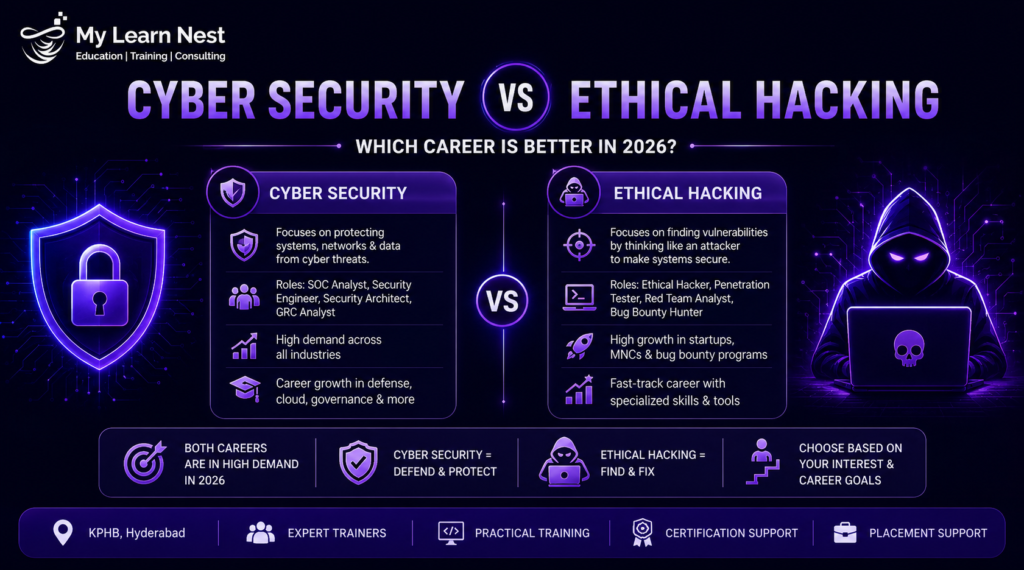
Cyber Security vs Ethical Hacking – Which Career Is Better in 2026?
Cybersecurity and ethical hacking are closely related fields, but they are not the same career. Both offer opportunities in the growing technology industry, but the skills, responsibilities, tools, and career paths can be different.
If you are confused between Cyber Security vs Ethical Hacking, this guide explains the differences, career scope, skills, salary factors, jobs, and learning roadmap to help you choose the right path.
What Is Cyber Security?
Cybersecurity is the broader field of protecting computers, networks, applications, cloud environments, data, and digital systems from cyber threats.
Cybersecurity professionals work on preventing attacks, detecting suspicious activity, investigating incidents, managing vulnerabilities, protecting identities, and responding to security incidents.
Common cybersecurity roles include SOC Analyst, Security Analyst, Incident Responder, Security Engineer, Cloud Security Engineer, Threat Hunter, Security Architect, and Cybersecurity Consultant.
What Is Ethical Hacking?
Ethical hacking is the authorized practice of identifying and testing security weaknesses in systems, networks, applications, and infrastructure. Ethical hackers simulate attacks within an approved scope to discover vulnerabilities before malicious attackers can exploit them.
Common ethical hacking activities include vulnerability assessment, penetration testing, web application testing, network security testing, API security testing, and security reporting.Ethical hacking is therefore a specialized area within the broader cybersecurity field.
Cyber Security vs Ethical Hacking: Main Difference
The easiest way to understand the difference is:
- Cybersecurity = Protect the organization.
- Ethical Hacking = Test the organization’s defenses.
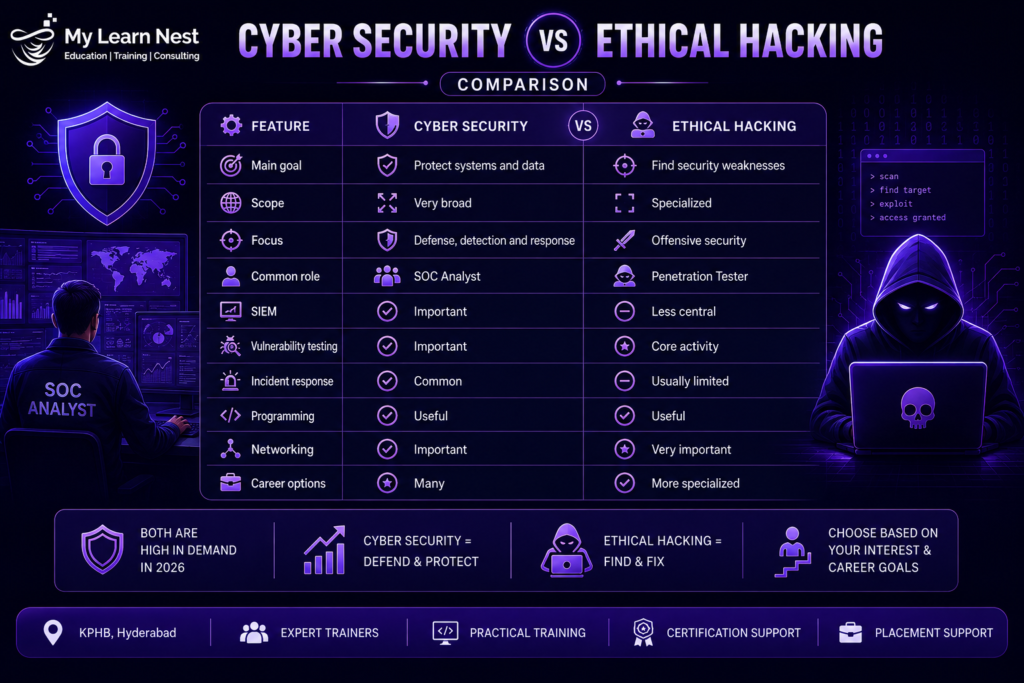
Cybersecurity covers a much broader range of activities, while ethical hacking focuses mainly on finding and validating security weaknesses through authorized testing.
Cyber Security vs Ethical Hacking Comparison
Cybersecurity Career Scope
Cybersecurity has a broad career scope because almost every organization needs security professionals.
You can work in security operations, cloud security, application security, identity and access management, incident response, threat intelligence, governance, risk and compliance, digital forensics, security engineering, and security architecture.
This makes cybersecurity a flexible career choice for people who are not yet sure which security specialization they want to pursue.
Ethical Hacking Career Scope
Ethical hacking provides a more specialized path within cybersecurity.Professionals can work as Penetration Testers, Ethical Hackers, Red Teamers, Application Security Testers, Vulnerability Assessment Analysts, Security Consultants, or Offensive Security Engineers.
Ethical hacking can be particularly attractive if you enjoy understanding how systems work and thinking about how vulnerabilities could be discovered and exploited in authorized environments.
Skills Required for Cybersecurity
A cybersecurity professional should develop a strong understanding of:
- Networking
- Operating systems
- Security fundamentals
- SIEM
- Incident response
- Threat detection
- Cloud security
- Identity and access management
- Security monitoring
- Risk management
The exact skills depend on the cybersecurity specialization you choose.
Skills Required for Ethical Hacking
Ethical hackers need strong technical knowledge of:
- Networking
- Linux
- Web applications
- Operating systems
- Vulnerabilities
- Authentication
- APIs
- Security testing
- Scripting
- Penetration-testing methodologies
They also need to understand how vulnerabilities work and how to document security findings clearly.
Programming Skills: Cybersecurity vs Ethical Hacking
Programming is useful in both careers, but the level required depends on the role.Cybersecurity professionals can benefit from Python, PowerShell, Bash, SQL, and scripting for automation and investigation.
Ethical hackers can benefit from Python and scripting for automation, security testing, data processing, and understanding application behavior.You do not need to become an expert programmer before starting either career.
Networking: Which Career Needs More?
Networking is important for both fields.
SOC Analysts need to understand network traffic to investigate suspicious connections, while ethical hackers need networking knowledge to understand how systems communicate and identify potential attack surfaces.
If you are planning to enter cybersecurity or ethical hacking, learning TCP/IP, DNS, HTTP/HTTPS, ports, protocols, routing, VPNs, and firewalls is a good starting point.
Tools Used in Cybersecurity
Cybersecurity professionals may use tools such as Microsoft Sentinel, Splunk, QRadar, Wireshark, endpoint detection platforms, vulnerability scanners, threat-intelligence platforms, and security automation tools.
The tools depend heavily on the role.
For example, a SOC Analyst may spend most of the day working with SIEM and EDR platforms, while a cloud security engineer may focus on cloud-native security tools.
Tools Used in Ethical Hacking
Ethical hackers may work with tools such as Nmap, Burp Suite, Wireshark, Metasploit, and vulnerability-scanning platforms, depending on their authorized testing environment.
The important point is to learn these tools only in legal and authorized environments such as your own lab, training platform, or systems for which you have explicit permission to test.
Cybersecurity Certifications
For beginners, certifications can provide a structured way to learn cybersecurity fundamentals.
CompTIA Security+ is one commonly considered entry-level cybersecurity certification.As you gain experience, you can choose certifications based on your specialization, such as security operations, cloud security, incident response, or security management.
Ethical Hacking Certifications
Ethical hacking candidates can consider certifications focused on penetration testing and offensive security.
Examples include Certified Ethical Hacker (CEH) and more practical penetration-testing certifications.
The right certification depends on your career goals and existing technical experience. Certifications should be combined with hands-on labs and projects.
Cyber Security vs Ethical Hacking Salary
Salary varies significantly based on experience, company, location, specialization, and technical skills.
Entry-level cybersecurity and ethical-hacking roles can have similar compensation, while experienced professionals can earn significantly more as they move into specialized or senior positions.
Instead of comparing only the job title, compare the skills, responsibilities, industry, and experience level associated with the role.
Cybersecurity Salary in India
Cybersecurity salaries in India vary widely.
Entry-level roles such as SOC Analyst or Junior Security Analyst may start at a relatively moderate salary, while experienced professionals in cloud security, security engineering, threat hunting, incident response, and security architecture can command higher compensation.
Hyderabad, Bengaluru, Pune, Chennai, Mumbai, and Delhi-NCR are among the major Indian technology markets where cybersecurity opportunities can be found.
Ethical Hacker Salary in India
Ethical hacking salaries depend heavily on practical penetration-testing skills and experience.
A beginner may start with a junior security-testing or vulnerability-assessment role. With experience, professionals can progress toward Penetration Tester, Red Team Specialist, Application Security Engineer, or Offensive Security Consultant positions.
Advanced skills in web security, cloud security, APIs, Active Directory, and security testing can increase career opportunities.
Which Career Is Better for Freshers?
For most freshers, cybersecurity is the broader starting point.
You can begin with networking, Linux, Windows, security fundamentals, SIEM, and incident response and then decide whether you want to specialize in offensive security later.
If you already know that you enjoy penetration testing and application security, ethical hacking can be a good specialization.
Which Career Is Easier to Start?
Neither career is completely easy, but cybersecurity operations can provide a clearer entry-level path through roles such as SOC Analyst L1.
Ethical hacking often requires stronger technical knowledge of networks, operating systems, web applications, and vulnerabilities before you can perform meaningful penetration testing.
For many beginners, starting with cybersecurity fundamentals and then moving into ethical hacking is a practical approach.
Cyber Security Roadmap for Beginners
A beginner can follow this roadmap:
Computer Fundamentals → Networking → Linux & Windows → Cybersecurity Fundamentals → SIEM → SOC → Incident Response → Cloud Security → Threat Hunting → Specialization
After gaining the fundamentals, you can choose areas such as cloud security, application security, threat intelligence, or ethical hacking.
Ethical Hacking Roadmap for Beginners
A practical ethical-hacking roadmap can look like:
Computer Fundamentals → Networking → Linux → Web Technologies → Security Fundamentals → Vulnerability Assessment → Web Security → Penetration Testing → Security Reporting → Advanced Specialization
Practice should always be performed in authorized environments.
Cybersecurity Projects for Your Resume
If you choose cybersecurity, build projects such as a SIEM monitoring dashboard, failed-login detection system, phishing investigation, Windows log analysis project, brute-force detection system, or threat-hunting investigation.
Document the tools, methodology, findings, and recommendations for each project.
Ethical Hacking Projects for Your Resume
Ethical-hacking portfolios can include authorized web application security assessments, vulnerability assessment reports, API security testing labs, network security testing, and penetration-testing reports.
Do not simply list tools. Explain the vulnerability, testing methodology, evidence, risk, and recommended remediation.
Cyber Security vs Ethical Hacking: Which Should You Choose?
Choose Cybersecurity if you enjoy:
- Security monitoring
- Investigation
- Incident response
- Threat detection
- Cloud security
- Security engineering
- Working with SIEM and security platforms
Choose Ethical Hacking if you enjoy:
- Finding vulnerabilities
- Penetration testing
- Web application security
- Network testing
- Offensive security
- Security research
- Thinking like an attacker
Can You Learn Both Cybersecurity and Ethical Hacking?
Yes. In fact, learning the fundamentals of both can make you a stronger security professional.
Understanding offensive techniques can help defensive professionals understand attacker behavior. Similarly, understanding defensive controls can help ethical hackers produce more useful security recommendations.
However, it is better to learn the fundamentals first and specialize later rather than trying to master everything at once.
Cybersecurity vs Ethical Hacking: Career Growth
Cybersecurity offers a wider range of long-term career paths.
A professional can move from SOC Analyst → Security Analyst → Security Engineer → Senior Security Engineer → Security Architect.
An ethical hacker might progress from Junior Penetration Tester → Penetration Tester → Senior Penetration Tester → Red Team Specialist → Offensive Security Consultant.
Experienced professionals can also move into security leadership and consulting.
How MyLearnNest Can Help
MyLearnNest can help learners build cybersecurity skills through a structured learning path covering cybersecurity fundamentals, ethical hacking, network security, SOC operations, SIEM, cloud security, application security, projects, and interview preparation.
Learners can first develop a strong cybersecurity foundation and then choose an area of specialization based on their interests and career goals.
Frequently Asked Questions
Is cybersecurity better than ethical hacking?
Neither is universally better. Cybersecurity is broader, while ethical hacking is a specialized offensive-security career. Your choice should depend on your interests and career goals.
Can I become an ethical hacker after learning cybersecurity?
Yes. Cybersecurity fundamentals provide a strong foundation for learning penetration testing and ethical hacking.
Is ethical hacking difficult for beginners?
It can be challenging because you need to understand networking, operating systems, applications, and vulnerabilities. Starting with basic cybersecurity and networking makes the learning process easier.
Does ethical hacking require coding?
Advanced coding is not always required, but scripting and programming skills can make you much more effective at security testing and automation.
Which has more career opportunities?
Cybersecurity generally has more job categories because it includes SOC, cloud security, security engineering, incident response, GRC, threat intelligence, application security, and other areas.
What should I learn first?
Start with networking, Linux, Windows, and cybersecurity fundamentals. After that, explore SOC operations or ethical hacking based on your interests.
Conclusion
The choice between Cyber Security vs Ethical Hacking depends on the type of work you enjoy. Cybersecurity provides a broader career path covering defense, monitoring, incident response, cloud security, and security engineering. Ethical hacking focuses more on finding vulnerabilities and testing systems through authorized offensive-security techniques.
For beginners, a strong approach is to learn cybersecurity fundamentals first and then specialize in ethical hacking or another security domain. Building practical projects, completing hands-on labs, and developing skills in networking, Linux, security tools, and scripting can help you prepare for cybersecurity careers in 2026.
For MyLearnNest learners, the best strategy is to build a strong foundation and gradually specialize in SOC, Ethical Hacking, Cloud Security, Network Security, or Application Security based on your career goals.

