
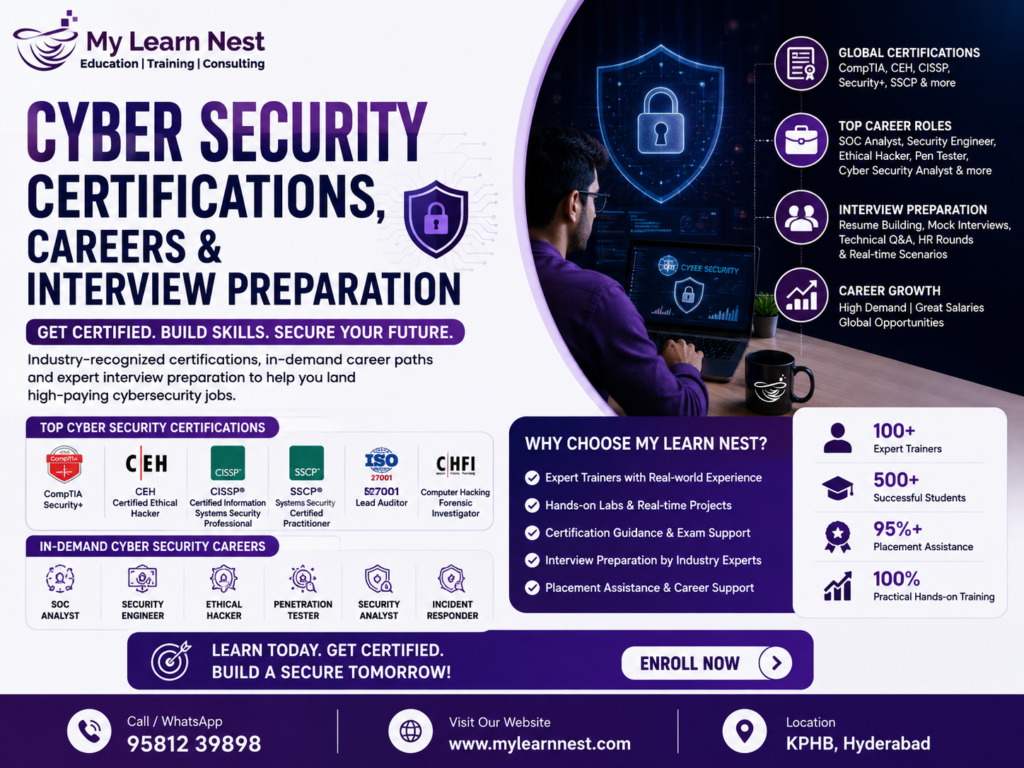
Cyber Security Certifications, Careers and Interview Preparation
Cyber security has become one of the most important career fields in the technology industry. As businesses move their applications, data, infrastructure, and services online, the need for professionals who can protect digital systems continues to grow.
A career in cyber security is not limited to ethical hacking. The field includes security operations, network security, cloud security, application security, penetration testing, incident response, vulnerability management, digital forensics, and security engineering.
For students and IT professionals planning to enter this field, having a clear Cyber Security career roadmap can make the learning process easier. Certifications, practical projects, technical skills, resume preparation, and interview practice can all contribute to building a successful career.
This guide explains the major cyber security career paths, popular certifications, salary considerations in India, interview preparation, and practical project ideas.
What Is a Cyber Security Career?
A cyber security career involves protecting computers, networks, applications, cloud environments, devices, and information from security threats.
Cyber security professionals work in different areas depending on their skills and interests. Some monitor security alerts in a Security Operations Center, while others test applications for vulnerabilities or design security controls for cloud infrastructure.
The field offers opportunities for both freshers and experienced IT professionals.
The important thing is to build a strong technical foundation before choosing a specialization.
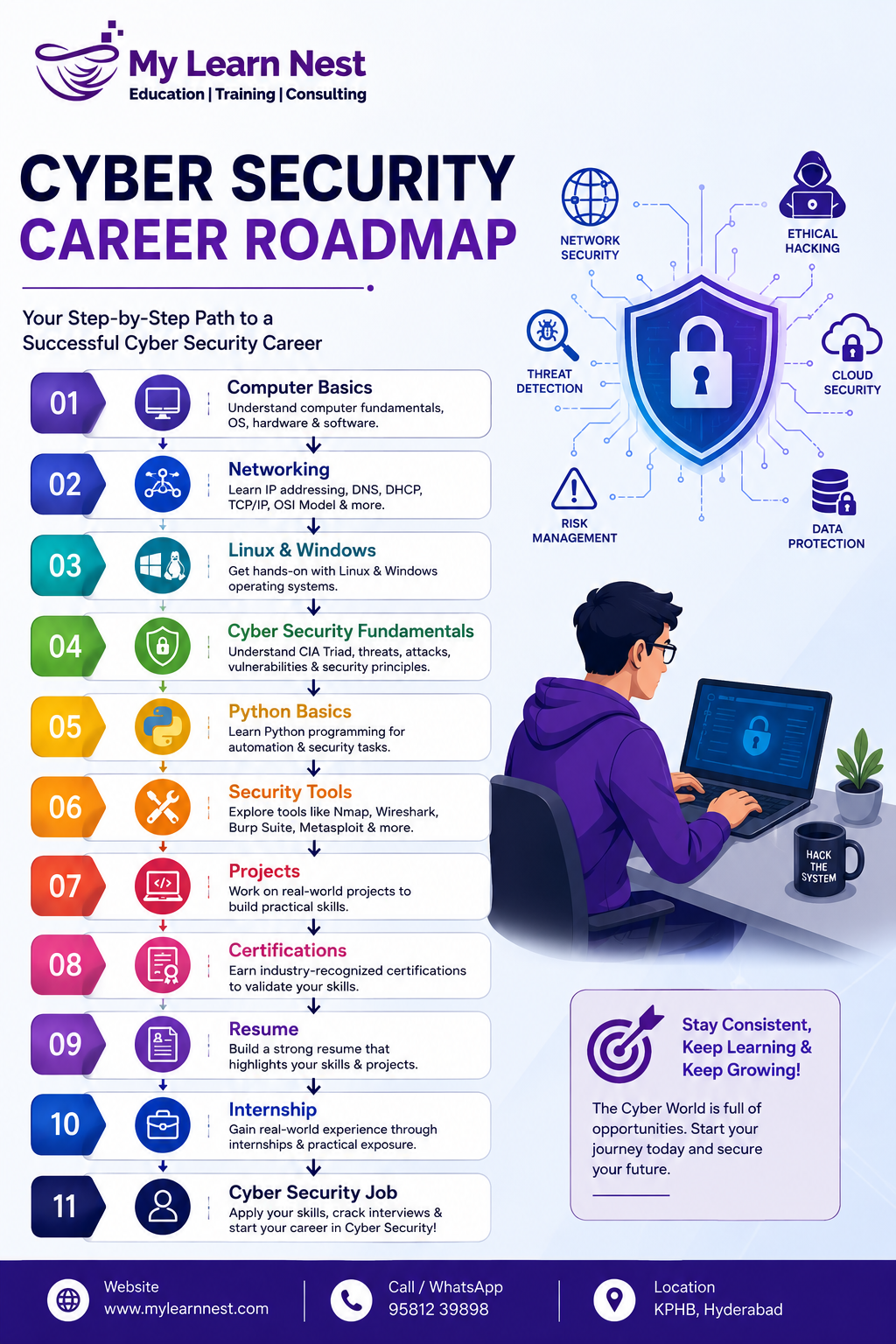
Cyber Security Career Roadmap
A good cyber security career roadmap starts with fundamentals.
Beginners should first understand computer systems, networking, operating systems, databases, web technologies, and basic security concepts.
After learning these foundations, students can explore areas such as ethical hacking, SOC operations, cloud security, application security, or incident response.
A practical roadmap can include:
- Learn networking and operating system fundamentals.
- Study cyber security concepts and common attack techniques.
- Learn security tools and technologies.
- Build practical projects in controlled environments.
- Choose a specialization.
- Prepare for relevant certifications.
- Create a strong resume and portfolio.
- Practice technical and scenario-based interviews.
This approach is more effective than trying to learn every cyber security technology at the same time.
Cyber Security Skills for Beginners
A beginner should focus on developing strong fundamentals rather than collecting a large number of tools.
Networking is particularly important. Knowledge of IP addresses, DNS, TCP/IP, ports, protocols, routing, firewalls, and VPNs can help learners understand how attacks and defenses work.
Operating system knowledge is also useful. Security professionals frequently work with Windows and Linux environments. Basic programming and scripting can be helpful for automation and security analysis. Python, Bash, PowerShell, and basic web technologies can provide useful skills depending on the chosen career path.
Communication and problem-solving are equally important because security professionals need to explain technical issues and investigate unfamiliar situations.
Cyber Security Certifications
Certifications can help demonstrate knowledge and provide a structured learning path, but they should not replace hands-on experience.
The most suitable certification depends on the learner’s career goals and existing experience.For beginners, foundational certifications can help build knowledge of general security principles.
Professionals interested in ethical hacking may consider certifications focused on penetration testing and offensive security. Those interested in security operations can explore certifications related to security analysis, incident response, and defensive security.
Cloud-focused professionals can consider security certifications offered by major cloud providers.
Popular certification categories include:
- Cyber security fundamentals
- Ethical hacking and penetration testing
- Security operations and incident response
- Cloud security
- Network security
- Governance, risk, and compliance
Learners should select certifications based on their target role rather than choosing certifications simply because they are popular.
How to Choose the Right Cyber Security Certification
Choosing a certification becomes easier when the desired career path is clear.
A student interested in SOC operations should prioritize networking, security monitoring, SIEM, incident response, and threat detection. Someone interested in ethical hacking should focus on web security, networking, vulnerability assessment, penetration testing, and security tools.
A cloud security professional should understand cloud architecture, IAM, networking, encryption, monitoring, and cloud-specific security controls.
Certification preparation becomes much more valuable when combined with practical labs and projects.
Ethical Hacker Career Path
An ethical hacker is an authorized security professional who evaluates systems and applications to identify security weaknesses.
The career path usually begins with networking, operating systems, web technologies, and cyber security fundamentals. After building these skills, learners can study vulnerability assessment, web application security, penetration testing methodology, and security reporting.
Ethical hackers should understand both offensive techniques and defensive recommendations. Finding a vulnerability is only one part of the job. A professional must also explain the risk and recommend appropriate remediation.
Practical experience in authorized laboratories is especially important for this career path.
SOC Analyst Career Path
A SOC Analyst monitors an organization’s security environment and investigates suspicious events.
The SOC career path is suitable for people who enjoy monitoring, analysis, investigation, and problem-solving. Beginners should learn networking, operating systems, security fundamentals, logs, SIEM concepts, endpoint security, and common attack techniques.
Hands-on practice with security alerts and log analysis can help learners understand the daily responsibilities of a SOC analyst.
With experience, a SOC analyst can progress toward roles such as incident response analyst, threat hunter, detection engineer, security engineer, or SOC lead.
Cyber Security Engineer Career Path
A cyber security engineer designs, implements, and maintains security controls across an organization’s technology environment.
This role can involve network security, cloud security, endpoint protection, identity management, vulnerability management, security automation, and infrastructure security.
The career path generally requires stronger technical knowledge than entry-level security roles. Professionals should understand networking, operating systems, cloud platforms, security architecture, scripting, monitoring, and security technologies.
Experience in infrastructure or system administration can also provide a useful foundation for moving into security engineering.
Cyber Security Salary in India
Cyber security salaries in India vary significantly based on experience, location, technical skills, organization, specialization, and certifications.
Freshers entering roles such as junior security analyst or SOC analyst may start with entry-level compensation. Professionals with several years of experience and specialized skills can move into higher-paying roles such as security engineer, cloud security engineer, penetration tester, or security architect.
Salary can also vary depending on the technology specialization.
For example, professionals with experience in cloud security, application security, incident response, security engineering, or advanced penetration testing may have different compensation levels from general security roles.
Instead of focusing only on a salary figure, learners should consider the long-term value of developing strong technical skills and gaining practical experience.
Factors That Influence Cyber Security Salary
Several factors can affect cyber security salary in India.
Experience is one of the most important factors. As professionals gain practical experience, their responsibilities and earning potential can increase.
Technical specialization also matters. Skills in cloud security, application security, penetration testing, threat detection, incident response, and security engineering can support different career opportunities.
Certifications can strengthen a professional profile, particularly when they are relevant to the target role. Location, organization size, industry, job responsibilities, and interview performance can also influence compensation.
Cyber Security Interview Preparation
Cyber security interviews can include questions about fundamentals, tools, technologies, security concepts, and real-world scenarios.
Interviewers often want to know whether candidates can apply their knowledge rather than simply memorize definitions.
A strong preparation strategy should include networking, operating systems, cyber security fundamentals, authentication, vulnerabilities, incident response, cloud security, and common attack techniques.
Candidates should also be prepared to explain projects they have completed.
Cyber Security Interview Questions
Common interview questions may include:
- What is cyber security?
- What is the difference between a vulnerability, threat, and risk?
- What is the CIA Triad?
- What is a firewall?
- What is the difference between IDS and IPS?
- What is SIEM?
- What is phishing?
- What is ransomware?
- What is vulnerability assessment?
- What is penetration testing?
- What is the difference between authentication and authorization?
- What is the OWASP Top 10?
- What is incident response?
Candidates should understand the concepts behind these questions rather than memorizing short answers.
Scenario-Based Cyber Security Interview Questions
Scenario-based questions are increasingly important in cyber security interviews because they test practical thinking. For example, an interviewer may ask what you would do if a user reports a suspicious email.
A strong answer should explain how you would investigate the email, identify indicators of compromise, determine whether the message is malicious, protect the user and other employees, and document the incident according to company procedures.
Another scenario may involve a sudden increase in failed login attempts.
The candidate should discuss reviewing authentication logs, identifying affected accounts, checking source information, determining whether the activity appears legitimate or malicious, and taking appropriate containment or escalation steps.
How to Answer Scenario-Based Questions
A structured approach can make scenario-based answers clearer. First, explain how you would identify and understand the problem. Then describe how you would investigate relevant evidence.
Next, explain how you would contain or reduce the risk if necessary. Finally, discuss recovery, documentation, and lessons learned.
Candidates should avoid giving overly aggressive responses without considering business requirements and authorization.
Cyber security professionals need to demonstrate both technical knowledge and good judgment.
Resume Preparation for Cyber Security Jobs
A cyber security resume should clearly communicate technical skills, projects, certifications, education, and relevant experience.
- Freshers should focus on practical projects, labs, internships, certifications, and technical skills.
- Instead of simply listing tools, candidates should explain how they used those tools in projects.
For example, rather than writing only “SIEM,” a candidate can describe a project involving log collection, alert analysis, detection rules, and incident investigation.
This gives recruiters a better understanding of the candidate’s practical knowledge.
Cyber Security Resume Skills
Depending on the target role, relevant skills may include:
- Networking and TCP/IP
- Linux and Windows
- SIEM and log analysis
- Vulnerability assessment
- Penetration testing
- Web application security
- Cloud security
- IAM
- Incident response
- Python or security scripting
Candidates should customize the skills section according to the job description rather than adding every technology they have encountered.
Cyber Security Portfolio
A portfolio can help freshers demonstrate practical knowledge when they have limited professional experience.
A good cyber security portfolio can include security projects, lab exercises, technical reports, detection rules, vulnerability assessment reports, and documented learning activities. Projects should clearly explain the objective, technologies used, security problem, approach, findings, and recommendations.
All security testing should be performed in authorized environments.
Cyber Security Real-Time Projects
Practical projects can help learners bridge the gap between classroom knowledge and professional security work.
A SOC monitoring project can involve collecting security logs, configuring a SIEM, creating alerts, and investigating simulated security events.
A web application security project can involve testing a deliberately vulnerable training application against relevant OWASP risks and preparing a security assessment report.
A network security project can involve configuring firewall rules, monitoring network traffic, identifying vulnerabilities, and documenting security recommendations.
A cloud security project can focus on IAM, secure network configuration, encryption, logging, and cloud vulnerability assessment.
An incident response project can simulate a security incident and require the learner to investigate the timeline, identify affected systems, contain the issue, and prepare a final report.
How Real-Time Projects Help in Interviews
Projects give candidates something concrete to discuss during technical interviews.
Interviewers may ask why a particular security control was selected, how a vulnerability was identified, what evidence was collected, or how an incident was handled.
Candidates who have completed practical projects can answer these questions using real examples from their learning experience.
Projects also demonstrate problem-solving ability, which is difficult to show through certification names alone.
Cyber Security Certifications vs Practical Skills
Certifications can help candidates demonstrate structured knowledge, but practical skills remain important.
A candidate may have several certifications but struggle to analyze a security alert or explain how a vulnerability affects an application.
Another candidate may have fewer certifications but strong hands-on experience and a clear understanding of security fundamentals.
The strongest profile combines relevant certifications with practical projects, technical knowledge, communication skills, and continuous learning.
Common Mistakes in Cyber Security Job Preparation
One common mistake is trying to learn too many tools without understanding basic concepts. Another mistake is collecting certifications without gaining practical experience.
Some candidates also prepare only theoretical interview questions and avoid scenario-based practice. A weak resume can create another problem. Listing dozens of technologies without demonstrating how they were used can make a resume less convincing.
Candidates should focus on depth, relevance, and practical application.
How Freshers Can Start a Cyber Security Career
Freshers should begin with networking, operating systems, cyber security fundamentals, and basic security tools.
After building the foundation, they can select a specialization such as SOC, ethical hacking, cloud security, application security, or security engineering.
Practical projects should be completed alongside learning.
Internships, training programs, security laboratories, certifications, and technical communities can provide additional exposure. The goal should be to gradually build a profile that demonstrates knowledge, practical ability, and interest in the field.
How IT Professionals Can Move Into Cyber Security
IT professionals from networking, system administration, software development, cloud, or infrastructure backgrounds may already have useful technical knowledge.
For example, a network engineer can move toward network security, while a cloud professional can specialize in cloud security.
Software developers can explore application security and DevSecOps. System administrators can move toward security operations or security engineering. Identifying existing technical strengths can make the transition into cyber security more efficient.
Importance of Communication Skills in Cyber Security
Cyber security is not only a technical field.
Security professionals need to explain vulnerabilities, incidents, risks, and recommendations to other teams.
A SOC analyst may need to communicate an incident to an incident response team. A penetration tester may need to explain a critical vulnerability to developers. A security engineer may need to explain security architecture to management.
Clear communication can therefore improve career growth.
Future Scope of Cyber Security Careers
The cyber security industry continues to evolve as organizations adopt cloud computing, artificial intelligence, APIs, mobile applications, remote work, automation, and connected technologies.
This creates opportunities across many security specializations.
Cloud security, application security, security operations, identity security, threat intelligence, incident response, security engineering, and DevSecOps are among the areas that require specialized knowledge.
Professionals who continue learning and adapt to new technologies can build long-term careers in the field.
Conclusion
Cyber Security Certifications, Careers and Interview Preparation provide an important foundation for learners who want to turn cyber security knowledge into a professional career.
A successful career does not depend on certifications alone. Candidates need strong fundamentals, practical experience, relevant projects, communication skills, and the ability to solve real-world security problems.
Whether the goal is to become an Ethical Hacker, SOC Analyst, Cyber Security Engineer, Cloud Security Professional, Penetration Tester, or Incident Response Analyst, a structured career roadmap can make the journey easier.
For freshers, the best approach is to start with networking and cyber security fundamentals, choose a specialization, complete real-time cyber security projects, earn relevant certifications, build a strong resume, and practice both technical and scenario-based interview questions. With continuous learning and practical experience, cyber security can become a rewarding and long-term technology career.

