

Cyber Security Fundamentals and Ethical Hacking
Cyber security has become one of the most important areas of technology as businesses, governments, educational institutions, and individuals depend on digital systems every day. From online banking and cloud applications to mobile apps and business websites, almost every service is connected to the internet. This increased connectivity also creates opportunities for cyber criminals to steal data, damage systems, and disrupt business operations.
Cyber Security Fundamentals and Ethical Hacking provide the foundation for understanding how digital systems are protected and how security weaknesses can be identified before attackers exploit them. Ethical hacking focuses on authorized security testing, where professionals use controlled techniques to discover vulnerabilities and help organizations improve their security.
For students, freshers, IT professionals, and anyone planning a career in information security, learning cyber security fundamentals is an important first step. A strong understanding of networking, operating systems, vulnerabilities, security controls, and ethical hacking techniques can help learners move toward roles such as Security Analyst, Ethical Hacker, Penetration Tester, Vulnerability Assessment Analyst, and Cyber Security Engineer.
What Is Cyber Security?
Cyber security is the practice of protecting computers, networks, applications, devices, cloud environments, and digital information from unauthorized access, attacks, damage, and misuse.
Organizations store large amounts of valuable information, including customer details, financial records, employee information, business documents, credentials, and intellectual property. If this information is not properly protected, attackers may use it for financial fraud, identity theft, espionage, or other malicious activities.
Cyber security is not limited to installing antivirus software. Modern security involves multiple layers of protection, including secure networks, identity management, access controls, encryption, vulnerability management, monitoring, incident response, employee awareness, and regular security testing.
The main objectives of cyber security are commonly explained through the CIA Triad:
- Confidentiality ensures that information is available only to authorized users.
- Integrity protects information from unauthorized modification.
- Availability ensures that systems and information remain accessible when required.
These three principles form the foundation of many cyber security practices.
Why Cyber Security Is Important
Businesses increasingly depend on digital infrastructure to operate. A security incident can affect not only technical systems but also a company’s reputation, finances, customer trust, and daily operations.
Cyber attacks can target organizations of every size. Small businesses may be targeted because they sometimes have fewer security resources, while large enterprises may be attractive because they manage valuable data and complex infrastructure.
A strong cyber security strategy helps organizations identify risks early and reduce the potential impact of security incidents. Security professionals work continuously to detect suspicious activity, identify weaknesses, improve security controls, and respond to incidents.
For individuals entering the technology industry, cyber security also offers a wide range of career opportunities. Learning Cyber Security Fundamentals and Ethical Hacking can provide a foundation for more advanced areas such as penetration testing, cloud security, application security, digital forensics, security operations, and threat intelligence.
Introduction to Ethical Hacking
Ethical hacking is the authorized process of testing computer systems, networks, applications, and other digital assets to identify security weaknesses.
An ethical hacker works with permission from the organization or system owner. The objective is not to steal information or damage systems. Instead, ethical hackers simulate certain attacker behaviors in a controlled environment to discover weaknesses before malicious attackers find them.
For example, an organization may ask an ethical hacker to test its website for security vulnerabilities. The tester may examine authentication, authorization, input validation, configuration, and other security controls. The findings are then documented and provided to the organization so that security teams can fix the identified issues.
This makes ethical hacking an important part of proactive cyber security.
Ethical Hacking Fundamentals
Ethical hacking follows a structured process rather than random experimentation. Before testing begins, the organization and security professional normally establish the scope, objectives, systems that can be tested, testing limitations, and rules of engagement.
Authorization is one of the most important concepts in ethical hacking. Testing a system without permission can be illegal, even if the intention is to identify vulnerabilities. A professional ethical hacker should therefore understand both technical security concepts and responsible security practices.
The general ethical hacking process includes reconnaissance, security assessment, vulnerability identification, controlled testing, analysis, documentation, and reporting.
The final report is particularly important because it explains what was discovered, why it matters, and how the organization can improve its security.
Types of Cyber Attacks
Cyber attacks can take many forms, depending on the attacker’s objective and the target environment. Some attacks attempt to steal credentials, while others aim to install malicious software, disrupt services, manipulate information, or gain unauthorized access.
Phishing is one of the most common attack types. Attackers may send fraudulent emails or messages designed to convince users to click malicious links, download files, or provide sensitive information.
Malware refers to malicious software created to perform unauthorized or harmful activities. Malware can include viruses, worms, trojans, ransomware, and spyware.
Ransomware is designed to prevent victims from accessing systems or data, often followed by a demand for payment.
Password attacks attempt to obtain or guess user credentials. Weak, reused, or exposed passwords can make accounts easier to compromise.
Denial-of-Service and Distributed Denial-of-Service attacks attempt to make a service unavailable by overwhelming it with traffic or requests.
Man-in-the-middle attacks involve an attacker attempting to intercept or manipulate communication between two parties.
Web application attacks target weaknesses in websites and web applications. Examples include injection vulnerabilities, broken authentication, access control weaknesses, and insecure configurations.
Understanding different attack categories helps security professionals think about how systems can be attacked and how appropriate security controls can be implemented.
Networking and Security Basics
Networking knowledge is essential for anyone learning ethical hacking. Security professionals need to understand how devices communicate and how information moves between systems. Important networking concepts include IP addresses, MAC addresses, DNS, HTTP and HTTPS, TCP and UDP, ports, routers, switches, firewalls, and network protocols.
An IP address identifies a device or network interface within a network. Ports are used by network services to communicate. For example, different services commonly use different TCP or UDP ports.
DNS translates domain names into IP addresses, allowing users to access websites using easy-to-remember names instead of numerical addresses. HTTPS provides encrypted communication between a browser and a web server. Encryption helps protect information while it is being transmitted.
Firewalls are another important security component. They can control network traffic according to predefined security rules. Network segmentation can also reduce the impact of a compromised system by separating sensitive environments from less trusted networks.
A strong understanding of networking makes it easier to understand vulnerability assessment and penetration testing.
Vulnerability Assessment
Vulnerability assessment is the process of identifying and evaluating security weaknesses in systems, networks, applications, or other digital assets. Organizations regularly perform vulnerability assessments because new vulnerabilities can appear as software changes, configurations are modified, or new security issues are discovered.
A vulnerability does not automatically mean that a system has been successfully compromised. Instead, it represents a weakness that could potentially be exploited under certain conditions. A vulnerability assessment typically involves identifying assets, discovering potential weaknesses, evaluating their severity, and recommending remediation.
Security teams may use vulnerability scanning tools to identify outdated software, insecure configurations, exposed services, and known vulnerabilities. However, automated scanning alone is not enough. Security professionals need to analyze the findings and determine which vulnerabilities present meaningful business risk.
Prioritizing vulnerabilities is also important. A critical vulnerability affecting an internet-facing business application may require immediate attention, while a lower-risk issue on an isolated internal system may have a different priority.
Vulnerability Scanning and Vulnerability Management
Vulnerability scanning is generally more automated than manual penetration testing. Scanners can examine systems for known security weaknesses and produce reports for security teams. However, scan results can sometimes contain false positives or require additional investigation. A security professional should validate important findings before making decisions based on them.
Vulnerability management goes beyond scanning. It includes identifying vulnerabilities, prioritizing them, assigning remediation responsibilities, fixing issues, and verifying that the fixes are effective.
This creates a continuous security improvement cycle.
Organizations that regularly perform vulnerability assessments can identify security gaps earlier and reduce their exposure to known threats.
Penetration Testing
Penetration testing, commonly called penetration testing or pentesting, is an authorized security testing process used to evaluate whether vulnerabilities can be exploited in a controlled manner.
Unlike a basic vulnerability scan, penetration testing generally involves deeper analysis and manual testing. The tester attempts to understand how weaknesses could be combined to affect the security of a system.
Penetration testing can be performed against different environments. Web application penetration testing focuses on websites and web applications. Network penetration testing examines network infrastructure and exposed services. Mobile application testing evaluates mobile apps and their supporting systems. API penetration testing focuses on application programming interfaces and their authentication, authorization, and data handling mechanisms.
The scope of a penetration test must be clearly defined before testing begins.
A professional penetration test should produce useful findings rather than simply demonstrating that a system can be attacked. The final objective is to help the organization understand its security risks and improve its defenses.
Vulnerability Assessment vs Penetration Testing
Vulnerability assessment and penetration testing are related but different activities.
A vulnerability assessment focuses primarily on discovering and evaluating potential security weaknesses. Penetration testing goes further by attempting to validate whether selected vulnerabilities can actually be exploited within the approved scope.
For example, a vulnerability scanner may identify an outdated service as potentially vulnerable. A penetration tester can investigate the finding in a controlled environment and determine its practical security impact.
Both approaches are valuable. Vulnerability assessments can provide broad coverage, while penetration testing can provide deeper insight into specific attack paths.
Common Hacking Techniques
Ethical hackers study common attack techniques so that they can recognize weaknesses and help organizations improve their defenses.
One important area is social engineering, where attackers manipulate people rather than directly attacking technical systems. Phishing and impersonation are common examples.
Another area is credential attacks, which focus on weak, reused, leaked, or poorly protected credentials. Strong password policies, multi-factor authentication, secure credential storage, and monitoring can reduce these risks.
Ethical hackers also examine application security weaknesses. Poor input validation, weak access controls, insecure authentication, and improper session management can create serious risks for web applications. Misconfiguration is another common source of vulnerabilities. Examples include unnecessary services, excessive permissions, exposed administrative interfaces, and incorrectly configured cloud resources.
The goal of studying these techniques in ethical hacking is defensive. Security professionals learn how attacks work so they can identify weaknesses, recommend appropriate controls, and improve the overall security posture of an organization.
Web Application Security Fundamentals
Web applications are frequently targeted because they are publicly accessible and often process valuable information.
Security professionals should understand important web security concepts such as authentication, authorization, session management, input validation, secure communication, access control, and secure coding practices.
Authentication answers the question, “Who are you?” Authorization answers the question, “What are you allowed to access?”
A system may have strong authentication but still have authorization problems. For example, a user who should only access their own account might be able to access another user’s information because of an access control weakness.
Secure application development should therefore consider security throughout the software development lifecycle.
Security Tools Used in Ethical Hacking
Ethical hackers use different categories of tools depending on the assessment. Network discovery tools can help identify hosts and services within an authorized environment. Vulnerability scanners can help identify known weaknesses. Web security testing tools can assist with analyzing application behavior and requests.
Common tools encountered in cyber security learning include Nmap, Wireshark, Burp Suite, OWASP ZAP, and vulnerability assessment platforms.
However, learning a tool is not the same as learning cyber security. A professional should understand what the tool is doing, how to interpret its results, and what security recommendation should follow.
Students should practice these tools only in authorized labs, training environments, or systems for which they have explicit permission to test.
Real-World Ethical Hacking Projects
Practical projects are an important part of learning ethical hacking because they allow students to apply theoretical concepts to realistic security scenarios.
A beginner project could involve creating a small lab network and performing an authorized security assessment. The learner can identify active systems, review services, analyze configurations, and prepare a basic security report.
Another useful project is a web application security assessment using a deliberately vulnerable training application. Students can study authentication, session management, access control, input validation, and other security concepts in a safe environment.
A network vulnerability assessment project can focus on identifying exposed services and known vulnerabilities in a controlled lab. The final project should include findings, risk levels, evidence, and recommended remediation. An advanced project can combine vulnerability assessment, penetration testing methodology, security reporting, and remediation verification.
The most valuable part of an ethical hacking project is not simply finding a vulnerability. It is learning how to document the finding clearly and explain how the organization can reduce the associated risk.
How to Write an Ethical Hacking Report
Security reporting is an important professional skill. Organizations need clear reports that can be understood by both technical teams and business stakeholders.
A good report generally explains the assessment scope, methodology, findings, severity, business impact, evidence, and remediation recommendations.
Technical teams need enough information to understand and fix the issue. Management needs to understand the business risk and priority.
For example, instead of simply reporting “authentication vulnerability,” a professional report should explain the nature of the weakness, affected component, potential impact, severity, and recommended corrective action.
Clear reporting can make the difference between a security test that simply identifies problems and one that actually helps an organization improve.
Skills Needed to Become an Ethical Hacker
A successful ethical hacker needs a combination of technical knowledge, analytical thinking, curiosity, and responsible security practices.
Networking is one of the most important foundations. Knowledge of operating systems, web applications, databases, scripting, cloud environments, and security concepts can further improve an individual’s capabilities.
Basic programming knowledge can also be useful. Python, JavaScript, Bash, and other scripting technologies can help security professionals understand applications and automate legitimate security tasks.
Problem-solving skills are equally important because security assessments often involve investigating unusual behavior and connecting multiple pieces of information. Ethical hackers must also understand professional ethics. Security testing should always remain within the approved scope and authorization.
Career Opportunities in Cyber Security
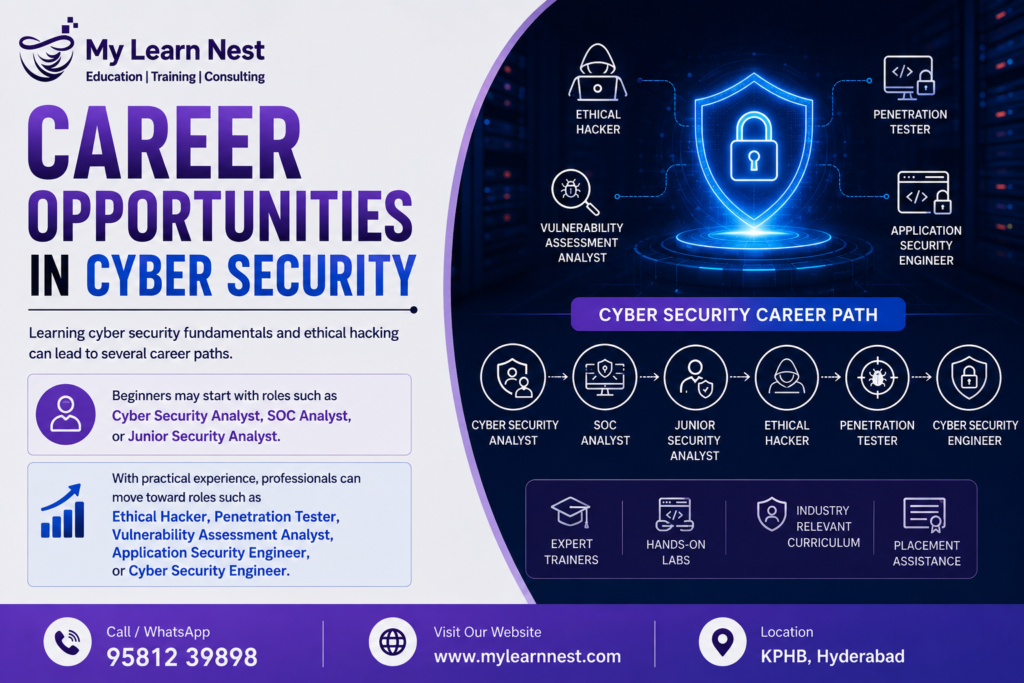
Professionals can also specialize in areas such as cloud security, network security, application security, incident response, digital forensics, threat intelligence, and security operations.
The cyber security field continues to evolve as organizations adopt cloud platforms, remote work, artificial intelligence, APIs, mobile applications, and other digital technologies. This makes continuous learning important for anyone building a long-term career in the field.
How to Start Learning Cyber Security and Ethical Hacking
Beginners should avoid trying to learn every security topic at once. A structured approach makes the learning process easier.
Start with computer fundamentals and networking. Learn how operating systems work, how devices communicate, how DNS and HTTP function, and how common network security controls operate.
After building networking knowledge, move into cyber security fundamentals. Study authentication, authorization, encryption, malware, phishing, vulnerabilities, security monitoring, and common security controls.
The next stage can focus on ethical hacking concepts, vulnerability assessment, web security, penetration testing methodology, and security reporting. Hands-on practice is especially important. Learners can use legal cybersecurity laboratories and intentionally vulnerable applications to develop their skills without affecting real systems.
Benefits of Learning Cyber Security Fundamentals and Ethical Hacking
Learning these concepts provides benefits beyond understanding hacking techniques. Students develop a broader understanding of how digital systems are designed, where security weaknesses can occur, and how organizations can reduce cyber risk.
It can also help learners prepare for technical interviews and entry-level security roles. Practical projects provide useful experience that can be discussed during interviews and included in a professional portfolio.
Another advantage is that ethical hacking knowledge can be useful across different technology careers. Developers, system administrators, network engineers, cloud professionals, and data professionals can all benefit from understanding basic security principles.
Why Practical Cyber Security Training Matters
Cyber security is a practical field. Reading about vulnerabilities is useful, but hands-on practice helps learners understand how security concepts work in real environments.
A good learning program should combine theoretical concepts with labs, demonstrations, security tools, vulnerability assessment exercises, penetration testing methodology, and real-world project scenarios.
Students should also learn how to document findings and communicate security risks clearly. These skills are important when working as part of a professional security team.
Future Scope of Ethical Hacking
The role of ethical hacking is expanding as organizations move more applications and infrastructure online. Cloud computing, APIs, mobile applications, remote work, connected devices, and artificial intelligence are creating new security considerations.
Organizations need professionals who can understand these technologies and evaluate their security risks.
Ethical hacking is therefore becoming part of a broader security strategy rather than being limited to traditional network testing. Modern security professionals may need to understand cloud environments, application security, identity management, APIs, containers, DevSecOps, and automated security testing.
Continuous learning is essential because attack techniques and defensive technologies change regularly.
Conclusion
Cyber Security Fundamentals and Ethical Hacking provide an important foundation for anyone interested in the cyber security industry. Understanding cyber attacks, networking, vulnerabilities, ethical hacking methodology, vulnerability assessment, penetration testing, and security reporting helps learners develop practical security knowledge.
Ethical hacking is not about attacking systems without permission. It is about thinking like an attacker while working responsibly to identify weaknesses and improve security. With strong fundamentals, hands-on practice, real-world projects, and continuous learning, students can build the skills required for a career in the growing cyber security industry.
For learners looking to develop job-ready skills, combining cyber security fundamentals with ethical hacking, practical labs, vulnerability assessment, penetration testing, and real-time projects can provide a strong starting point for a professional cyber security career.

