SOC Analyst Skills and Career Path 2026
A Security Operations Center (SOC) Analyst is responsible for monitoring security events, investigating suspicious activity, identifying potential threats, and supporting incident response. SOC teams work with logs and alerts from endpoints, networks, cloud environments, identity systems, and other security technologies.
In 2026, the SOC Analyst role is increasingly connected with SIEM, threat intelligence, endpoint security, automation, cloud security, detection engineering, and AI-assisted security operations. Microsoft describes Sentinel as a cloud-native SIEM that supports threat detection, investigation, response, and proactive hunting, while Splunk Enterprise Security combines SIEM with detection, investigation, response, SOAR, UEBA, and AI capabilities.
Start With Networking
Networking is one of the most important foundations for a SOC Analyst. Learn IP addresses, TCP/IP, DNS, HTTP/HTTPS, ports, VPNs, firewalls, routing, and common network protocols.
When an alert appears, a SOC Analyst may need to understand the source IP, destination IP, port, protocol, authentication activity, and communication pattern. Strong networking knowledge makes this investigation much easier.
Learn Windows and Linux
SOC analysts investigate events generated by operating systems, applications, servers, and security tools.
For Linux, learn commands, permissions, processes, services, authentication logs, and basic shell usage. For Windows, understand Event Viewer, Windows services, user accounts, authentication events, Active Directory basics, and common security logs.
Understand Security Fundamentals
Learn authentication, authorization, malware, phishing, vulnerabilities, encryption, endpoint security, access control, and incident-response concepts.
You should also understand common attack techniques at a conceptual level so you can recognize suspicious behavior in logs.
Learn SIEM
SIEM is central to many SOC environments. A SIEM collects and analyzes security events so analysts can identify suspicious patterns and investigate incidents.
Microsoft Sentinel and Splunk Enterprise Security are two important platforms to learn. Splunk Enterprise Security specifically supports alert triage, investigation, response, threat intelligence, risk-based alerting, and automation.
Learn Incident Response
SOC analysts should understand what happens after an alert is confirmed.
A basic process is:
Detection → Triage → Investigation → Containment → Escalation/Response → Recovery → Documentation
A beginner does not need to memorize every incident-response framework immediately. The important skill is learning how to investigate evidence systematically.
Learn Threat Intelligence and MITRE ATT&CK
Threat intelligence helps analysts understand indicators, adversary behavior, and known attack techniques.
MITRE ATT&CK is particularly useful for understanding attacker tactics and techniques and for mapping detections to real-world adversary behavior.
Learn Cloud and Endpoint Security
Modern SOC environments increasingly include cloud workloads, SaaS applications, identity systems, and endpoint protection.
A SOC Analyst should gradually understand cloud authentication, suspicious sign-ins, endpoint alerts, malware detections, privilege changes, and unusual user behavior.
Build Practical Labs
Theory alone is not enough. Build an authorized home lab or use cybersecurity training environments to practice log analysis, SIEM queries, alert investigation, network traffic analysis, and incident documentation.
A practical roadmap is:
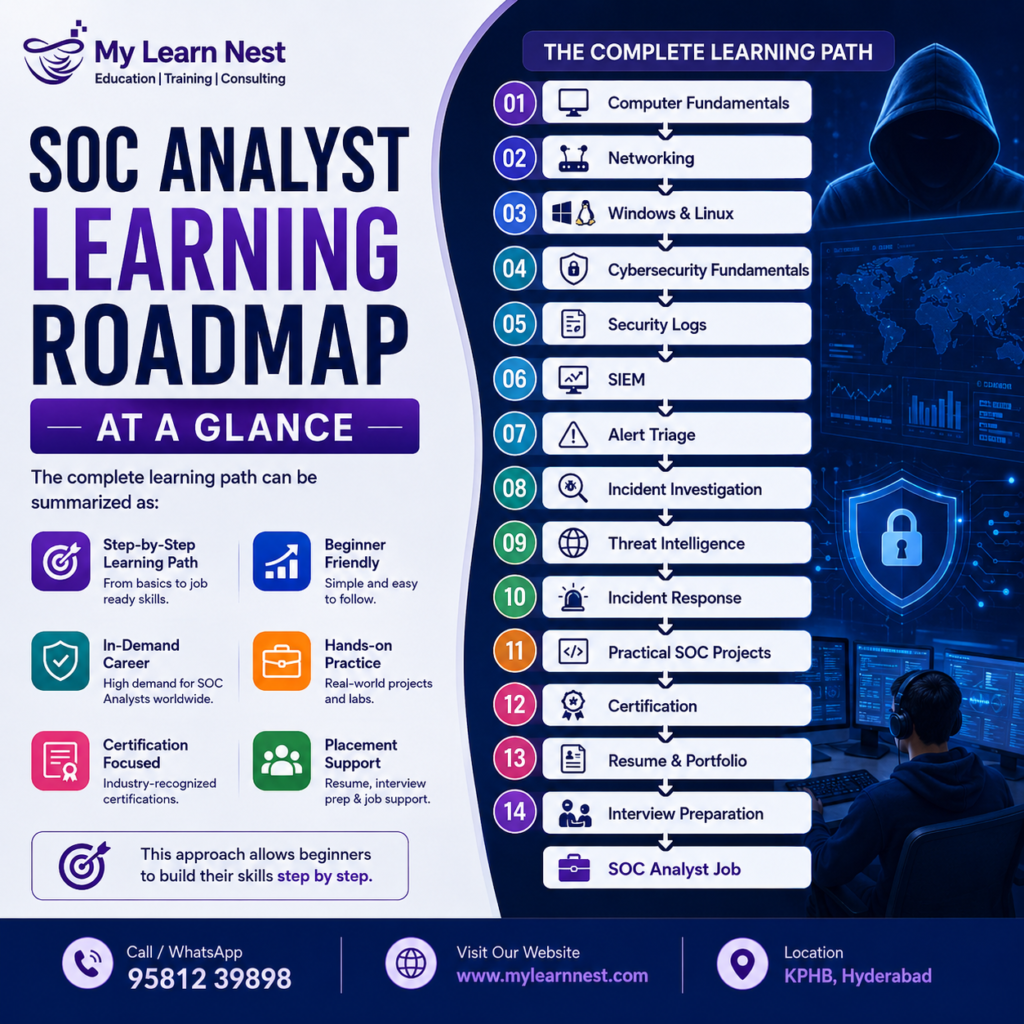
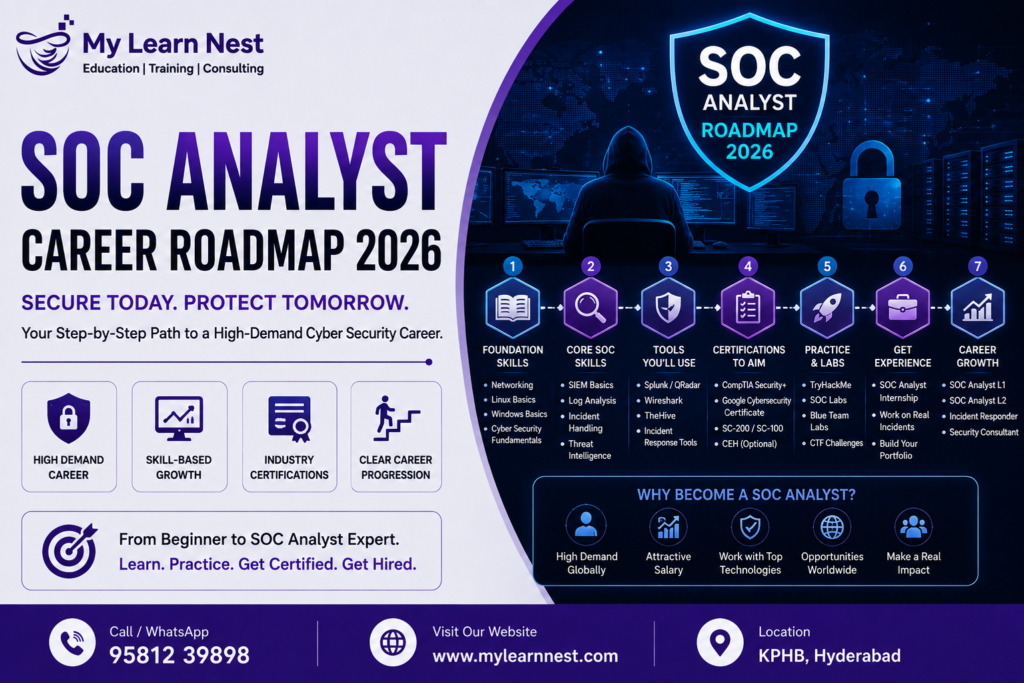
Networking → Windows/Linux → Security Fundamentals → SIEM → Incident Response → Threat Intelligence → Cloud/Endpoint Security → Labs → Real-Time Projects → Interview Preparation
How to Become a SOC Analyst with No Experience
Many beginners ask how to become a SOC Analyst without previous professional experience. The most realistic approach is to replace missing work experience with strong fundamentals and demonstrable practical skills.
You do not need to know every cybersecurity tool before applying for entry-level positions. Instead, focus on the technologies and activities that appear repeatedly in junior SOC work.
Learn Networking and Operating Systems First
Start with networking, Windows, and Linux. This gives you the background required to interpret security events.
For example, when you see repeated failed authentication attempts, you should know what authentication means, where related logs may exist, and what additional evidence would help determine whether the activity is suspicious.
Learn One SIEM Properly
Rather than learning five SIEM platforms superficially, become comfortable with one.
Microsoft Sentinel is a useful option, especially for candidates interested in Microsoft security environments. Splunk is another strong platform for learning security-event search, detection, investigation, and SOC workflows.
Practice Security Scenarios
Create simple lab scenarios such as repeated failed logins, suspicious PowerShell activity, unusual network connections, malware alerts, or impossible-travel-style login events.
Then investigate the available logs and write a short incident summary.
Build a SOC Portfolio
A beginner portfolio can contain SIEM investigation reports, log-analysis exercises, detection rules, incident timelines, network-analysis reports, and vulnerability findings from authorized environments.
Do not claim lab work as professional experience. Clearly label it as a personal project, academic project, internship, or training exercise.
Apply for Entry-Level Positions
Search beyond the exact title “SOC Analyst.” Junior opportunities can include:
L1 SOC Analyst, Security Operations Trainee, Cyber Security Analyst, Security Monitoring Analyst, Junior Security Analyst, and SOC Support roles.
Current Hyderabad listings show L1 SOC roles involving SIEM monitoring, alert triage, incident analysis, documentation, and monitoring of network, endpoint, and cloud alerts.
What Should a Fresher Be Able to Explain?
A beginner should confidently explain what a SIEM does, how an alert is investigated, what a false positive is, how logs help with investigation, why escalation is required, and how an incident should be documented.
That practical understanding is often more valuable than simply listing many cybersecurity tools on a resume.
SOC Analyst L1 vs L2 vs L3
SOC teams commonly divide responsibilities into L1, L2, and L3 levels, although the exact responsibilities vary between organizations.
SOC Analyst L1
L1 is generally the first line of monitoring and alert triage.
The analyst monitors alerts, validates basic indicators, gathers initial context, identifies potential false positives, documents findings, and escalates suspicious or serious incidents.
Current Hyderabad job listings describe L1 responsibilities that include monitoring SIEM alerts, performing initial triage, escalating critical incidents, creating incident reports, and monitoring network, endpoint, and cloud alerts.
SOC Analyst L2
L2 analysts perform deeper investigation.
They may correlate multiple alerts, investigate attack timelines, analyze endpoint and network evidence, perform threat hunting, investigate suspicious accounts or hosts, and tune detection rules.
Current Hyderabad listings describe L2 responsibilities including deeper incident analysis, threat hunting, forensic investigation, and reviewing or tuning SIEM use cases and alert rules.
SOC Analyst L3
L3 generally handles advanced investigations and more complex security engineering activities. Depending on the organization, L3 may work on advanced threat hunting, detection engineering, malware analysis, major incident response, forensic investigations, and security architecture.
L3 roles usually require significantly more experience and deeper technical specialization.
A practical career progression can therefore be:
L1 → L2 → L3 / Detection Engineering / Threat Hunting / Incident Response
However, career progression is not always strictly linear. Some professionals move from L1 directly into cloud security, detection engineering, security engineering, or other specialized areas.
SOC Analyst Tools You Must Learn
SOC analysts use multiple tools, but learning the purpose of each technology is more important than collecting a long list of products.
SIEM Tools
Start with one major SIEM platform.
Microsoft Sentinel is a cloud-native SIEM designed for threat detection, investigation, response, and proactive hunting.
Splunk Enterprise Security provides security-event visibility, detection, alert triage, investigation, response, threat intelligence, risk-based alerting, and automation. For beginners, learn how to search logs, filter events, investigate an alert, correlate evidence, and document findings.
Wireshark
Wireshark is useful for analyzing network packets and understanding communication between systems.
A SOC Analyst can use network traffic analysis to support investigations involving suspicious connections, unusual protocols, or potentially compromised hosts.
Endpoint Detection and Response
Learn the concept of EDR before focusing on a specific vendor product. EDR tools provide visibility into endpoint processes, files, connections, users, and security events.
The exact product depends on the organization, but understanding endpoint telemetry is an important SOC skill.
Threat Intelligence Platforms
Threat intelligence tools and feeds can help analysts investigate IP addresses, domains, hashes, and other indicators.
The important skill is learning how to evaluate the context of an indicator rather than automatically treating every match as malicious.
Ticketing and Case Management
SOC work is not only technical investigation. Analysts must document findings, track incidents, assign ownership, record actions, and communicate with other teams.
Learning a ticketing or case-management workflow is therefore useful for anyone preparing for a SOC role.
Which Tools Should a Beginner Learn First?
A practical starting combination is:
Microsoft Sentinel or Splunk → Wireshark → Windows Event Logs → Linux Logs → EDR Concepts → Threat Intelligence
Learn them through investigations instead of studying them only as product features.
SOC Analyst Real-Time Projects
Real-time SOC projects should simulate the way a security operations team actually works: an event occurs, an alert is generated, the analyst investigates it, determines severity, and documents the outcome.

SIEM Alert Investigation Project
Create a controlled lab and generate legitimate security events such as repeated failed logins. Send the logs to a SIEM and build a simple detection for unusual authentication activity. Investigate the alert by checking the affected user, source IP, timestamps, successful logins, and related events.
The final output should be an incident report explaining what happened and whether the activity was malicious, suspicious, or benign.
Phishing Investigation Project
Use simulated phishing messages or public training datasets.Analyze sender information, URLs, headers, attachments, and other indicators. Then create an investigation report that explains the evidence and recommended response.
The project should remain focused on detection and analysis rather than sending phishing messages to real users.
Suspicious PowerShell Activity Project
Create a controlled Windows lab where benign test activity produces PowerShell-related logs.Collect the logs and investigate the command execution, user, host, timestamp, parent process, and related events.
The purpose is to learn how endpoint telemetry can help identify suspicious behavior.
Malware Alert Investigation Project
Use safe, authorized malware-analysis or training datasets rather than real-world malware execution on uncontrolled systems.
Investigate the available indicators, identify the affected endpoint, examine related events, and document the recommended containment and remediation steps.
Network Traffic Analysis Project
Capture authorized lab traffic using Wireshark and identify unusual or unexpected communication.
The project can demonstrate understanding of DNS, HTTP/HTTPS, TCP connections, source and destination addresses, and basic network investigation.
Cloud Login Investigation Project
Create a controlled cloud environment and investigate simulated suspicious sign-in behavior.
Review location, authentication method, user account, device information, time, and related events to determine whether the activity requires escalation.
SOC Project Workflow
A strong SOC project can be explained as:
Alert → Triage → Evidence Collection → Investigation → Severity → Escalation/Response → Documentation
This structure is useful for interviews because it demonstrates how a SOC Analyst thinks rather than simply showing screenshots of tools.
SOC Analyst Salary in Hyderabad
SOC Analyst salaries in Hyderabad depend on experience, employer, shift requirements, certifications, technical skills, and the complexity of the SOC environment.
Current Glassdoor data for Hyderabad lists SOC Analyst base pay around ₹5 lakh per year on average, with a reported base-pay range of approximately ₹4 lakh to ₹7 lakh per year. The data was last updated on January 8, 2026, with 162 submitted salaries.
The same source shows higher reported pay levels for more senior information-security roles, indicating that compensation can increase as professionals move beyond entry-level SOC responsibilities.
SOC Analyst Salary for Freshers
Freshers generally enter through L1 or trainee-level positions. Compensation can vary considerably between service companies, product companies, managed security providers, and internal SOC teams.
The most important objective at the beginning should be to gain real security-monitoring experience, learn a SIEM, improve investigation skills, and build a foundation for moving to L2 or specialized security roles.
SOC Analyst Salary for Experienced Professionals
As experience increases, professionals can move into L2 and L3 roles or specialize in areas such as threat hunting, detection engineering, incident response, cloud security, or security engineering.
Current Hyderabad SOC job listings demonstrate a tiered structure involving L1, L2, and L3 roles, with deeper investigation and threat-hunting responsibilities at higher levels.
What Can Increase a SOC Analyst Salary?
Career growth is usually driven by deeper technical skills and broader responsibilities.
Strong areas to develop include SIEM investigation, threat hunting, detection engineering, cloud security, incident response, endpoint security, scripting, and security automation.
Certifications can support the profile, but employers generally value practical investigation ability as well.
SOC Analyst Interview Questions
SOC interviews often focus on how candidates investigate security events rather than only testing definitions.
What Is a SOC?
A Security Operations Center is a security function that monitors, detects, investigates, and responds to cybersecurity threats and incidents.
What Is a SIEM?
A SIEM collects and analyzes security logs and events from multiple sources to help security teams detect and investigate suspicious activity.
What Does an L1 SOC Analyst Do?
An L1 analyst generally monitors alerts, performs initial triage, gathers context, identifies potential false positives, documents findings, and escalates incidents that require deeper investigation.
What Is a False Positive?
A false positive occurs when a security detection generates an alert for activity that is actually legitimate or non-malicious.
Reducing unnecessary false positives is important because excessive alert noise can make it harder for analysts to focus on genuine threats.
How Would You Investigate a Failed-Login Alert?
First identify the account, source IP, timestamps, authentication method, device, and number of attempts.
Then check whether there were successful logins afterward and whether similar activity appears elsewhere in the environment. The final decision should be based on the available evidence rather than the number of failed attempts alone.
What Would You Do After Confirming a Suspicious Login?
Determine the scope and severity, gather supporting evidence, follow the organization’s containment and escalation procedures, and document the investigation.
The specific response may include actions such as disabling or protecting an affected account, depending on company policy and incident severity.
What Is the Difference Between an Alert and an Incident?
An alert is a notification generated by a security tool or detection rule.
An incident is a confirmed or suspected security event that requires formal investigation or response according to the organization’s process. Not every alert becomes an incident.
What Is Threat Hunting?
Threat hunting is a proactive process of searching for suspicious or malicious activity that may not have triggered a known security alert.
What Is MITRE ATT&CK?
MITRE ATT&CK is a knowledge base that organizes adversary tactics and techniques. SOC teams can use it to understand attacker behavior and improve detection coverage.
How Would You Investigate a Phishing Alert?
Check the sender, recipient, message content, URLs, attachments, domain information, authentication records where available, and related endpoint or network activity.
Determine whether the message is malicious, identify affected users, and follow the organization’s response process.
How Do You Handle a High-Severity Alert?
Do not assume that severity alone proves compromise. Validate the alert, gather context, determine impact, investigate associated users and systems, and escalate according to the incident-response process.
How Do You Reduce Alert Fatigue?
Improve detection quality, tune noisy rules, add useful context, prioritize alerts based on risk, automate repetitive tasks where appropriate, and regularly review detection performance.
Splunk Enterprise Security, for example, provides risk-based alerting, threat intelligence, automation, and detection capabilities intended to help SOC teams prioritize and investigate threats more effectively.
What Would You Do If You Don’t Know the Answer During an Investigation?
Do not guess. State what evidence is available, identify what information is missing, explain how you would investigate it, and escalate when required.
A strong SOC Analyst demonstrates disciplined investigation rather than pretending to know everything.
SOC Analyst Career Growth in 2026
The SOC Analyst role can be a starting point for several cybersecurity career paths.
A common progression is:
L1 SOC Analyst → L2 SOC Analyst → L3 SOC Analyst
From there, professionals can specialize in:
Threat Hunting, Detection Engineering, Incident Response, Cloud Security, Security Engineering, Digital Forensics, or Security Architecture.
The SOC environment is also becoming more automated. Current security platforms are incorporating AI, automation, SOAR, and behavioral analytics into security operations. Splunk’s current Enterprise Security platform, for example, integrates SIEM, SOAR, UEBA, threat intelligence, and AI-assisted workflows.
This does not eliminate the need for analysts. Instead, it increases the value of professionals who can interpret alerts, validate automated findings, investigate complex incidents, and improve detection quality.
Why Learn SOC Analyst Skills With MyLearnNest?
SOC training should focus on the complete investigation process rather than only teaching security-tool interfaces.
MyLearnNest can structure SOC Analyst training around networking, Windows and Linux security, SIEM, Microsoft Sentinel, Splunk, log analysis, incident response, threat intelligence, MITRE ATT&CK, real-time projects, and interview preparation.
The most useful learning approach is scenario-based. Learners should receive an alert, investigate the evidence, determine whether it is a real threat, document the incident, and explain the recommended response.
Final Thoughts on SOC Analyst Careers in 2026
A SOC Analyst career can be a strong entry point into cybersecurity for people who enjoy monitoring, investigation, problem-solving, and security technologies.
The practical roadmap is: