
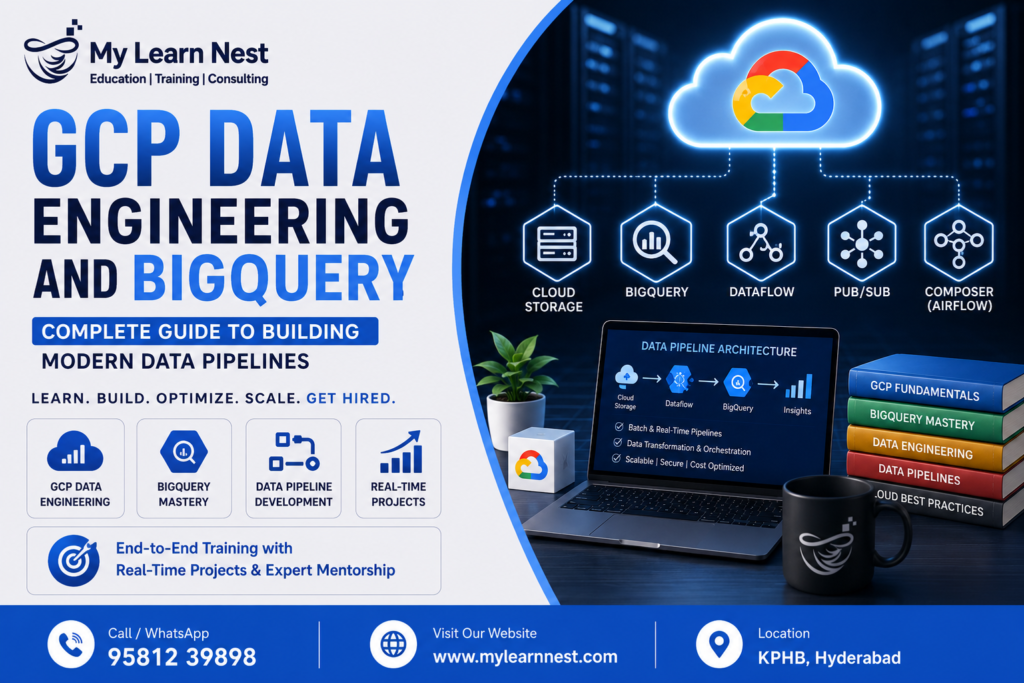
Complete Guide to Building Modern Data Pipelines
Data is growing rapidly across every industry. Businesses collect information from websites, mobile applications, customer transactions, IoT devices, business applications, and many other sources. However, collecting data is only the first step. Organizations need reliable systems to store, process, transform, and analyze this data before it can support business decisions.
This is where GCP Data Engineering plays an important role. Google Cloud provides a strong set of cloud services that help data engineers build scalable data platforms and automated data pipelines. Among these services, Google Cloud BigQuery is one of the most widely used technologies for cloud data warehousing and analytics.
GCP Data Engineering and BigQuery help organizations manage large datasets without maintaining complex physical infrastructure. Data engineers can use services such as BigQuery, Cloud Storage, Dataflow, Dataproc, and Cloud Composer to create complete data workflows.
For students and professionals planning to build a career in cloud data engineering, learning these technologies can provide practical knowledge that is useful across many industries. MyLearnNest provides training focused on practical concepts, cloud technologies, projects, and job-oriented skills.
What Is GCP Data Engineering?
GCP Data Engineering is the process of designing, developing, and maintaining data systems using Google Cloud Platform services. A data engineer is responsible for making sure that data can move from source systems to storage and analytics platforms in a reliable and efficient way.
A typical data engineering workflow starts with data ingestion. Data may come from databases, applications, APIs, files, sensors, or external systems. The data is then stored in services such as Cloud Storage or BigQuery.
After storage, the data may need to be cleaned, transformed, filtered, joined, or aggregated. Services such as Dataflow and Dataproc can be used for processing. Cloud Composer can help schedule and manage workflows.Finally, processed data can be stored in BigQuery where analysts, developers, and business teams can query it for reporting and decision-making.
The overall process can be understood as:
Data Sources → Data Ingestion → Data Storage → Data Processing → Data Warehouse → Analytics
Learning this complete workflow is important for anyone preparing for a GCP Data Engineer career.
Why GCP Data Engineering Is Important for Modern Businesses
Modern businesses cannot depend only on traditional data processing systems. Data volumes are increasing, and organizations need faster access to useful information.
Cloud data engineering makes it possible to build systems that can scale according to business requirements. Instead of purchasing and maintaining large physical servers, organizations can use cloud services for storage, processing, orchestration, and analytics.
GCP also provides services that work together. A data engineer can use Cloud Storage for raw files, Dataflow for data processing, BigQuery for analytics, and Cloud Composer for workflow orchestration. For organizations, some of the major benefits include scalability, automation, faster analytics, flexible infrastructure, and easier integration between different data services.
For learners, understanding these technologies can also help prepare for roles such as GCP Data Engineer, Cloud Data Engineer, BigQuery Developer, Data Engineer, and Cloud Analytics Engineer.
Understanding Google Cloud BigQuery
Google Cloud BigQuery is a fully managed, cloud-based data warehouse and analytics platform. It is designed to analyze large amounts of data using SQL without requiring organizations to manage traditional database infrastructure.
BigQuery is an important part of many modern GCP data engineering projects because it provides a central environment for storing and analyzing structured and semi-structured data. A data engineer can load data into BigQuery from different sources and then use SQL queries to analyze it. BigQuery can handle large analytical workloads while separating storage and computing resources.
This makes BigQuery different from many traditional database systems.
Instead of focusing mainly on transactional applications, BigQuery is commonly used for analytical workloads such as sales analysis, customer analytics, financial reporting, marketing analysis, operational reporting, and business intelligence.
Key Features of Google Cloud BigQuery
BigQuery provides several capabilities that make it useful for modern data engineering and analytics.
It supports SQL-based analysis, large-scale data processing, data partitioning, clustering, integration with other Google Cloud services, and different approaches to loading and querying data.BigQuery can also work with structured and semi-structured data, making it suitable for many modern analytics environments.
For example, an e-commerce company may store customer orders, product information, website activity, and payment-related analytics data. These datasets can be brought into BigQuery and analyzed to understand customer behavior and business performance.
Some important BigQuery concepts that learners should understand include datasets, tables, views, schemas, partitions, clusters, SQL queries, data loading, and query optimization.
Google Cloud Storage for Data Engineering
Google Cloud Storage, commonly called Cloud Storage, is an object storage service used to store files and large amounts of unstructured data. In a data engineering environment, Cloud Storage is often used as a landing area for raw data.
For example, a company may receive CSV, JSON, XML, Parquet, or other files every day. Instead of immediately loading every file into a database, the files can first be stored in Cloud Storage.
A data pipeline can then process these files and load the required information into BigQuery.This approach is useful because it creates a separation between raw data and processed analytical data.
A typical workflow may look like:
Source Files → Cloud Storage → Dataflow → BigQuery
Cloud Storage can therefore become an important component of a scalable GCP data engineering pipeline.
Google Cloud Dataflow for Data Processing
Google Cloud Dataflow is a managed service for processing data in both batch and streaming environments. Dataflow is especially useful when data needs to be transformed before it reaches the analytics layer.
For example, suppose an organization receives customer transaction data from multiple sources. The incoming data may contain duplicate records, missing values, inconsistent formats, or incorrect fields.A Dataflow pipeline can process this information by applying transformations such as filtering, cleaning, mapping, joining, and aggregation.
Dataflow can be used for both batch processing and real-time data processing. This makes it useful for organizations that need to process continuously arriving data as well as large historical datasets.
Understanding Dataflow is an important part of learning GCP Data Engineering because data engineers frequently need to build transformation and ingestion pipelines.
Google Cloud Dataproc for Big Data Processing
Google Cloud Dataproc is a managed service designed for running big data processing workloads using technologies such as Apache Spark and Apache Hadoop.
Dataproc can be useful when organizations already have Spark-based workloads or need distributed processing for large datasets.
For example, an organization may have millions or billions of records that require complex transformations. Spark can distribute the processing workload across multiple computing resources.Dataproc reduces the infrastructure management effort involved in running these technologies.
A learner preparing for a GCP Data Engineer role should understand when to use Dataproc and when another service, such as Dataflow, may be more suitable.
The choice depends on the workload, existing technology, processing requirements, and project architecture.
Cloud Composer for Data Pipeline Orchestration
Data engineering pipelines often contain many individual tasks. These tasks need to run in the correct order.
Google Cloud Composer can be used to orchestrate these workflows.Cloud Composer is based on Apache Airflow and allows data engineers to create workflows that define how different tasks should run.
A simple workflow could be:
Extract Data → Validate Data → Transform Data → Load BigQuery → Run Data Quality Check
If one task fails, the workflow can be configured to retry or notify the appropriate team.
Learning workflow orchestration is important because real-world data engineering is not only about writing transformation code. Engineers also need to manage dependencies, schedules, failures, retries, and monitoring.
ETL and ELT Pipelines in GCP
ETL and ELT are two important concepts in data engineering.
ETL stands for Extract, Transform, Load. Data is extracted from source systems, transformed before loading, and then stored in the target system.
ELT stands for Extract, Load, Transform. Data is first extracted and loaded into a storage or warehouse platform, and transformations are performed later.
With BigQuery, organizations can often use ELT patterns because large amounts of data can be loaded into the warehouse and transformed using SQL.
For example:
Source Database → BigQuery → SQL Transformation → Analytics Tables
In another architecture, raw files may be stored in Cloud Storage, processed using Dataflow, and then loaded into BigQuery.
The best approach depends on the organization’s data volume, transformation requirements, architecture, governance, and business needs.
Data Ingestion and Transformation in GCP
Data ingestion is the process of bringing data from different sources into a data platform.
Data can come from relational databases, applications, APIs, files, business systems, logs, and streaming platforms. A data engineer needs to consider several factors when designing an ingestion pipeline. These include data format, data volume, frequency, latency requirements, data quality, security, and failure handling.
After ingestion, data transformation is performed to make the information suitable for analytics.Typical transformations may include removing duplicate records, handling missing values, changing data types, standardizing formats, joining datasets, calculating business metrics, and filtering unwanted records.
For example, customer information may be received from three different systems. One system may use “India,” another may use “IN,” and another may use “IND.” A transformation process can standardize these values before the final dataset is stored in BigQuery.
Real-Time Data Processing with GCP
Many businesses need information immediately rather than waiting for a daily or weekly report. Real-time data processing helps organizations analyze data as it arrives.
Consider an online shopping platform. Every customer click, product search, cart update, and purchase can generate data. Processing this information continuously can help businesses understand current customer behavior.Real-time processing can also be useful for monitoring systems, financial transactions, application logs, IoT devices, and operational events.
GCP provides services that can be combined to build streaming data pipelines. Dataflow can process streaming workloads and send transformed information toward analytical systems such as BigQuery.
A simplified architecture can be:
Real-Time Data Source → Streaming Pipeline → Dataflow → BigQuery → Analytics Dashboard
Learning this architecture can help students understand how modern cloud data platforms support real-time business requirements.
BigQuery Data Analytics
BigQuery becomes especially powerful when it is used as the analytical layer of a data platform.
Data engineers can prepare clean datasets, while analysts and business teams can use SQL to answer important business questions.
These questions can be answered by querying data stored in BigQuery.BigQuery can also support analytical workloads involving large datasets, making it useful for business intelligence and data analytics.
For learners, SQL remains an important skill even when working with cloud platforms. Understanding SELECT statements, joins, aggregations, window functions, subqueries, CTEs, and analytical functions can help build a strong foundation for BigQuery.
BigQuery Data Modeling
Data modeling is another important part of GCP data engineering.
A good data model helps organizations organize information so that it can be queried efficiently and understood easily.Data engineers may work with concepts such as fact tables, dimension tables, star schemas, and denormalized analytical tables.
For example, an e-commerce data warehouse may contain a sales fact table along with customer, product, date, and location dimensions. A well-designed model can make analytical queries easier to write and maintain.
BigQuery also provides features such as partitioning and clustering that can help improve query performance and reduce unnecessary data scanning when used appropriately.
BigQuery Partitioning and Clustering
When working with large datasets, query performance becomes important.
Partitioning divides a table into smaller sections based on a selected column, often a date or timestamp.
For example, a sales table can be partitioned by transaction date. A query that only needs data from January may not need to scan the entire table.
Clustering organizes data based on selected columns within a table or its partitions. It can help queries that frequently filter or group data using those columns.
Understanding partitioning and clustering is useful for anyone preparing for BigQuery interview questions and real-world data engineering work.
GCP Data Engineering Pipeline Architecture
A typical GCP data engineering architecture can include several services working together.
A simple batch pipeline may look like:
Data Sources → Cloud Storage → Dataflow → BigQuery → BI/Analytics
A more advanced workflow may use Cloud Composer for orchestration:
Data Sources → Cloud Storage → Cloud Composer → Dataflow → BigQuery → Reporting
For large-scale Spark workloads, Dataproc can also be included:
Data Sources → Cloud Storage → Dataproc/Spark → BigQuery → Analytics
For streaming workloads, Dataflow can process incoming events continuously before sending the transformed information to BigQuery.
The architecture depends on the project requirements rather than using every service in every project.
Real-Time GCP Data Engineering Project Example
One practical project for learning GCP data engineering is a real-time retail analytics platform.
Imagine an online shopping company receiving customer events throughout the day. Every customer action generates data.
The project can begin with raw event data arriving from application systems. The data can be stored or streamed into the Google Cloud environment.Dataflow can process incoming events and perform transformations. The processed data can then be stored in BigQuery.
Cloud Composer can be used for scheduled workflows and data quality tasks.
Finally, analysts can use BigQuery to answer questions such as which products are popular, how customers behave, and how sales change over time.This type of project helps learners understand how multiple GCP services work together rather than learning each service separately.
GCP Data Engineering Projects for Practical Learning
Projects are one of the best ways to understand cloud data engineering.
A beginner can start with a simple batch data pipeline. For example, CSV files can be uploaded to Cloud Storage, processed, and loaded into BigQuery.
An intermediate project can include automated transformations, scheduled workflows, data quality checks, and partitioned BigQuery tables. An advanced project can combine streaming data, Dataflow, BigQuery, Cloud Composer, and analytical dashboards.
Some useful project ideas include:
- Retail sales data pipeline
- Customer analytics platform
- Banking transaction analytics
- E-commerce data warehouse
- Real-time application monitoring
- IoT data processing pipeline
The goal of these projects should not be only to complete the project. Learners should understand why each GCP service is used and how the components communicate with each other.
GCP Data Engineering Skills You Should Learn
A successful GCP data engineer needs more than knowledge of individual cloud services. SQL is one of the most important skills because BigQuery relies heavily on SQL-based analytics.
Python is also useful for data processing, automation, and pipeline development.Learners should understand databases, data warehousing, ETL and ELT concepts, cloud storage, distributed processing, workflow orchestration, data modeling, and basic cloud security.
It is also important to understand monitoring and troubleshooting because real-world pipelines can fail due to incorrect data, network problems, schema changes, service errors, or configuration issues.
At MyLearnNest, learners can focus on these concepts through practical and project-oriented learning rather than studying cloud services only from a theoretical perspective.
GCP Data Engineering Career Opportunities
The growth of cloud platforms has increased the demand for professionals who can work with large-scale data systems.
After developing the required skills, learners can explore roles such as GCP Data Engineer, Cloud Data Engineer, BigQuery Developer, Data Engineer, Cloud Analytics Engineer, and related data roles.
The exact responsibilities depend on the organization and job position.
A data engineer may spend one day developing a data pipeline and another day troubleshooting a failed workflow. In some organizations, the role may also involve data modeling, cloud infrastructure, performance optimization, monitoring, and collaboration with analysts and software developers.
This is why practical knowledge is valuable when preparing for a GCP data engineering career.
Why Learn GCP Data Engineering at MyLearnNest?
Choosing the right learning environment can make a major difference when learning cloud data engineering.
MyLearnNest focuses on practical technology training that helps learners understand concepts and apply them to real-world scenarios.
For GCP data engineering, learners should not stop with definitions of BigQuery, Dataflow, Dataproc, or Cloud Composer. They should understand how these services are combined to build complete data pipelines.
A project-oriented learning approach can help students practice data ingestion, transformation, orchestration, analytics, and troubleshooting. MyLearnNest can be a useful learning destination for students, working professionals, and career changers who want to develop practical cloud and data engineering skills.
Who Can Learn GCP Data Engineering?
GCP data engineering can be learned by students, graduates, software professionals, database developers, data analysts, cloud professionals, and people looking to move into data engineering.
A strong background in advanced programming is not always necessary to begin. However, basic SQL, databases, programming concepts, and data processing knowledge can make the learning process easier.
Beginners should first understand data engineering fundamentals and then gradually move into BigQuery, Cloud Storage, Dataflow, Dataproc, and Cloud Composer.
Professionals who already understand SQL or traditional ETL tools may find it easier to connect their existing knowledge with GCP technologies.
GCP Data Engineering and BigQuery Interview Preparation
Technical interviews for GCP data engineering roles may cover both cloud concepts and practical data engineering scenarios.
Interviewers may ask questions about BigQuery architecture, SQL queries, partitioning, clustering, data loading, Cloud Storage, Dataflow, Dataproc, Cloud Composer, ETL pipelines, ELT workflows, and real-time processing.
Scenario-based questions are particularly important.
For example, an interviewer may ask how you would design a pipeline that receives millions of records every day and loads the processed data into BigQuery.A strong answer should explain the data source, ingestion method, storage layer, transformation process, orchestration, monitoring, error handling, and analytical layer.
This is why hands-on GCP data engineering projects are useful for interview preparation.
Common Challenges in GCP Data Engineering
Building a data pipeline is not always straightforward.
Data quality is one of the most common challenges. Incoming data may contain duplicates, missing values, incorrect formats, or unexpected schema changes. Performance is another important consideration. Poorly designed queries or pipelines can increase processing time and operational costs.
Pipeline failures can also occur because of service configuration issues, connectivity problems, invalid data, or application changes.Security should also be considered throughout the pipeline. Sensitive information should be protected using appropriate access controls and security practices.
A good data engineer therefore focuses not only on making a pipeline work but also on making it reliable, secure, maintainable, and scalable.
Best Practices for GCP Data Engineering
A successful cloud data engineering project should be designed with long-term maintenance in mind.
Data pipelines should have clear naming conventions, consistent schemas, proper error handling, monitoring, and documentation. BigQuery tables should be designed carefully, and partitioning and clustering should be used when they provide a practical performance benefit.
Data engineers should also avoid unnecessary data processing and regularly review pipeline performance.Automation is another important practice. Repetitive tasks should be automated wherever possible so that engineers do not need to perform the same manual operations every day.
Testing should also be included in the development process. Data quality checks can help identify problems before incorrect information reaches business users.
GCP Data Engineering vs Traditional Data Engineering
Traditional data engineering often involves managing physical servers, storage systems, databases, networking, and software infrastructure.
Cloud data engineering moves many of these responsibilities to managed cloud services.
With GCP, data engineers can use services such as BigQuery, Cloud Storage, Dataflow, Dataproc, and Cloud Composer instead of building every component from scratch.This allows teams to focus more on data workflows and business requirements.
However, cloud data engineering does not eliminate the need for strong fundamentals. SQL, data modeling, ETL concepts, programming, distributed processing, and database knowledge remain important.
Future Scope of GCP Data Engineering
The demand for data-driven decision-making continues to influence how businesses build their technology platforms.
As organizations generate more data, they need scalable systems for collecting, processing, storing, and analyzing that information.
Cloud data platforms are therefore expected to remain an important part of modern technology environments.Professionals who understand GCP Data Engineering and BigQuery can build skills that connect cloud computing, data engineering, analytics, and business intelligence.
Learning the fundamentals today can also make it easier to understand more advanced topics such as streaming analytics, data governance, machine learning data pipelines, and modern cloud architectures.
Final Thoughts on GCP Data Engineering and BigQuery
GCP Data Engineering and BigQuery provide a strong foundation for building modern cloud-based data platforms. Services such as BigQuery, Cloud Storage, Dataflow, Dataproc, and Cloud Composer can be combined to create scalable data ingestion, processing, orchestration, and analytics workflows.
For anyone planning to enter cloud data engineering, it is important to learn more than individual service definitions. Understanding how these services work together in real-world pipelines is what builds practical confidence.
From ETL and ELT pipelines to real-time data processing and BigQuery analytics, GCP offers a broad ecosystem for modern data engineering.With structured learning, SQL practice, hands-on projects, and cloud-based exercises, learners can gradually build the skills required for data engineering roles.
MyLearnNest can help learners develop these skills through practical, career-focused training and project-based learning. Whether you are a student starting your cloud journey or a professional looking to upgrade your data engineering skills, learning GCP and BigQuery can be a valuable step toward a modern cloud data career.

