
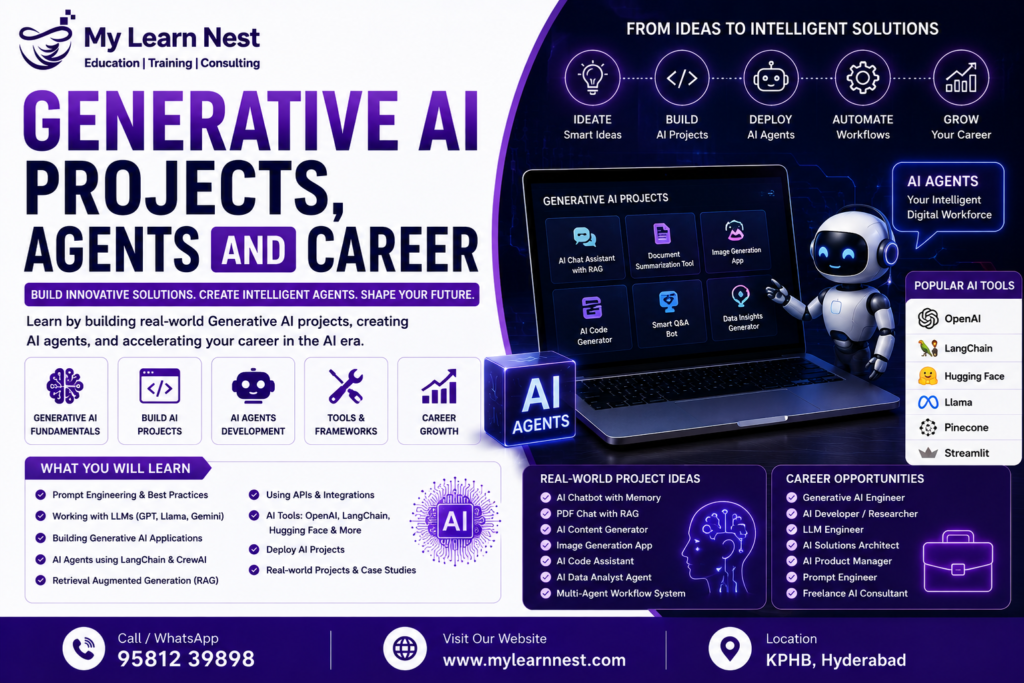
Generative AI Projects, Agents and Career
Generative AI has moved beyond simple chatbots and content-generation tools. Today, organizations are exploring AI systems that can understand instructions, work with business data, use external tools, automate repetitive tasks, and complete multiple steps with limited human intervention.
This change is creating a new generation of AI applications built around Generative AI projects, AI agents, agentic AI, automation, RAG, LLMs, and intelligent workflows.
For students and working professionals, learning Generative AI is no longer limited to understanding how an LLM generates text. Practical knowledge of AI application development, AI agents, automation, APIs, Python, databases, and real-world projects can help learners prepare for emerging AI career opportunities.
At MyLearnNest, learners can build their understanding from Generative AI fundamentals to practical projects and career-oriented skills. The goal should be to understand how AI technologies can solve real business problems rather than simply learning individual AI tools.
What are Generative AI Projects?
Generative AI projects are applications that use technologies such as Large Language Models, embeddings, RAG, AI APIs, machine learning models, and automation tools to solve practical problems.
- A project can be simple or highly advanced.
- A beginner may build a text summarization application using Python and an LLM API.
An intermediate learner may build a document question-answering chatbot using RAG and a vector database.
An advanced developer may build an AI agent that retrieves information, calls APIs, analyzes data, and completes a multi-step workflow. Projects are important because they demonstrate practical understanding.
Someone who can explain what an LLM is may understand the theory, but someone who can build an application using an LLM, database, API, retrieval system, and user interface can demonstrate development skills.
Why Real-Time Generative AI Projects Matter
Real-time projects help learners understand how Generative AI works in practical environments.
A real-world AI application has more challenges than a simple demonstration.
Developers need to think about data quality, API failures, security, user input, response accuracy, latency, cost, authentication, monitoring, and scalability.
For example, a customer-support chatbot may need to answer thousands of questions while protecting customer information.
A document-analysis system may need to process large files and return accurate results.An AI recommendation system may need to consider user preferences and business rules.These challenges provide valuable experience for aspiring Generative AI professionals.
Beginner Generative AI Projects
Beginners can start with relatively simple applications before moving to advanced AI systems.
A text summarizer is a good starting project because it introduces LLM APIs and prompt design. An AI content generator can help learners understand how prompts influence model output.
A basic question-answering chatbot can introduce conversation handling and API integration.A resume analyzer can demonstrate document processing and structured output.
These projects can be developed using Python and an LLM API without requiring an extremely complex infrastructure.
Intermediate Generative AI Projects
After learning the basics, learners can build applications involving external data.
A document-based chatbot can use RAG to answer questions from PDFs or company documents.
A knowledge-base assistant can retrieve relevant information from a vector database before generating a response. An AI SQL assistant can convert natural-language questions into database queries.
A customer-support system can combine an LLM with company documentation and business rules.
These projects introduce concepts such as embeddings, vector databases, retrieval, structured outputs, and application-level security.
Advanced Generative AI Projects
Advanced projects can combine multiple AI technologies.
An AI research assistant can search approved information sources, summarize findings, and produce a structured report.An AI business analyst can retrieve data, analyze results, and generate explanations.
An AI coding assistant can understand source code, answer developer questions, and help generate tests.An AI agent can use tools and APIs to complete multi-step tasks.
These projects require stronger knowledge of Python, APIs, LLMs, databases, RAG, Prompt Engineering, software development, and AI evaluation.
What are AI Agents?
An AI agent is an AI-based system that can use a model together with tools, information sources, and actions to complete a task.
A traditional chatbot generally responds to a user’s message.An AI agent can go further.
For example, a user might ask:
“Find the latest sales report, summarize the major changes, and prepare a short management report.”
An agent-based system could potentially retrieve the report, analyze the information, generate a summary, and prepare the requested output using appropriate tools.The important concept is that the AI is not limited to generating text. It can participate in a workflow.
What is Agentic AI?
Agentic AI refers to AI systems designed to perform tasks with a degree of autonomy by planning or selecting actions, using tools, observing results, and continuing through multiple steps.
Agentic AI systems can combine LLMs with tools, APIs, databases, memory, retrieval systems, and workflow logic.
For example, an AI travel assistant could receive a request, search approved travel information, compare options, organize the results, and present a final plan.
In an enterprise environment, an agent might retrieve information from a database, perform calculations, create a report, and send the output through an approved communication system.
Agentic AI is therefore closely connected with automation and AI workflow design.
AI Agents vs Traditional Chatbots
A traditional chatbot typically focuses on conversation.
It may answer questions based on predefined responses, an LLM, or a knowledge base.An AI agent focuses more on completing tasks.
For example, a chatbot might tell a customer how to reset a password.
An agent could potentially verify the appropriate account information through an authorized system, initiate the approved password-reset process, and confirm the result.
The exact capabilities depend on the tools and permissions provided to the AI system.This distinction is important because AI agents require stronger security and control than simple question-answering systems.
Components of an AI Agent
- An AI agent may contain several components working together.
- The LLM acts as the reasoning and language-processing component.
- Tools allow the agent to interact with external systems.
- Memory or state management can help maintain relevant information during a workflow.
- Retrieval systems can provide access to external knowledge.
- A planning or workflow layer can determine which steps should be performed.
- The application also needs security controls to determine which actions are permitted.
- A well-designed AI agent should not have unrestricted access to business systems.
Tool Calling in AI Agents
Tool calling allows an AI application to interact with external functions or services.
For example, an agent might have access to a weather API, database query function, calculator, search system, or internal business service.The AI model can determine when a tool may be useful based on the user’s request and the application’s rules.
The application then executes the approved tool and provides the result back to the model.This creates a workflow where the LLM and software tools work together.
AI Agents and RAG
RAG and AI agents can be combined to create more capable applications.
- A customer-support agent could use RAG to search product documentation.
- It could then use an approved API to check an order status.
- Finally, it could generate a response explaining the result to the customer.
- In this architecture, RAG provides knowledge while tools provide actions.
- The combination can make AI systems more useful for real business workflows.
What are Multi-Agent Systems?
A multi-agent system contains multiple AI agents that work together to complete a larger task.Instead of giving one AI agent every responsibility, different agents can be assigned specialized roles.
For example, a research system might contain a research agent, analysis agent, verification agent, and report-generation agent.
Each agent can focus on a particular part of the workflow.
The agents can communicate through a controlled orchestration system.Multi-agent systems can be powerful, but they also introduce additional complexity.Developers need to manage communication, permissions, errors, costs, and coordination between agents.
Example of a Multi-Agent AI System
Imagine a business wants to analyze a new market.
- A research agent could collect approved information.
- An analysis agent could organize and interpret the information.
- A verification agent could check important claims.
- A report agent could generate the final report.
- An orchestration layer could coordinate the workflow.
This approach demonstrates how multiple specialized AI components can work together instead of relying on a single general-purpose agent.
AI Automation
AI automation combines Generative AI with software workflows to reduce repetitive manual work.
Traditional automation generally follows predefined rules.Generative AI can add language understanding and flexible content generation.
For example, a traditional workflow may move a customer ticket from one system to another.
An AI-powered workflow could classify the customer’s issue, summarize the conversation, retrieve relevant information, draft a response, and route the ticket according to business rules.
This combination can improve productivity while keeping important decisions under appropriate human supervision.
AI Automation in Businesses
Businesses can use AI automation in many departments.Customer service teams can automate ticket classification and response drafting.
Sales teams can summarize customer interactions and prepare follow-up messages.Human resources teams can organize candidate information and answer common employee questions.
Finance teams can process and summarize documents.IT teams can classify support requests and assist with troubleshooting. The most effective AI automation projects usually target clearly defined repetitive workflows.
Customer-Support Chatbot Project
A customer-support chatbot is one of the most practical Generative AI projects.The application can combine an LLM, company knowledge base, RAG, and business rules.
A customer submits a question.
- The system identifies the topic and retrieves relevant information.
- The LLM generates a response based on the available information.
If the request requires a human agent or an action outside the chatbot’s permissions, the system can escalate the issue.
This project teaches learners about LLMs, Prompt Engineering, RAG, APIs, vector databases, conversation history, and AI safety.
Advanced Customer-Support Agent
A more advanced version can turn the chatbot into an AI support agent.The agent can retrieve product information, check approved customer data, access order-status systems, and generate responses.
For example, a customer might ask:
“Where is my order?”
The agent could use an authorized order-status API and return the latest available information.The agent should not be allowed to perform sensitive actions without appropriate authentication and business controls.
This project demonstrates how Generative AI can interact with real software systems.
Resume and Document Analysis System
- A resume and document analysis system is another useful Generative AI project.
- The application can accept a resume and compare it with a job description.
- An LLM can identify relevant skills, experience, qualifications, and possible gaps.
- The system can generate structured feedback instead of simply returning a paragraph.
The same architecture can be extended to analyze business documents, contracts, reports, or technical documents.
For document-heavy applications, RAG and structured extraction can make the system more useful.
AI-Powered Recommendation Systems
Recommendation systems traditionally use machine learning techniques to suggest products, movies, articles, courses, or other items.Generative AI can enhance recommendation systems by adding natural-language explanations.
For example, an online learning platform could recommend courses based on a learner’s interests and previous activity.
The AI could then explain why each course is relevant.
A recommendation application can combine user data, business rules, traditional recommendation algorithms, embeddings, and LLMs. This creates a more interactive recommendation experience.
AI Learning Assistant Project
An AI learning assistant can help students understand educational content.The system can use course materials as a knowledge source.
Students can ask questions, request explanations, generate practice questions, or summarize topics.
- RAG can ensure that responses are based on the provided course content.
- The application can also personalize explanations based on the learner’s level.
- This is a strong project for demonstrating Generative AI in the education sector.
AI Research Assistant Project
An AI research assistant can help users organize and analyze information.
A system can retrieve information from approved sources, summarize documents, identify key points, and generate structured reports.The project can be extended using multiple agents.
For example, one agent can perform research, another can organize the information, and another can review the output. Human verification remains important, particularly when the generated report is used for important decisions.
AI Coding Assistant Project
An AI coding assistant can help developers understand and work with software projects.
It can explain code, generate snippets, create test cases, identify potential issues, and assist with documentation.A more advanced version can use RAG to search a project’s internal documentation and source code.
The assistant can then answer questions about the specific application rather than providing only generic programming information.
This type of project demonstrates the combination of LLMs, code analysis, retrieval, and developer workflows.
Generative AI Interview Questions
Generative AI interviews can cover both fundamentals and practical development.
Interviewers may ask candidates to explain Generative AI, LLMs, Transformers, tokens, embeddings, Prompt Engineering, RAG, vector databases, AI agents, and model APIs.
Practical interviews may focus on how a candidate would design an AI chatbot, build a document-based assistant, reduce hallucinations, secure an LLM application, or evaluate a RAG system.
Candidates may also be asked to explain their own projects.This is why project-based learning is important for Generative AI careers.
Common Generative AI Interview Topics
Candidates preparing for Generative AI interviews should understand concepts such as:
- Generative AI and traditional machine learning
- LLMs and Transformer architecture
- Prompt Engineering
- Embeddings and vector databases
- RAG architecture
- AI agents and tool calling
- LLM APIs and application development
- AI evaluation and security
Interview preparation should focus on understanding concepts rather than memorizing definitions.
Scenario-Based Generative AI Interview Questions
Scenario-based questions are particularly useful for experienced candidates.
For example, an interviewer may ask:
“How would you build an AI chatbot that answers questions from 50,000 company documents?”
A strong answer should discuss document ingestion, chunking, embeddings, vector search, retrieval, LLM generation, access control, evaluation, monitoring, and security.
A candidate could discuss RAG, trusted knowledge sources, prompt constraints, retrieval evaluation, response validation, citations, and human escalation.These questions test practical problem-solving rather than theoretical knowledge alone.
Generative AI Career Roadmap
A Generative AI career can be approached step by step.The first stage is learning programming fundamentals, particularly Python.
The next stage is understanding AI, machine learning, deep learning, NLP, and LLM fundamentals. After that, learners can focus on Prompt Engineering, LLM APIs, embeddings, vector databases, and RAG.
The next stage can involve building AI applications such as chatbots, document assistants, and AI-powered automation systems.
Advanced learners can then explore AI agents, agentic AI, multi-agent systems, evaluation, deployment, security, and scalable enterprise applications.Finally, learners should build a project portfolio and prepare for technical interviews.
Step 1: Learn Python
Python is one of the most useful programming languages for Generative AI development.
Learners should become comfortable with functions, data structures, modules, APIs, JSON, exception handling, file processing, and basic object-oriented programming.
They should also learn how to use packages and virtual environments.Strong Python fundamentals make it easier to work with AI frameworks and APIs later.
Step 2: Learn AI and LLM Fundamentals
Before building complex agents, learners should understand how Generative AI and LLMs work.
Important concepts include neural networks, Transformers, attention, tokens, embeddings, context windows, model inference, and model limitations.
This knowledge helps developers make better technical decisions when designing AI applications.
Step 3: Learn Prompt Engineering and APIs
After understanding the basics, learners can start working with LLM APIs.
They should learn how to create effective prompts, manage context, process responses, handle errors, and protect API credentials.
At this stage, learners can build simple text-generation, summarization, and chatbot applications.
Step 4: Learn RAG and Vector Databases
The next stage is learning how AI applications can work with external knowledge.
Learners can explore embeddings, semantic search, vector databases, document chunking, retrieval, and RAG.
Building a document question-answering chatbot is an excellent project at this stage.
Step 5: Learn AI Agents and Automation
Once learners understand LLM applications and RAG, they can explore AI agents.
They can learn about tool calling, workflows, state management, planning, automation, and agent orchestration.
The goal should be to build controlled agents that solve clearly defined tasks rather than giving an AI unlimited access to external systems.
Step 6: Build Real-Time Projects
Projects should become increasingly complex as skills improve.
- A beginner can build a summarization application.
- An intermediate learner can build a RAG chatbot.
An advanced learner can build an AI agent that combines RAG, APIs, databases, and automation.
A strong portfolio should demonstrate different aspects of Generative AI rather than several projects that all perform the same task.
Generative AI Roles
The Generative AI ecosystem includes several different career paths.
A Generative AI Developer focuses on building applications using LLMs and AI APIs.An AI Engineer may work across models, applications, deployment, evaluation, and infrastructure.
An LLM Application Developer focuses on integrating language models into software products.A Machine Learning Engineer may work on model development, training, inference, and optimization.
An AI Solutions Architect focuses on designing larger AI systems that integrate models with enterprise technologies.
The exact responsibilities vary between organizations.
Skills Required for Generative AI Careers
A strong Generative AI professional usually needs a combination of technical and problem-solving skills.
Python programming is highly useful.
Knowledge of LLMs, Prompt Engineering, APIs, RAG, embeddings, vector databases, databases, cloud platforms, and software development can provide a strong foundation.
For advanced roles, knowledge of AI agents, model evaluation, deployment, monitoring, security, and system architecture becomes increasingly important.
Communication and business understanding are also valuable because AI professionals need to translate business problems into practical technical solutions.
Generative AI Developer Skills
A Generative AI Developer should be comfortable building applications around AI models.
Important skills include Python, REST APIs, LLM APIs, Prompt Engineering, embeddings, vector databases, RAG, Git, databases, and application development.
Experience with frameworks such as LangChain or LlamaIndex can also be useful. Developers should understand how to test and evaluate AI outputs and how to protect applications from common AI-related security risks.
AI Engineer Skills
AI Engineers may work across a broader technical area.
They may need knowledge of machine learning, deep learning, LLMs, data processing, APIs, cloud infrastructure, model deployment, evaluation, and system architecture.
AI Engineers may also work with AI agents, multimodal models, and enterprise AI platforms.Strong software engineering practices become particularly important for production systems.
AI Solutions Architect Skills
An AI Solutions Architect focuses more on system-level design.
They need to understand how LLMs, databases, APIs, security, cloud services, enterprise applications, data pipelines, and AI workflows can work together.
They also need to consider scalability, reliability, cost, governance, privacy, and business requirements. This role generally requires several years of experience across software, cloud, data, and AI technologies.
Generative AI Portfolio Projects
A good Generative AI portfolio should demonstrate practical skills.
A portfolio could include a RAG-based knowledge assistant, customer-support chatbot, resume analysis system, AI recommendation application, document analysis tool, and AI agent.
Each project should clearly explain the business problem, architecture, technologies used, development approach, challenges, and results.Including source code and documentation can make the portfolio more useful for technical interviews.
How to Prepare for a Generative AI Job
Job preparation should combine technical learning with practical demonstration.
Candidates should understand the fundamentals, build projects, practice coding, prepare for scenario-based questions, and become comfortable explaining their architecture decisions.
During interviews, candidates should be able to explain why they selected a particular model, how they handled data, how they reduced hallucinations, how they secured the application, and how they evaluated the system. A candidate who can clearly explain the decisions behind a project often demonstrates stronger practical understanding than someone who has only memorized AI terminology.
Generative AI Training at MyLearnNest
At MyLearnNest, learners can build a structured Generative AI skill set that progresses from fundamentals to real-world application development.
A practical learning path can include Generative AI fundamentals, LLMs, Prompt Engineering, Python, APIs, RAG, embeddings, vector databases, AI chatbots, AI agents, automation, and real-time projects.
Project-based learning can help students understand how individual technologies fit together.
For example, a learner can start with an LLM API project, move to a document-based RAG chatbot, and eventually build an AI agent that combines retrieval, tools, and automation. This progression provides a practical foundation for learners preparing for Generative AI careers.
Future of Generative AI Careers
Generative AI is continuing to evolve rapidly.
The industry is moving from basic content generation toward AI systems that can interact with enterprise data, use tools, automate workflows, and support complex business processes.
AI agents and agentic workflows are becoming important areas of experimentation and development.
At the same time, organizations are paying increasing attention to AI security, evaluation, governance, data privacy, and reliability.Professionals who understand both AI capabilities and software engineering principles will be well positioned to contribute to this changing ecosystem.
Conclusion
Generative AI projects, AI agents, and career development represent the practical side of modern Generative AI.
Learning concepts such as LLMs and Prompt Engineering provides the foundation, but building real applications helps learners understand how these technologies solve actual problems.
Projects such as customer-support chatbots, resume and document analysis systems, AI recommendation systems, RAG knowledge assistants, AI automation workflows, and AI agents provide valuable practical experience. As learners progress, they can explore multi-agent systems, agentic AI, tool calling, enterprise AI architecture, evaluation, and security.
For anyone planning a career in Generative AI, the strongest approach is to combine programming skills, AI fundamentals, practical projects, problem-solving ability, and interview preparation. With a structured learning path and hands-on practice, learners can progress from using Generative AI tools to designing and building intelligent applications for real-world business requirements.

