
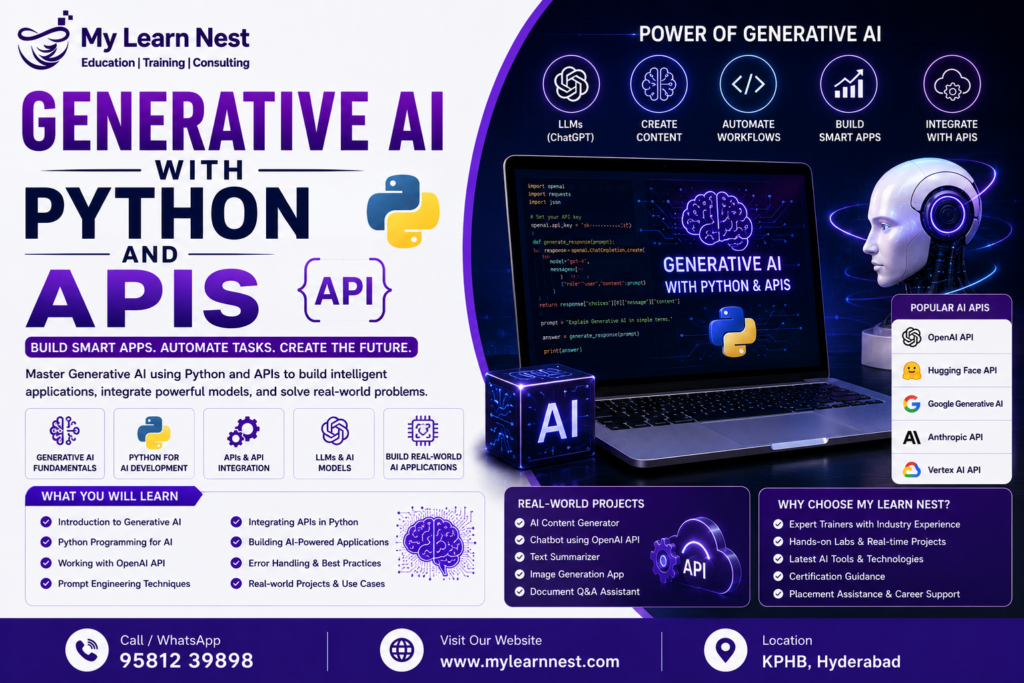
Generative AI with Python and APIs
Generative AI has quickly become one of the most important areas in modern technology. Businesses are using AI to automate repetitive work, create content, analyze documents, build intelligent assistants, and improve customer experiences. At the same time, developers are learning how to connect powerful Large Language Models with their own software applications.
Python plays an important role in this development.
With its simple syntax, extensive AI ecosystem, and strong developer community, Python has become one of the most widely used programming languages for Generative AI development. Developers can use Python to connect with LLM APIs, process data, build chatbots, create AI assistants, work with Hugging Face models, and develop complete AI-powered applications.
Learning Generative AI with Python and APIs gives students and professionals the ability to move beyond simply using AI tools. Instead of only interacting with an AI chatbot through a website, developers can integrate AI capabilities directly into their own applications.
For learners planning a career in AI, Python development, machine learning, data science, or software engineering, this combination of skills can provide a strong foundation for building real-world AI solutions.
What is Generative AI with Python?
Generative AI with Python involves using the Python programming language to interact with, control, and build applications around Generative AI models.
Python can be used for many stages of an AI application. A developer can collect user input, process documents, call an LLM API, send prompts to a model, receive the generated response, process the output, store information in a database, and display the final result through a web application.
The basic workflow may look like this:
User input → Python application → LLM API → AI model → Generated response → Python application → User.
This simple workflow can eventually become a much larger system involving databases, document retrieval, authentication, monitoring, and external tools.
Why Python is Popular for Generative AI
Python has become popular in AI development because it provides a large ecosystem of libraries and frameworks.
Developers can use Python for machine learning, data processing, API integration, web development, automation, and AI application development.
Libraries such as NumPy and Pandas are useful for data processing. Machine learning frameworks support model development and experimentation. AI-specific libraries and SDKs make it easier to communicate with LLM APIs and model platforms.
For beginners, Python is relatively easy to read compared with many other programming languages. This makes it a practical language for learning Generative AI application development.
Python Skills Required for Generative AI
You do not need to be an advanced Python developer to begin learning Generative AI. However, a basic understanding of Python programming can make the learning process much easier.
Important concepts include variables, strings, lists, dictionaries, conditional statements, loops, functions, exception handling, modules, and working with external packages.
Developers should also understand how to work with JSON data because many AI APIs communicate using JSON-based requests and responses.
Knowledge of HTTP requests, APIs, authentication, environment variables, and basic software development practices is also useful.Once these fundamentals are clear, learners can start building simple applications with LLM APIs.
Working with LLM APIs
An API, or Application Programming Interface, allows one software application to communicate with another. LLM APIs allow developers to send requests to AI models and receive generated responses programmatically.
Instead of manually opening an AI chatbot and typing a question, a developer can create a Python program that sends a prompt to an AI model automatically. For example, a business application could send a customer question to an LLM and receive a suggested response.
A typical LLM API workflow involves creating an API request, providing the required authentication, specifying the model, sending input such as a prompt or conversation messages, and processing the response.
The exact API format depends on the provider and model being used.
How LLM APIs Work
The basic concept behind an LLM API is relatively straightforward.
A Python application sends information to an AI service. The service processes the request using an appropriate model and returns a response.
The application can then use that response in its own workflow.
For example, an online learning platform could receive a student’s question, send it to an LLM, and display the generated explanation on the website. An enterprise application could send a document summary request to an LLM and save the generated summary in a database.
The API acts as the connection between the application and the AI model.
OpenAI API Concepts
OpenAI provides APIs that developers can use to integrate AI capabilities into software applications.
When working with an OpenAI-based application, developers need to understand concepts such as API authentication, model selection, input messages or prompts, output handling, token usage, and error management.
A Python application can use an official SDK or HTTP requests to communicate with supported OpenAI models.
The exact models, API features, and SDK interfaces can change over time, so developers should always refer to the current official documentation when implementing a production application. The important concept for beginners is that an API allows the developer to use an AI model as a component inside a larger software system.
API Authentication and Security
API keys are sensitive credentials and should never be placed directly into publicly shared source code.
Developers commonly store credentials in environment variables or secure secret-management systems.
For example, a Python application can read an API credential from its environment instead of hardcoding it into the program.
This becomes especially important when applications are deployed to cloud platforms or shared among development teams. Security should be considered from the beginning of an AI application rather than added after deployment.
Understanding Tokens and API Usage
Tokens are an important concept when working with LLM APIs.
The input sent to the model consumes tokens, and the generated output can also consume tokens.
Token usage can affect application performance, context limits, and API costs depending on the model and provider. Developers should therefore avoid unnecessarily sending large amounts of irrelevant information.
For applications that process long documents, techniques such as chunking, retrieval, summarization, and selective context management can help control the amount of information sent to the model.
Handling API Responses in Python
When a Python program sends a request to an LLM API, the response generally contains information that the application needs to process.
The developer may extract the generated text, usage information, metadata, or other response fields depending on the API.
The application can then display the response, store it in a database, send it to another service, or use it as input for another step.
Good error handling is important because API requests can fail due to invalid credentials, network problems, rate limits, unavailable services, incorrect parameters, or other issues.A production application should therefore handle errors gracefully rather than assuming every API request will succeed.
Hugging Face Models
Hugging Face has become an important platform in the machine learning and Generative AI ecosystem.
It provides access to a large collection of models, datasets, libraries, and development resources.
Developers can explore different language models and other AI models through the Hugging Face ecosystem.Depending on the model and licensing conditions, models may be accessed through hosted services or used in suitable local or cloud environments.
Hugging Face is particularly useful for developers who want to experiment with different open and openly available model ecosystems.
Hugging Face Transformers
The Transformers library is one of the widely used tools in the Hugging Face ecosystem.
It provides developers with access to many pretrained models and tools for working with modern machine learning architectures.
Developers can use Transformers for tasks such as text generation, classification, question answering, summarization, and other natural language processing applications.
For learners, working with Transformers provides practical exposure to how pretrained AI models can be integrated into Python applications.
Hosted Models vs Local Models
When building Generative AI applications, developers may choose between using a hosted model through an API and running a model within their own infrastructure.
Hosted APIs can be easier to start with because the developer does not need to manage the underlying model infrastructure.
Local or self-hosted models can provide greater control over data and deployment, but they may require appropriate hardware, optimization, monitoring, and infrastructure management.
The right approach depends on the application’s requirements.Factors such as cost, latency, privacy, scalability, hardware availability, model capabilities, and maintenance should be considered before choosing a deployment strategy.
LLM Application Development
LLM application development involves using language models as part of a larger software system.
The LLM has usually only one component.
A complete application may contain a user interface, backend services, databases, authentication, business logic, external APIs, document processing, retrieval systems, and an AI model.
For example, a company knowledge assistant may include a web interface, document storage, an embedding model, a vector database, a retrieval layer, an LLM, and an application backend.
Python can be used to connect many of these components.This is why learning LLM application development with Python is more valuable than learning isolated AI prompts alone.
Building Text Generation Applications
Text generation is one of the most common Generative AI use cases.
A Python application can accept a topic or instruction from the user and send it to an LLM.The generated response can then be displayed to the user.
Text generation applications can be used for drafting emails, creating product descriptions, generating educational content, preparing summaries, creating ideas, and assisting with documentation.
However, generated content should be reviewed before being used in situations where accuracy is important.
Text Summarization with Python
Summarization is another common LLM application.
A Python program can accept a document, article, meeting transcript, or other text and send the content to an appropriate AI model.The model can then generate a shorter version containing the main points.
For long documents, developers need to consider the model’s context limitations. Instead of sending an extremely large document in a single request, the application may divide the content into smaller sections, summarize them individually, and then combine the summaries.
This approach can be useful for document-processing applications.
Building AI Chatbots
AI chatbots are among the most popular applications of Generative AI. A basic chatbot can accept a user’s message, send it to an LLM API, receive the response, and display it back to the user.
A more advanced chatbot can maintain conversation history, retrieve information from a knowledge base, use external tools, and follow specific business rules.
Python can handle the backend logic while a web framework can provide the user interface.
For example, a training academy could create an AI learning assistant that answers questions about courses, explains concepts, generates quizzes, and recommends learning materials.
Building a Python AI Assistant
A Python AI assistant can combine several capabilities into one application.
The assistant might accept natural-language requests, answer questions, summarize documents, search a knowledge base, generate content, and perform specific actions.
An advanced assistant can also connect with APIs and databases.
For example, a business assistant could retrieve sales information from a database and use an LLM to explain the results in simple language. The LLM handles the language interaction while Python manages the application logic.
Chatbot Memory and Conversation History
A simple LLM request is generally independent unless previous conversation information is included.
To create a conversational chatbot, developers need to manage conversation history or use an appropriate memory architecture.The application can store previous messages and provide relevant parts of the conversation when sending a new request.
However, storing an unlimited amount of conversation history is not always practical.Large conversation histories consume tokens and may reduce application efficiency.
Developers can therefore use techniques such as summarizing previous conversations or retrieving only relevant historical information.
Generative AI with Python and Databases
Databases become important when AI applications need to store user information, conversations, documents, or business data.
Python can connect AI applications with databases such as PostgreSQL, MySQL, MongoDB, and other database technologies.
For example, an AI customer-support application can store customer conversations in a database and retrieve relevant information when a new request arrives.
Generative AI applications can also use vector databases for semantic search and RAG systems.
Embeddings and Vector Search
Embeddings convert information into numerical vector representations.
These representations can be stored in vector databases and used to find information that is semantically similar to a user’s query.
This capability is important for building AI applications that work with private or organization-specific information.
A typical workflow may involve converting documents into embeddings, storing them in a vector database, retrieving relevant sections when a user asks a question, and providing those sections to an LLM.
This approach is commonly associated with Retrieval-Augmented Generation (RAG).
Building RAG Applications with Python
RAG applications combine information retrieval with Generative AI.
Python can be used to process documents, generate embeddings, communicate with a vector database, retrieve relevant information, and send the retrieved context to an LLM.
For example, an organization could build an internal AI assistant that answers employee questions using company policies.
Instead of asking the LLM to rely entirely on its training knowledge, the application retrieves relevant company documents and provides them as context. This can make the application more useful for organization-specific questions.
Python Frameworks for AI Applications
Developers can use several Python frameworks and libraries when building AI applications.
Depending on the project, developers may work directly with model provider SDKs, Hugging Face libraries, web frameworks, database libraries, embedding tools, vector databases, and LLM application frameworks.
The choice should be based on the application’s actual requirements rather than simply using every available framework.
For beginners, it is often better to understand the basic API workflow first and then gradually introduce additional frameworks when they solve a specific problem.
Building AI Applications with Python
A typical Python Generative AI project can be divided into several stages. The developer first identifies the problem and defines the expected AI capability.
The next step is selecting an appropriate model and determining whether an API-based or self-hosted approach is suitable.
The application can then be developed to accept input, communicate with the model, process the output, and display the result. Testing is an important part of the process. Developers should test normal inputs, unusual inputs, incorrect inputs, long inputs, and potentially harmful requests.
Finally, the application can be deployed with appropriate security, monitoring, and error handling.
Generative AI API Project for Text Summarization
A text summarization application is a good beginner project for learning LLM APIs.The application can provide a text input box where the user enters an article or document.
Python processes the input and sends it to the selected LLM. The generated summary is then returned to the user.
The project can be extended by adding options such as summary length, target audience, language, and output format.
This project helps learners understand API calls, prompts, response handling, token usage, and basic application design.
Generative AI Chatbot Project
A Generative AI chatbot is another practical project for Python learners.
The chatbot can have a simple web interface where users enter questions.Python acts as the backend and communicates with an LLM API.
The project can initially be built as a basic question-answering chatbot and later expanded with conversation history, document retrieval, authentication, and database integration.
This progression helps learners understand how a simple AI demonstration can evolve into a complete AI application.
AI Resume Assistant Project
An AI resume assistant can help users analyze their resumes against a job description.
The Python application can accept resume content and job requirements and send them to an LLM. The model can identify matching skills, missing skills, relevant experience, and possible improvements.
The output can be returned in a structured format.
This project demonstrates how Generative AI can be used for document analysis and career-related applications.
AI SQL Assistant Project
An AI SQL assistant can allow users to ask database questions using natural language.
For example:
“Show the total sales for each region.” The Python application can provide the database schema to the LLM and ask it to generate an appropriate SQL query.
Before execution, the query should be validated to prevent unsafe operations. The project can be extended with query explanations and natural-language summaries of the results.
This is a useful project for professionals who want to combine Generative AI, Python, SQL, and data analytics.
AI Document Assistant Project
An AI document assistant allows users to interact with documents using natural language. The application can process PDF files, text documents, or other supported content.
The document can be divided into manageable sections, converted into embeddings, and stored for retrieval.
When the user asks a question, the application retrieves relevant information and provides it to the LLM. The model then generates an answer based on the retrieved context.
This project provides practical exposure to RAG, embeddings, vector search, Python, APIs, and LLMs.
AI Applications for Businesses
Businesses can build many applications using Python and LLM APIs. Customer-support assistants can help employees respond to common questions.
Internal knowledge assistants can help employees find information from company documentation.
Marketing applications can assist with content creation. Document-processing systems can extract and summarize information.Sales applications can summarize customer conversations and generate follow-up drafts.
The important point is that the LLM should be integrated into a clearly defined business workflow rather than being added simply because AI is popular.
API Cost and Performance Considerations
When building an LLM application, developers need to consider more than functionality. API usage can have costs depending on the model, input size, output size, and provider pricing.
Performance is also important.
Large prompts can increase latency and usage. Sending unnecessary conversation history can make an application less efficient.
Developers can improve performance by reducing unnecessary context, selecting suitable models, caching appropriate results, and designing efficient application workflows.
Security in Generative AI Applications
Security should be considered throughout the development process.
API credentials should be protected and should not be exposed in frontend code or public repositories.
Applications should validate user input and control access to sensitive information. If an AI application connects to databases or external tools, developers should carefully restrict what actions the model can trigger.
AI applications can also face risks such as prompt injection, data leakage, insecure tool use, and unauthorized access.
Learning AI security alongside application development is increasingly important for professional Generative AI developers.
Testing and Evaluating AI Applications
Traditional software testing and AI evaluation are both important for Generative AI applications.
Developers should test whether the application returns useful responses for different types of inputs. Evaluation can include accuracy, relevance, consistency, response time, safety, formatting, and adherence to business requirements.
For applications that use RAG, developers should also evaluate whether the system retrieves the right information.
An AI application should be tested before it is used in important business workflows.
Skills Required for a Generative AI Developer
A Generative AI developer benefits from a combination of programming, AI, and software development skills.
Python is one of the most useful programming languages for this career path.
LLM fundamentals, Prompt Engineering, APIs, embeddings, vector databases, RAG, databases, Git, cloud platforms, and basic application security can also be valuable.
Developers should also understand how to evaluate AI outputs rather than assuming that every model response is correct.
Career Opportunities in Generative AI
The growth of LLM-based applications is creating opportunities for developers who understand how to integrate AI into software.
Possible career paths include Generative AI Developer, AI Engineer, LLM Application Developer, Machine Learning Engineer, AI Solutions Developer, AI Automation Developer, and AI Software Engineer.
Professionals who already know Python, Java, JavaScript, SQL, cloud computing, or data engineering can add Generative AI skills to their existing technical background.
Practical projects can make a significant difference because employers often want candidates who can demonstrate that they can build and integrate AI solutions rather than only explain theoretical concepts.
Why Learn Generative AI with Python and APIs?
Learning Generative AI with Python and APIs provides a bridge between AI concepts and real software applications.
Instead of simply using an AI chatbot, learners can understand how to build applications that communicate with LLMs programmatically.
They can learn how to create AI chatbots, summarization tools, document assistants, content-generation applications, SQL assistants, and RAG-based systems.
This combination of Python programming and Generative AI can be useful for students, developers, data professionals, and working IT professionals.
Generative AI Training at MyLearnNest
At MyLearnNest, learners can build their Generative AI skills through a structured approach that connects fundamental concepts with practical development.
Learning should begin with Python and LLM fundamentals before progressing to APIs, Prompt Engineering, model integration, embeddings, RAG, chatbots, and real-time projects.
Hands-on development is particularly important because Generative AI is a rapidly changing field. Building applications gives learners an opportunity to understand how models, APIs, prompts, databases, and application logic work together.
For learners planning a career in AI, developing a project portfolio can also help demonstrate practical knowledge during interviews.
Future of Generative AI Application Development
Generative AI application development is moving toward more intelligent and integrated systems.
Future applications are likely to combine LLMs with databases, enterprise knowledge, APIs, automation tools, multimodal models, and AI agents.
Developers will increasingly build systems where AI can understand a user’s request, retrieve relevant information, interact with approved tools, and complete multiple steps.
Python is likely to remain an important language within this ecosystem because of its strong AI, data science, automation, and software development libraries. Professionals who learn how to connect LLMs with real applications will be better positioned to take advantage of these developments.
Conclusion
Generative AI with Python and APIs provides a practical foundation for building modern AI-powered applications.
Python gives developers a flexible programming environment, while LLM APIs provide access to powerful Generative AI models. Together, they can be used to create chatbots, summarization tools, document assistants, content-generation systems, SQL assistants, and RAG applications.
Learning concepts such as OpenAI API integration, Hugging Face models, LLM application development, text generation, summarization, chatbot development, embeddings, and Python AI development can help learners move from basic AI usage toward real application development. For students and professionals interested in building a career in Generative AI, the combination of Python, APIs, LLMs, and hands-on projects provides a strong technical foundation.

