
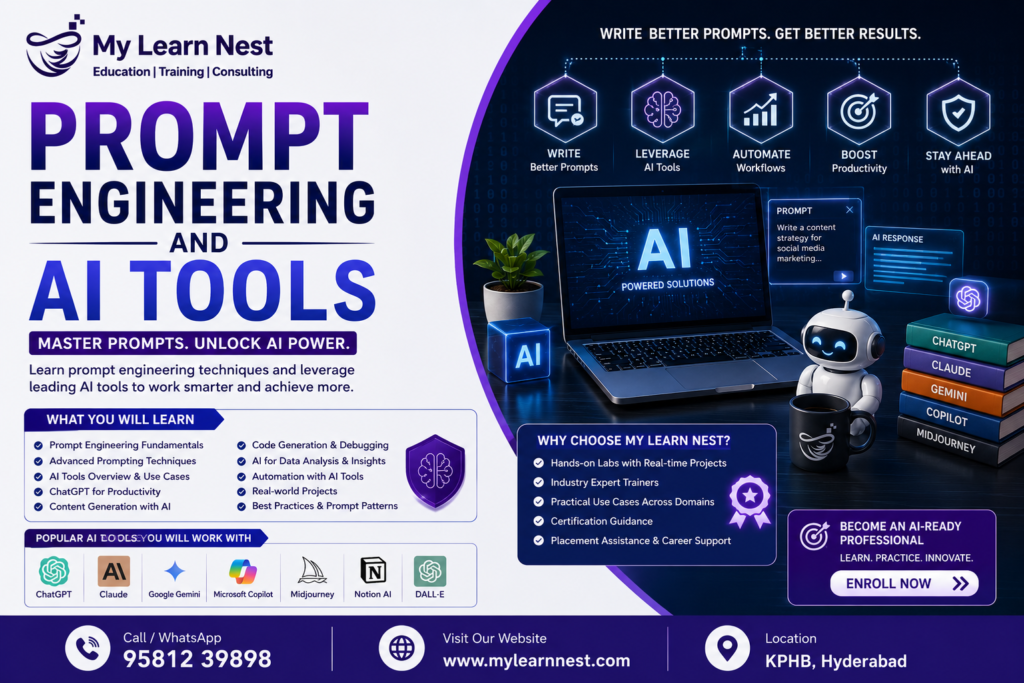
Prompt Engineering and AI Tools
Prompt Engineering has become an important skill in the Generative AI ecosystem. As businesses increasingly use Large Language Models (LLMs) for content creation, software development, customer support, data analysis, research, and automation, the ability to communicate effectively with AI models has become highly valuable.
A Generative AI model can produce different results depending on the instructions it receives. A short and unclear prompt may generate a general answer, while a well-structured prompt can guide the model toward a specific, useful, and professional response.
This is where Prompt Engineering becomes important.
Prompt Engineering involves designing, improving, and testing instructions given to AI models to obtain better results. It is useful for students, developers, data professionals, marketers, business teams, researchers, and anyone working with Generative AI tools.
For professionals planning to build a career in Artificial Intelligence, learning Prompt Engineering provides a practical starting point for understanding how humans interact with modern AI systems.
What is Prompt Engineering?
Prompt Engineering is the process of creating effective instructions for Generative AI models so that they can produce useful and relevant outputs.
A prompt can be a question, command, instruction, task description, or combination of several elements. The quality of the prompt can influence the quality, accuracy, structure, and relevance of the generated response.
For example, a basic prompt could be:
“Explain Python.” Although the AI model can answer this question, the response may be broad.
A more specific prompt could be: “Explain Python programming to a beginner in simple English. Cover variables, data types, conditional statements, loops, functions, and basic examples.”
Prompt Engineering is not simply about writing longer prompts. Good Prompt Engineering is about providing the right information in a clear and structured way. A well-designed prompt can define the role of the AI, explain the task, provide context, specify constraints, and describe the desired output format.
Why is Prompt Engineering Important?
Generative AI systems are powerful, but they do not automatically understand what every user expects from a vague instruction.
Prompt Engineering helps users communicate their requirements more effectively.
Businesses can use carefully designed prompts to generate marketing content, summarize documents, classify customer feedback, create reports, assist employees, and automate repetitive knowledge-based tasks.
Developers can use prompts to generate code explanations, test cases, documentation, SQL queries, debugging suggestions, and development ideas.
Students can use structured prompts to understand complex concepts, create study plans, generate practice questions, and receive explanations at different difficulty levels.As organizations adopt LLM-based applications, Prompt Engineering has become a useful skill that complements programming, data analytics, cloud computing, and business knowledge.
How Does Prompt Engineering Work?
Prompt Engineering starts with understanding the objective.
Before writing a prompt, the user should determine what the AI needs to accomplish. The task might involve generating content, summarizing information, extracting data, classifying text, explaining a concept, writing code, or analyzing a document.
The next step is to provide sufficient context.
For example, instead of asking an AI model to “write an email,” the user can specify the audience, purpose, tone, important information, and expected length.
Prompt Engineering is therefore an iterative process. A user may create a prompt, evaluate the result, identify weaknesses, modify the instructions, and test the prompt again.This process is especially important in professional environments where consistent outputs are required.
Types of Prompts
There are several approaches to writing prompts depending on the task and the complexity of the AI application.
A simple instruction may be enough for straightforward tasks. More advanced tasks may require examples, roles, constraints, structured outputs, or multi-step instructions.
Common Prompt Engineering approaches include zero-shot prompting, few-shot prompting, role-based prompting, instruction-based prompting, contextual prompting, and structured prompting.
The best approach depends on the model, task, available context, and desired output.
Zero-Shot Prompting
Zero-shot prompting means asking an AI model to perform a task without providing examples of the expected output.
For example:
“Classify this customer review as positive, negative, or neutral.”
The model receives the instruction and the input but does not receive sample classifications.Zero-shot prompting works well when the task is straightforward and the AI model already has enough general knowledge to understand the instruction.
It is commonly used for basic classification, summarization, translation, question answering, and content generation.The advantage of zero-shot prompting is simplicity. The prompt is usually shorter and easier to maintain.
However, complex tasks may require additional context or examples.
Few-Shot Prompting
Few-shot prompting provides examples to show the AI model how the task should be performed.
For example, a prompt might provide several customer reviews and their classifications before asking the model to classify a new review.
The examples help communicate the expected pattern.
Few-shot prompting can be useful when the task has a specific format or when a simple instruction does not produce consistent results.For business applications, examples can help maintain a particular writing style, classification format, or response structure.
However, examples consume part of the model’s available context, so they should be selected carefully.
Chain-of-Thought Prompting
Chain-of-thought prompting is an approach associated with encouraging a model to reason through complex problems in a structured way.
It has been widely discussed in the development of reasoning-oriented AI applications.
For users building AI solutions, it is generally more useful to focus on asking the model to provide a concise explanation, structured result, or verification rather than unnecessarily requesting private internal reasoning.
For example, a developer can ask an AI model to solve a calculation problem and provide the key steps or assumptions used to reach the answer.
In production applications, prompts should be designed around the required output rather than relying on the model exposing hidden reasoning.
Role-Based Prompting
Role-based prompting gives the AI a specific role or perspective before asking it to perform a task.
For example: “You are a senior Python developer helping a beginner understand programming concepts.”
The prompt can then specify the actual task. Role-based prompting can help establish the expected communication style, expertise level, and perspective.
It is frequently used for education, technical support, content creation, customer service, business analysis, and software development. For example, a training organization could instruct an AI assistant to behave like a technical instructor and explain a complex cloud computing concept using simple examples.
Instruction-Based Prompting
Instruction-based prompting clearly tells the AI what it needs to do.
For example:
“Summarize the following article in 150 words and identify the three main conclusions.”
This approach works well because the model receives a clearly defined task.A strong instruction generally identifies the action, relevant context, constraints, and expected output.
For professional applications, clear instructions can reduce inconsistent responses and make AI workflows easier to manage.
Contextual Prompting
Contextual prompting provides background information that helps the AI understand the situation. For example, a customer-support application may provide information about the customer, product, previous conversation, and company policies before asking the model to create a response.
Context is particularly important when building enterprise AI applications.
Without sufficient context, an LLM may provide a generic answer. With relevant context, the model can generate a response that is more closely aligned with the user’s situation.
However, developers should avoid unnecessarily sending sensitive or irrelevant information to AI systems.
Structured Prompting
Structured prompts organize instructions into clear sections. A prompt may contain the role, objective, context, input data, rules, and expected output format.
This approach can be useful for complex workflows.
For example, an AI application that analyzes customer feedback may instruct the model to identify the customer’s issue, sentiment, product category, urgency, and recommended action.Structured prompting makes the requirements easier to understand and can also make prompts easier for developers to maintain.
Prompt Optimization Techniques
Prompt optimization involves improving a prompt so that the AI produces more useful, consistent, and reliable results. One of the simplest techniques is to make the task specific.
“Write about cloud computing.”
A better instruction could specify the audience, topic, tone, length, structure, and purpose.
Another important technique is to provide relevant context. If the model needs information about a product, company, document, or process, that information should be supplied when appropriate. Output formatting is also important. If an application needs JSON, a table, a list of fields, or a specific structure, the prompt should clearly describe the expected format.
Define the AI’s Role
Defining a role can help establish the expected perspective.
For example, a prompt might instruct the model to act as a Python instructor, data analyst, cybersecurity trainer, or customer-support assistant.
The role should be relevant to the task.
For example:
“You are a data analyst. Analyze the following sales information and identify the major trends.”This provides more direction than simply saying:”Analyze this data.”
Provide Clear Constraints
Constraints tell the AI what it should or should not do.
A prompt can specify the number of words, target audience, tone, language, format, required sections, or information that must be included.
For example:
“Explain Generative AI for college students using simple English. Keep the explanation under 500 words and include three real-world examples.”
The constraints make the expected result clearer.
Specify the Output Format
Output format is especially important when AI is being integrated into software applications.
A developer may need the model to return structured information rather than a long paragraph.
For example, an application may request fields such as:
Name, Role, Skills, Experience, and Location.Structured output can make it easier for software systems to process the AI response.
This is one reason Prompt Engineering is becoming closely connected with software development.
Use Examples When Necessary
Examples can help the model understand a specific pattern.
If an organization wants an AI system to classify support tickets into categories such as billing, technical issue, account problem, or product request, a few examples can demonstrate how the classification should work.
Examples should be relevant and representative.Poor examples can teach the wrong pattern and lead to inconsistent results.
Test and Improve Prompts
- A prompt should not always be considered complete after the first attempt.
- Professional Prompt Engineering involves testing prompts with different inputs.
- A prompt that works well for one example may fail when the input changes.
Developers can evaluate responses for accuracy, consistency, relevance, formatting, safety, and completeness.
Based on the results, the prompt can be modified and tested again.This creates a continuous improvement process.
Prompt Engineering for Developers
Developers can use Prompt Engineering throughout the software development lifecycle.
AI tools can help developers understand programming errors, generate code suggestions, create unit tests, write documentation, explain APIs, generate SQL queries, and assist with debugging.
For example, instead of asking an AI assistant:
“Fix this code.”
A developer can provide the programming language, expected behavior, current behavior, error message, relevant code, and constraints.
This gives the model better information for producing a useful response.However, generated code should always be reviewed and tested before being used in production systems.
Prompt Engineering for Businesses
Businesses can use Prompt Engineering to create repeatable AI workflows.
- A marketing team might develop prompts for product descriptions and campaign ideas.
- A customer-support team might use prompts for response generation and ticket classification.
- A human resources team could use prompts to summarize job descriptions or organize candidate information.
- A finance team could use AI to summarize reports or extract structured information from documents.
The main advantage is not simply generating content faster. Well-designed prompts can help create standardized workflows that employees can reuse.
AI Tools for Developers
The growth of Generative AI has resulted in a wide range of AI tools for developers.
AI coding assistants can help generate code, explain functions, identify potential bugs, create tests, and assist with documentation.
LLM APIs allow developers to integrate AI capabilities directly into applications.
Developers can build chatbots, document assistants, recommendation systems, coding assistants, search applications, and automated content systems using these technologies.
Some commonly used AI ecosystems include GPT-based tools, Gemini, Claude, Llama-based solutions, AI coding assistants, vector databases, and LLM application frameworks.The right tool depends on the project requirements, cost, security needs, data requirements, model capabilities, and deployment environment.
AI Tools for Businesses
AI tools are no longer limited to software developers.
Businesses can use Generative AI for content creation, customer communication, meeting summaries, document analysis, research, sales assistance, knowledge management, and workflow automation.
For example, a company can create an internal AI assistant that helps employees search company policies and documentation.
A sales team can use AI to summarize customer conversations and prepare follow-up messages.A marketing team can use AI to generate initial campaign drafts.
These applications can improve productivity when they are implemented with appropriate review and governance.
Prompt Engineering and RAG Applications
Prompt Engineering becomes even more useful when combined with Retrieval-Augmented Generation.
In a RAG application, relevant information is retrieved from external sources and supplied to an LLM as context.
The prompt can then instruct the model to answer using the retrieved information.
For example, an educational institution could create an AI assistant that answers student questions using course materials, policies, and training documents.
The prompt can instruct the model to use the provided documents and avoid inventing information when the answer is not available.This combination of retrieval, context, and carefully designed instructions is widely used in enterprise Generative AI applications.
Prompt Engineering and AI Agents
Modern AI applications are increasingly moving toward AI agents.
An AI agent can use an LLM together with tools, APIs, databases, and external systems to complete multi-step tasks.
For example, an AI business assistant could receive a request, retrieve information from a database, analyze the information, create a report, and return the result.
Prompt Engineering plays an important role in defining how the agent should behave, what tools it can use, and how it should respond to different situations.As agent-based AI systems develop, professionals will need skills in prompting, tool integration, APIs, workflow design, evaluation, and AI security.
Common Prompt Engineering Mistakes
- One common mistake is writing prompts that are too vague.
- Another mistake is providing too much irrelevant information.
- Users may also forget to define the expected output format.
Another problem occurs when people assume that an AI model will always provide accurate information simply because the response sounds confident.
AI-generated results should be evaluated carefully, especially when they are used for business, technical, financial, legal, or other high-impact applications.
Prompt Engineering improves communication with AI, but it does not eliminate the need for human judgment.
Prompt Evaluation and Testing
Professional AI applications require more than creating a good-looking prompt.
Prompts should be evaluated using representative test cases.
For example, if an organization develops an AI customer-support assistant, the testing dataset could contain common questions, difficult questions, incomplete requests, incorrect assumptions, and unusual customer situations.
The system can then be evaluated based on response accuracy, relevance, consistency, safety, and adherence to company policies.
Prompt evaluation is especially important when AI applications are deployed at scale.
Real-Time Prompt Engineering Projects
Practical projects are one of the best ways to understand Prompt Engineering.
A beginner project could involve creating an AI-powered study assistant. The system can accept a topic and generate explanations, examples, quizzes, and revision questions based on carefully designed prompts.Another useful project is an AI resume assistant. The application can analyze a resume and job description and generate suggestions for improving the resume while following predefined instructions.
A customer-support assistant can be developed using prompts that classify incoming questions and generate responses based on company guidelines.A document summarization system can accept business documents and generate structured summaries containing key points, risks, actions, and conclusions.
These projects help learners understand how prompts behave in practical scenarios rather than only learning Prompt Engineering concepts theoretically.
AI Content Generation Project
An AI content generation project can demonstrate how prompts control writing style, structure, audience, and output format.
For example, a user can provide a topic and target audience while the system generates a structured article.
The project can include prompt templates for different content types such as blogs, product descriptions, social media content, email drafts, and educational materials.
Learners can experiment with different prompts and compare the results.This project helps demonstrate the importance of prompt clarity and output constraints.
AI Customer Support Assistant Project
An AI customer-support assistant is another practical Prompt Engineering project.
The system can receive a customer’s question and determine the appropriate response based on predefined company information.
The prompt can instruct the AI to be professional, avoid unsupported claims, ask for clarification when required, and escalate sensitive issues to a human agent.
The project can also include conversation history so that the AI understands the context of the customer’s request.
This provides learners with experience in prompt design, context management, and AI workflow development.
AI Resume Screening Project
An AI resume screening application can use LLMs to analyze resumes against job requirements.
The prompt can instruct the model to identify relevant skills, experience, certifications, and potential gaps.
Instead of simply producing a paragraph, the system can be designed to return structured information.For example, the output could include candidate skills, matching requirements, missing requirements, and an overall assessment.
Such a project demonstrates how Prompt Engineering can be combined with structured outputs and document processing.
AI Document Question-Answering Project
A document question-answering application is another strong project for learners.
Users can upload documents and ask questions about their content.
The system can retrieve relevant sections, provide them as context to an LLM, and use a carefully designed prompt to generate an answer.
This project introduces learners to several important Generative AI concepts, including document processing, embeddings, vector search, RAG, context management, and Prompt Engineering.
AI SQL Assistant Project
An AI SQL assistant can convert natural-language questions into SQL queries.
For example, a user might ask:
“Show the top five products by sales in 2026.”The AI system can generate an SQL query based on the database schema.
A good prompt should provide information about tables, columns, relationships, SQL dialect, and expected output.The generated query should then be validated before execution. This project is especially useful for learners interested in data analytics, data engineering, and Generative AI.
Prompt Engineering Career Opportunities
Prompt Engineering skills can be useful across multiple technology and business roles.
Professionals can work in Generative AI development, AI application development, AI product development, data science, software engineering, automation, AI consulting, and business process optimization.
Prompt Engineering alone may not be sufficient for every AI career. Combining it with programming, LLM concepts, APIs, databases, cloud platforms, RAG, AI agents, and evaluation techniques can create a stronger professional skill set.
This is why modern Generative AI training should focus on practical application rather than treating Prompt Engineering as an isolated skill.
Who Can Learn Prompt Engineering?
- Prompt Engineering can be learned by beginners as well as experienced professionals.
- Students can use it to understand AI technologies and develop practical projects.
- Software developers can use it to improve productivity and build LLM-powered applications.
- Data analysts can use AI for SQL generation and data interpretation.
- Digital marketers can use Generative AI for content workflows.
- Business professionals can use AI assistants to automate repetitive tasks.
Professionals from different backgrounds can therefore benefit from learning Prompt Engineering.
Why Learn Prompt Engineering at MyLearnNest?
A structured learning approach can make it easier to understand Prompt Engineering and apply it to real-world Generative AI applications.
At MyLearnNest, learners can build their Generative AI knowledge from fundamentals and gradually move toward practical applications. Instead of focusing only on theoretical prompt examples, learners can work with real-world scenarios and projects involving LLMs, AI tools, APIs, RAG, and AI-powered applications.
Practical learning can help students understand how prompts behave with different inputs and why evaluation is necessary. For learners preparing for careers in Generative AI, combining Prompt Engineering with programming, LLM fundamentals, and project experience can provide a stronger foundation for future opportunities.
Future of Prompt Engineering
Prompt Engineering is expected to continue evolving as AI models become more capable.
In the early stages of Generative AI adoption, users primarily interacted with AI through simple text prompts. Modern applications are becoming more sophisticated and may combine prompts with structured outputs, retrieval systems, tools, APIs, memory, workflows, and AI agents.
This means the future of Prompt Engineering will likely involve more than simply writing good instructions. Professionals will increasingly need to understand how prompts interact with models, data, tools, application logic, evaluation systems, and security controls.
Prompt Engineering is therefore becoming part of a broader discipline of LLM application development.
Conclusion
Prompt Engineering is an important skill for anyone working with Generative AI. It provides a practical way to communicate requirements to AI models and improve the usefulness, consistency, and structure of their responses.
Concepts such as zero-shot prompting, few-shot prompting, role-based prompting, contextual prompting, structured prompting, and prompt optimization provide the foundation for effective AI interaction.
However, the real value of Prompt Engineering becomes clearer when it is applied to practical projects. AI chatbots, document assistants, resume analyzers, SQL assistants, customer-support systems, and RAG applications demonstrate how prompts can become part of complete AI solutions.
For students and professionals planning to build a career in Generative AI, Prompt Engineering is a valuable starting point. When combined with LLMs, Python, APIs, databases, RAG, AI agents, and real-time projects, it can help learners move from simply using AI tools to building practical Generative AI applications.

